
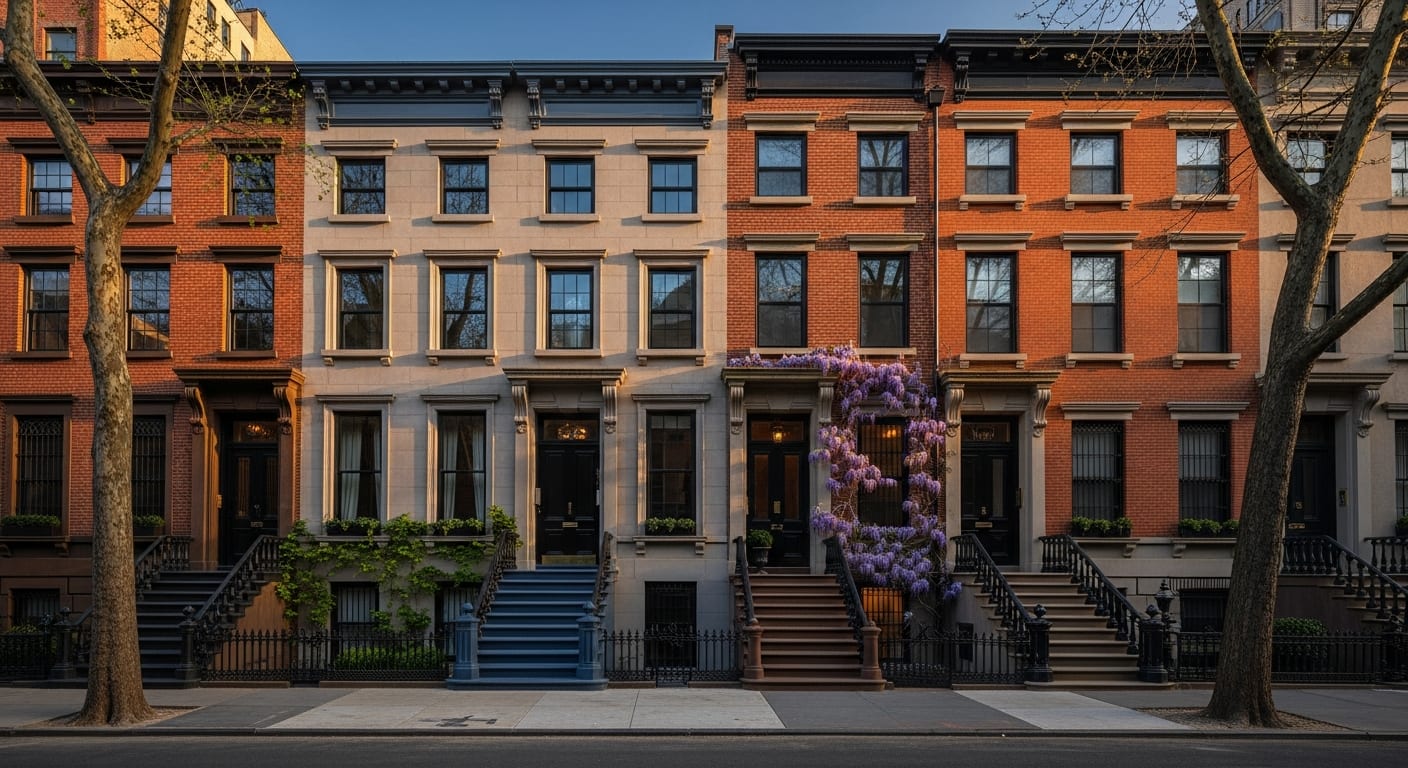
A townhouse is the most distinctive form of ownership in Manhattan. Nothing else in the city delivers what it delivers: a single-family residence, a garden, total renovation control within landmark limits, no board above you, and a block-level architectural presence that takes a century to build and that no new construction can replicate. For ultra-high-net-worth buyers, a townhouse is often the end of a long series of Manhattan moves — the last address, the one that stays in the family. This guide is written for buyers at that stage. It covers inventory, pricing by neighborhood, the townhouse-versus-co-op-versus-condo decision, landmark constraints, the width question, condition tiers, operating costs, financing, and the off-market dynamics that determine whether a buyer sees the best houses or only what is publicly listed.
The Manhattan Townhouse Market in 2026
Industry estimates place the total Manhattan single-family townhouse inventory at roughly 3,000 to 4,000 properties in 2026, down meaningfully from the mid-20th-century peak. The largest concentrations sit in the West Village, Greenwich Village, Upper East Side (particularly Carnegie Hill and Lenox Hill), Chelsea, the Upper West Side, and Harlem, with smaller but distinguished pockets in Tribeca, Brooklyn Heights, Cobble Hill, and Park Slope. The count continues to contract — not through demolition, which is rare, but through conversion into multi-unit condominiums or cooperatives, or through absorption into institutional and private foundation ownership where the property exits the single-family market indefinitely.
Pricing varies more by neighborhood than any other residential segment in the city. A 20-foot Harlem brownstone in good condition trades for $3 million to $6 million. An equivalent-width Upper East Side townhouse three miles south can trade at ten times that number. The spread reflects block quality, school districts, historic-district status, and — most importantly — the social and logistical coordinates of the neighborhood itself. Townhouses are sold within micro-markets, and the micro-market drives pricing far more than square footage.
Transaction volume at the top of the market is structurally low. In a typical year, fewer than 150 Manhattan townhouses trade above $10 million, and fewer than 40 trade above $20 million. That scarcity, combined with long ownership holds — 12 to 25 years is typical — means inventory turnover is thin and that the best houses frequently pass from one private buyer to another without ever reaching a public listing.
Where the Best Townhouses Are — Neighborhood by Neighborhood
Six Manhattan neighborhoods (plus a handful of Brooklyn blocks) contain the vast majority of townhouse inventory that UHNW buyers will seriously consider. Each has a distinct architectural character, pricing band, and buyer profile.
West Village
The most consistently sought-after townhouse neighborhood in the city. Tree-lined blocks on Charles, Perry, West 11th, West 12th, Bank, and Horatio produce the tightest architectural continuity in Manhattan — much of it Federal and Greek Revival from the 1820s–1850s. Pricing runs $10 million to $30 million, with the widest and best-condition houses on premier blocks trading at the top end. West Village buyers are typically creative-industry principals, writers, and long-tenure New Yorkers.
Greenwich Village
Architecturally similar to the West Village but with slightly more institutional presence (NYU, the major medical centers). Washington Square North's "The Row," West 10th Street, West 12th Street, MacDougal Street, and the gold coast blocks between Fifth Avenue and Sixth Avenue deliver some of the grandest Federal and Greek Revival houses in the city. Pricing typically runs $9 million to $25 million, with "The Row" commanding trophy-tier numbers when those houses trade.
Upper East Side — Carnegie Hill and Lenox Hill
The widest and grandest houses. The East 60s, 70s, 80s, and 90s between Fifth Avenue and Lexington Avenue were built as single-family mansions for the early-20th-century industrial class, and many retain 25-foot to 45-foot widths, grand stair halls, and ballroom-scale reception floors. Pricing runs $15 million to $60 million and above, with Fifth Avenue and Park Avenue frontage commanding substantial premiums. Carnegie Hill's school density (Spence, Chapin, Nightingale, Dalton, Brearley) makes it the default family-buyer neighborhood above the $20M line.
Chelsea
Italianate and Greek Revival rowhouses on West 20th, 21st, and 22nd Streets between Ninth and Tenth Avenues — the Cushman Row blocks — are some of the finest in Manhattan. Pricing runs $8 million to $20 million. Chelsea buyers typically come from the art world, fashion, and design.
Harlem
The largest remaining inventory of sound, unaltered Manhattan townhouses. Strivers' Row (West 138th–139th between Seventh and Eighth), the Mount Morris Park Historic District, and Hamilton Heights contain hundreds of 1890s–1910s brownstones and limestone houses, many in strong original condition. Pricing runs $3 million to $8 million for renovated properties in the best blocks — the entry point to single-family Manhattan ownership.
Brooklyn Heights
The closest true-rowhouse neighborhood outside Manhattan, and a serious alternative for buyers who want family scale without Upper East Side pricing. Pierrepont Street, Remsen Street, Joralemon Street, and Willow Street produce Federal, Greek Revival, and Italianate rowhouses at $7 million to $18 million. Widths run generous — 22 to 28 feet is common — and many have intact original interiors.
| Neighborhood | Core Blocks | Typical Width | Price Range | Character |
|---|---|---|---|---|
| West Village | Charles, Perry, W 11th, Bank | 20–25 ft | $10M–$30M | Federal / Greek Revival; tightest blocks |
| Greenwich Village | W 10th, W 12th, MacDougal, Wash. Sq N | 20–28 ft | $9M–$25M | Federal / Greek Revival; grander |
| Upper East Side | E 70s–90s, Fifth–Lex | 25–45 ft | $15M–$60M+ | Beaux-Arts mansions; trophy tier |
| Chelsea | W 20th–22nd, 9th–10th Aves | 20–25 ft | $8M–$20M | Italianate / Greek Revival; Cushman Row |
| Tribeca | Hubert, N Moore, Harrison, Beach | 20–25 ft | $12M–$35M | Scarce; converted commercial stock |
| Harlem | Strivers' Row, Mt Morris, Hamilton Hts | 18–25 ft | $3M–$8M | 1890s–1910s brownstone / limestone |
| Brooklyn Heights | Pierrepont, Remsen, Willow | 22–28 ft | $7M–$18M | Federal / Greek Revival; family scale |
Pricing reflects 2026 ranges; individual houses vary widely by block, width, and condition.
Townhouse vs. Co-op vs. Condo — The Decision Framework
Before narrowing a search, most UHNW buyers benefit from a clear-eyed comparison of the three main Manhattan ownership forms. Each rewards different priorities.
| Factor | Townhouse | Co-op | Condo |
|---|---|---|---|
| Ownership | Fee-simple real property | Shares in a corporation + proprietary lease | Fee-simple unit + common element interest |
| Governance | None (you are the board) | Strict board; often interviews, financial review | Moderate; typically approval but not rejection |
| Renovation freedom | Full, within LPC & DOB | Board approval; often capped | Board approval; usually straightforward |
| Privacy | Highest — no shared walls, no lobby | Moderate — doormen, neighbors, interviews | Moderate — doorman, neighbors |
| Resale flexibility | High — open market | Lower — board approval for buyer | High — right of first refusal only |
| Financing limits | Portfolio lenders; 40–60% LTV | Often capped at 50–75% LTV | Standard jumbo up to 70–75% LTV |
| Cost of ownership | $80K–$400K+ annual carry | Maintenance + assessments | Common charges + taxes |
| Best for | Privacy, control, family scale, legacy | Price per sqft, classic buildings | Amenities, move-in condition |
For buyers who value single-family privacy, a garden, staff quarters, and long-term control, nothing in Manhattan substitutes for a townhouse. For buyers who prioritize amenity, concierge service, and modern mechanical systems, new-construction condos often fit better. Co-ops tend to work best for buyers who value classic pre-war architecture and are comfortable with governance. The decision is a lifestyle decision before it is a real estate decision.
Landmark & Historic District Constraints
Roughly 60 percent of Manhattan townhouses sit within a designated historic district or are individually landmarked. Among the most relevant to townhouse buyers: the Greenwich Village Historic District, the West Village Historic District, the Upper East Side Historic District, the Carnegie Hill Historic District, the Chelsea Historic District, the Gramercy Park Historic District, the Tribeca North/West Historic Districts, the Mount Morris Park Historic District, and the various Harlem historic districts. Any exterior work on a landmarked house requires Landmarks Preservation Commission (LPC) review.
There are two primary LPC approval paths. A Certificate of No Effect (CNE) is issued for minor, in-kind work that does not affect significant architectural features — typical examples include replacing deteriorated trim with matching material or installing compliant windows that match the existing. CNEs are processed at staff level and typically take four to eight weeks. A Certificate of Appropriateness (COA) is required for work visible from a public right of way that changes the building's appearance — new windows in a different style, rear extensions, rooftop additions, stoop reconstruction, storefront changes. COAs are reviewed by the full Commission at public hearings and typically take three to nine months, sometimes longer for contested projects.
What's generally approvable: restoration of original features; rooftop additions set back far enough to not be visible from the street; rear extensions where contextual to neighboring properties; window replacement in historically appropriate profiles. What's generally not approvable: visible rooftop additions from the primary facade; facade alterations inconsistent with the district's character; demolition of contributing structures. Interior work is almost always outside LPC jurisdiction unless the interior itself is landmarked, which is rare.
Buyers should budget realistically. A full landmark-compliant gut renovation of a 5,000-square-foot townhouse typically runs $600 to $1,200 per square foot with a 24- to 36-month timeline from contract to certificate of occupancy. Buyers who need faster occupancy should focus their search on mint-renovated inventory.
Townhouse Widths — What They Mean
Width is the single most important physical specification of a townhouse. Two houses of the same square footage, same neighborhood, and same condition can have entirely different interior scale depending on width.
20 feet — tight
The most common width for Manhattan rowhouses. Parlor-floor front rooms run roughly 17 feet wide by 20 to 22 feet deep. The stair hall eats meaningful interior volume and often requires single-loaded circulation. Works well for smaller families or for owners who don't entertain at scale. Expect the bottom of the price range for the neighborhood.
25 feet — standard
The Manhattan single-family standard. Double-loaded circulation becomes possible; the stair hall sits to one side, with rooms running the full depth of the other side. Proper formal entertaining works. Master floors accommodate a true primary suite with walk-in closet and dedicated dressing. Median-tier pricing for the neighborhood.
35 feet and above — transformative
Rare. A 35-foot-wide townhouse allows a grand central stair hall with rooms on both sides, a formal double parlor, and the interior proportions normally associated with country houses. Fewer than 200 such houses exist in Manhattan, most concentrated on the Upper East Side (Fifth Avenue, Park Avenue, and the gold coast cross-streets) and a few Upper West Side blocks. Expect a 25 to 40 percent per-foot premium over the same neighborhood's 25-foot baseline.
Condition Tiers — Mint, Good Bones, and Shell
Every townhouse market splits into three condition tiers. Understanding where a given listing sits — and pricing it accordingly — is the central diligence question for buyers.
| Tier | Description | Price Position | Time to Move In |
|---|---|---|---|
| Mint renovated | Gut-renovated within 5–10 years; current mechanicals, modern kitchen, restored envelope | Top of range — 15–30% premium | Immediate |
| Good bones, cosmetic | Sound structure, recent mechanicals, dated finishes; kitchen and baths need updating | Middle of range — baseline pricing | 6–12 months of work |
| Shell / estate condition | Unmodernized envelope, outdated mechanicals, original kitchen/baths, possible structural issues | Bottom of range — 20–35% discount | 24–36+ months of renovation |
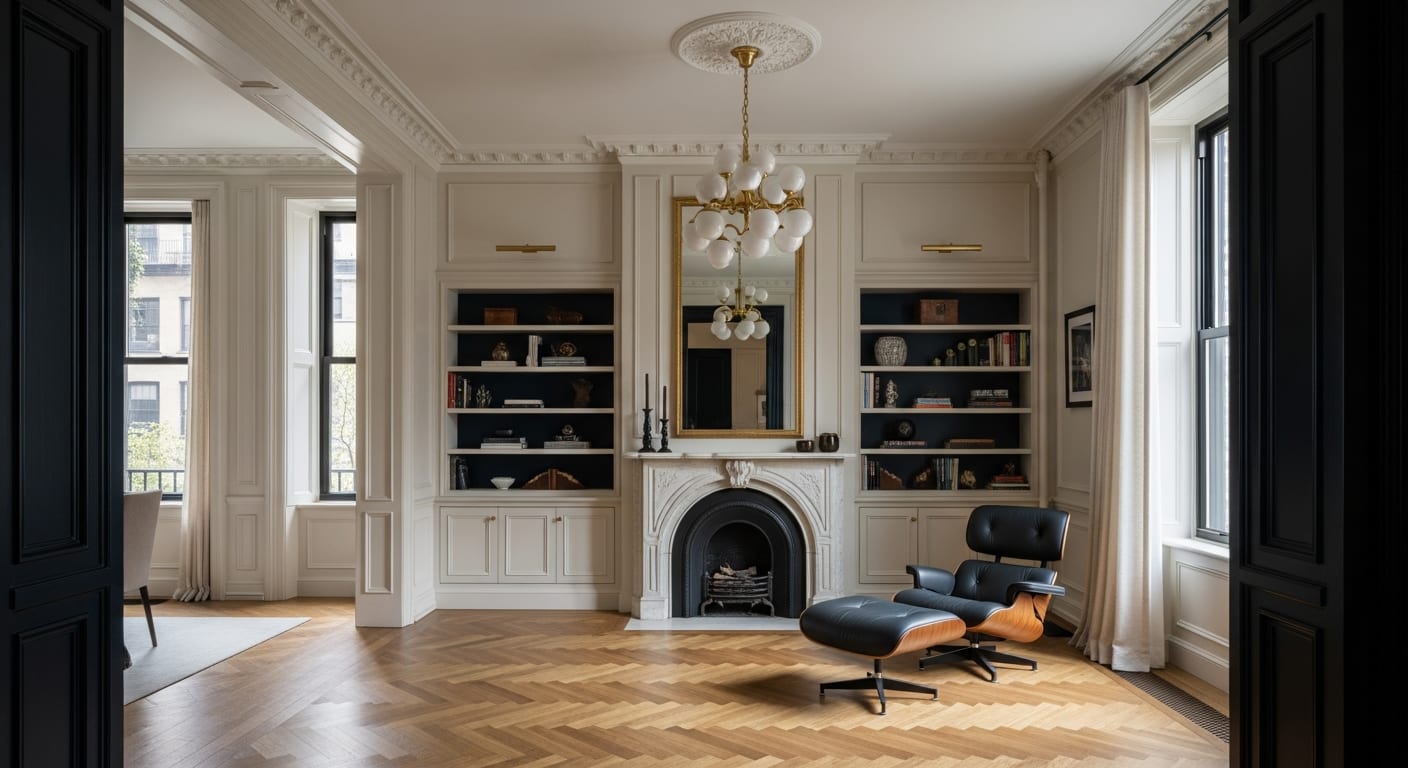
Buyers are often surprised by how close "mint" and "good bones" trade. The reason: a top-quality gut renovation in a landmarked Manhattan townhouse can easily run $4 million to $8 million and take two to three years, so the "renovation savings" of buying at the middle tier is largely consumed by actual renovation cost plus time. The buyers who capture genuine value in the middle tier are those who have a trusted architect, contractor, and expediter lined up in advance, and who are prepared for the schedule.
Operating Costs — What Ownership Actually Runs
Townhouse operating costs surprise buyers who come from the condo and co-op world. A townhouse owner bears every cost directly — there is no building to spread it across. Annual operating budgets typically run $80,000 to $400,000+, depending on size, condition, and staffing profile.
Typical line items for a 5,000-square-foot Upper East Side townhouse: property tax $60,000 to $200,000; homeowner's insurance $15,000 to $40,000; utilities (gas, electric, water, sewer) $20,000 to $50,000; mechanical and systems service contracts (HVAC, boiler, elevator if applicable, security, fire suppression) $20,000 to $45,000; regular maintenance and minor repairs $15,000 to $35,000; optional staffing (housekeeping, house management, gardening) $30,000 to $150,000+. Homes with pools, multiple staff bedrooms, or elevators run higher; mint-renovated homes with current envelope and mechanicals run materially lower than shell-condition equivalents.
For budgeting purposes, most buyers underwrite a townhouse at 2 to 4 percent of purchase price per year in all-in operating costs. A $20 million house at the high end of that range runs roughly $800,000 annually in total carry — a number that should factor into the original price discussion, not a surprise that arrives after closing.
Financing a Manhattan Townhouse
Financing a townhouse is not the same as financing a condo or co-op. Appraisal is the first constraint: comparable sales are thin (townhouses of similar width, condition, and block are often last-traded three to seven years ago), which creates underwriting friction for lenders working from tight comp sets. Most UHNW townhouse buyers use a portfolio lender — a private bank, family-office lender, or a regional bank with jumbo capacity — rather than a conventional jumbo mortgage. These lenders underwrite against the borrower's overall balance sheet rather than solely against the property, which matches the nature of the asset.
Expect 40 to 60 percent loan-to-value at the top of the market, bespoke appraisal workflows (often including a bracketed approach using condo comps on the high side and outer-borough townhouse comps on the low side), and 45 to 75 days to close — longer than a standard condo financing timeline. All-cash closings remain common at $15 million and above, often with post-close financing put in place against the property once ownership is recorded.
The Off-Market Dynamic
The Manhattan townhouse market is the single most off-market segment of NYC luxury real estate. Industry estimates suggest that 35 to 50 percent of UHNW townhouse transactions happen without a public listing — in some neighborhoods and at certain price points the number is higher. Estate sales, celebrities, finance principals, divorcing couples, and foreign-national sellers consistently prioritize discretion. Many of the best houses trade in a sequence that starts with a broker's private email to a short list of qualified buyers and never reaches StreetEasy or OneKey.
For buyers, the operational implication is that access to the full market depends on having a broker with a multi-decade relationship base in the townhouse segment — the kind of presence that earns the first call when an owner decides, often privately and slowly, that they are ready to sell. Buyers limited to public listings in the townhouse market are, by definition, seeing roughly half of the actually-available inventory.
Common Mistakes to Avoid
Buying a rowhouse instead of a townhouse
The terms are often used interchangeably in listing copy, but in a technical sense a townhouse is a true single-family residence while a "rowhouse" in Manhattan frequently refers to a multi-unit building with a single-family-style facade. Confirm the legal certificate of occupancy — a four-family CO cannot be simply converted to a single-family without a multi-year DOB and often LPC process.
Underestimating renovation timelines
A landmark-compliant gut renovation is a 24- to 36-month project from contract to certificate of occupancy — often longer if the Commission pushes back on a Certificate of Appropriateness. Buyers who need to move in within 12 months should not underwrite a renovation project as their path.
Trusting facade photographs
Townhouse listings are often photographed to maximize facade presence. The interior is where value actually lives. A beautiful facade can conceal an unmodernized envelope, a compromised rear yard, and structural issues in the cellar. The diligence sequence for a townhouse should always include a cellar and mechanical-system walk with a specialist engineer before contract.
Skipping the cellar
The cellar is where water, structure, and mechanicals live. Water-table issues, compromised lateral bracing, deteriorated heating systems, and undersized electrical service all live in the cellar. Skipping a rigorous cellar inspection is the single most common expensive mistake townhouse buyers make.
Ignoring block quality
Within any townhouse neighborhood, block quality varies substantially. Two houses four blocks apart in the West Village can have identical interior specifications and materially different resale prospects because one block has consistent architectural character and the other has mid-century infill. Walk the block in the morning, afternoon, and evening before going to contract.
How Caryl Works With Townhouse Buyers
Caryl Berenato has represented townhouse buyers and sellers for the entirety of her 40-year Manhattan career, and townhouses remain the core of her practice today. Her client roster has included architects, designers, art collectors, authors, finance principals, and multi-generational New York families who value a broker who understands the architectural, programmatic, and lifestyle considerations that distinguish a great townhouse purchase from a merely expensive one.
Caryl is a member of REALM Global — the invitation-only luxury real estate network — and holds the Certified Senior Advisor (CSA) designation, which matters particularly for townhouse buyers engaged in multi-generational or estate-level decisions. Her process with townhouse buyers typically begins with a walk through three to five houses calibrated to the buyer's priorities across width, condition, neighborhood, and renovation appetite. From there, introduction to off-market inventory follows — the quiet houses that don't reach the public market are unlocked through relationships, not search portals. Negotiation, due diligence (including cellar and mechanical engineering), and coordination with landmark counsel where applicable are managed end-to-end.
If a Manhattan townhouse is the right next move for you, the conversation begins privately. Review Caryl's notable sales, explore individual neighborhood pages, or schedule a private consultation.
Frequently Asked Questions
How many single-family townhouses are left in Manhattan?
Industry estimates place the Manhattan single-family townhouse inventory at roughly 3,000 to 4,000 properties as of 2026, spread across the West Village, Greenwich Village, Chelsea, the Upper East Side, Upper West Side, Harlem, Tribeca, and a handful of smaller enclaves. That count continues to contract as owners convert to multi-unit use or the properties are absorbed into institutional ownership.
What does a Manhattan townhouse cost in 2026?
Prices vary sharply by neighborhood. West Village and Greenwich Village trade $10M to $30M; Upper East Side (Carnegie Hill, Lenox Hill) $15M to $60M+ for the widest houses; Tribeca $12M to $35M; Chelsea $8M to $20M; Brooklyn Heights $7M to $18M; Harlem $3M to $8M. Width, condition, and landmark status drive the variance inside every neighborhood.
Townhouse, co-op, or condo — which is right?
A townhouse offers total control: no board, no neighbors above or below, full renovation freedom within landmark limits. Co-ops offer the lowest price per square foot and the highest governance. Condos offer amenity-building living with moderate governance. For buyers who want single-family privacy, staff quarters, a garden, and long-term control, nothing in Manhattan replaces a townhouse.
What width townhouse should I buy?
20 feet is tight — rooms run small and the staircase eats valuable interior volume. 25 feet is the Manhattan standard and works for most family programs. 35 feet and above is rare and transformative — it allows a proper double-wide stair hall, two rooms across the front, and the interior scale that defines the trophy tier. Expect a 25 to 40 percent price premium per foot of added width at the top of the market.
What are the annual operating costs of a Manhattan townhouse?
Expect $80,000 to $400,000+ per year, depending on size and staffing. Typical line items: property tax $40K–$200K, insurance $10K–$40K, heating/cooling/utilities $15K–$50K, maintenance and mechanical service contracts $15K–$40K, staff (housekeeper, house manager, gardener) if applicable $30K–$150K+. Older homes with legacy mechanicals and unmodernized envelopes run materially higher than mint-renovated equivalents.
What do Landmarks Preservation Commission rules mean for my renovation?
Roughly 60 percent of Manhattan townhouses sit in a historic district or are individually landmarked. Exterior work — facade restoration, windows, stoop, cornice, rear extensions — requires LPC approval. Minor in-kind work qualifies for a Certificate of No Effect (typically 4 to 8 weeks). Anything visible from a public right of way requires a Certificate of Appropriateness (typically 3 to 9 months, sometimes longer). Interior work generally does not require LPC review unless the interior itself is landmarked, which is rare.
Can I finance a townhouse purchase?
Yes — with the right lender. Most UHNW townhouse buyers use a portfolio lender (private bank, family-office lender, or a regional bank with jumbo capacity) rather than a conventional jumbo mortgage. Expect 40 to 60 percent LTV at the top of the market, bespoke appraisal workflows (comparable sales are thin), and longer underwriting timelines than a condo or co-op purchase. All-cash closings remain common at $15M and above.
How much of the townhouse market is off-market?
Industry estimates suggest 35 to 50 percent of UHNW townhouse transactions in Manhattan happen off-market. The best houses often never reach a public listing. Estate sales, divorcing couples, celebrities, and finance principals consistently prioritize discretion over public marketing. Access to that inventory depends on a broker with a multi-decade relationship base in the segment.
Sources & Further Reading
- Inventory estimates reflect combined data from the NYC Department of Finance, Department of City Planning, and industry reporting by UrbanDigs, Compass, Douglas Elliman, and Corcoran.
- Pricing benchmarks drawn from Q1–Q2 2026 Manhattan townhouse transaction data (Miller Samuel, Compass, StreetEasy).
- LPC approval categories and review timelines from the NYC Landmarks Preservation Commission public guidance and Rules of the City of New York, Title 63.
- Historic district boundaries verified against the NYC LPC interactive designation map.
- Off-market transaction estimates reflect combined brokerage data for the $10M+ townhouse segment.
- Renovation cost benchmarks reflect 2024–2026 landmark-compliant gut-renovation bidding across Manhattan contractors.