
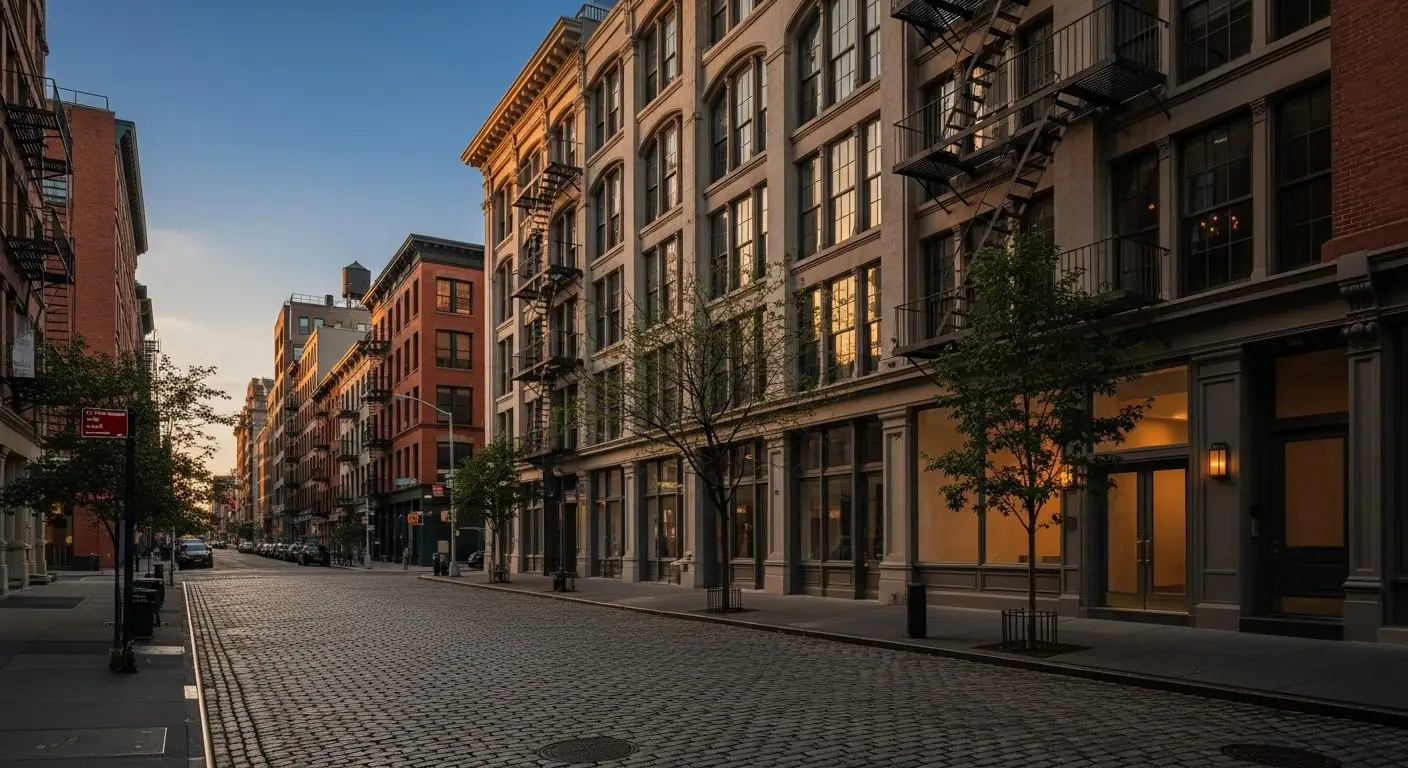
Tribeca is the only Manhattan neighborhood that consistently rewards both privacy and presence. Its converted cast-iron warehouses, cobblestone blocks, and unusually wide streets have produced a residential market that does not behave like the rest of the city — and for ultra-high-net-worth buyers in the $4M and above tier, understanding why is the difference between paying market and paying a premium for a building that no longer carries one. This guide is written for serious buyers: the architect who wants 14-foot ceilings and original cast-iron columns, the collector who needs museum-grade wall lighting, the family that wants the quietest school catchment in downtown Manhattan. It is not a tour. It is what to actually look for, where, and at what price, in 2026.
The Tribeca Premium — What You're Actually Paying For
The neighborhood's median sale price sits at approximately $3.8 million as of early 2026, with luxury condominiums regularly trading above $2,500 per square foot and the most distinguished full-floor lofts and townhouses commanding $10 million to $25 million. That headline median masks the reality of how Tribeca actually trades. Pricing here is driven by three factors that don't apply uniformly elsewhere in Manhattan: the building, the floor plate, and the block. A $5 million budget at 56 Leonard buys an entirely different lifestyle than the same budget at 250 West Street, and both are different from a townhouse on Hubert Street. Knowing which premium you are paying for — and which you should refuse to pay — is the buyer's most important leverage.
The "Tribeca premium" itself reflects four structural realities. First, the supply of converted lofts with original architectural features (cast-iron columns, oversized arched windows, true 12- to 14-foot ceilings) is fixed and slowly contracting as buildings are renovated. Second, new construction is sharply limited by zoning, lot constraints, and historic district protections. Third, the neighborhood's amenity set — Hudson River Park, Stuyvesant High School, PS 234, the restaurant density — has remained best-in-class for two decades. Fourth, demand from creative-industry buyers, financial principals, and discreet international UHNW capital has been remarkably stable through multiple market cycles. The premium isn't fashion. It's structural scarcity.
The Buildings That Matter
Tribeca's high-end inventory concentrates in roughly twenty buildings. These are the ones serious buyers should know.
56 Leonard Street. Herzog & de Meuron's Jenga-stacked tower remains the neighborhood's most architecturally significant new-construction building. Cantilevered floor plates, full-floor and half-floor units, and unobstructed Manhattan-to-Hudson views. Pricing runs $4 million for smaller units to $30 million-plus for the penthouses. The building trades less frequently than its profile would suggest, which contributes to durable resale values.
443 Greenwich Street. The standard-bearer for converted-loft condominium living in Tribeca. A former book bindery converted by Cetra Ruddy into 53 residences with private parking, a 71-foot pool, and one of the most discreet entry sequences in Manhattan. Owners include several recognizable names. Asking prices typically range from $5 million for two-bedroom residences to $40 million-plus for penthouse duplexes. Resale activity is light; when units do trade, they hold their pricing.
70 Vestry Street. Robert A.M. Stern's most recent Tribeca project — limestone-clad, 13 stories, with the longest pool in any private NYC residential building. Pricing has run $7 million to $65 million across the unit mix. The building's classical proportions and handcrafted detailing have made it the consensus choice for buyers who want new construction without contemporary aesthetic.
250 West Street. A converted warehouse with the largest residential floor plates in Tribeca and direct Hudson River frontage. Loft-style layouts, soaring ceilings, and an unusually deep amenity package. Caryl's recent transaction at 250 West Street, Unit 3F closed at $3.8 million — a transaction that underscores how this building rewards buyers who understand the difference between asking and intrinsic value.
108 Leonard. Stanford White's 1894 limestone landmark, converted to residences in 2018. Period detailing throughout, dramatic vaulted ceilings on the lower floors, and a rare opportunity to own in a building of this architectural pedigree. Pricing $3 million to $20 million.
The Sterling Mason (71 Laight). A 33-unit conversion known for its hand-laid Roman brick facade and exceptional interior finishes. Trades infrequently. When it does, expect $5 million to $25 million.
Beyond these: 11 Hubert, 10 Hubert, 49 Chambers, 30 Park Place, 145 Hudson, 161 Hudson, 165 Charles, and a small number of full-block conversions on Greenwich Street round out the high-end set. Outside this group, due diligence quality matters more than building reputation — there are excellent values, but also buildings whose finishes and operating costs do not justify Tribeca pricing.
| Building | Architect / Developer | Type | Price Range |
|---|---|---|---|
| 56 Leonard | Herzog & de Meuron | New construction tower | $4M – $30M+ |
| 443 Greenwich | Cetra Ruddy (conversion) | Converted loft condo | $5M – $40M+ |
| 70 Vestry | Robert A.M. Stern | New construction limestone | $7M – $65M |
| 250 West Street | Warehouse conversion | Loft condo (largest floor plates) | $3M – $15M+ |
| 108 Leonard | Stanford White (1894) | Landmark conversion | $3M – $20M |
| The Sterling Mason | 71 Laight — Morris Adjmi | Converted loft condo | $5M – $25M |
Pricing reflects current secondary market ranges. Individual unit pricing varies significantly by floor, exposure, and condition.
Loft vs. New Construction — How to Choose
The fundamental Tribeca decision is not which building, it's which type of building. Both work for UHNW buyers; they reward entirely different priorities.
Converted lofts
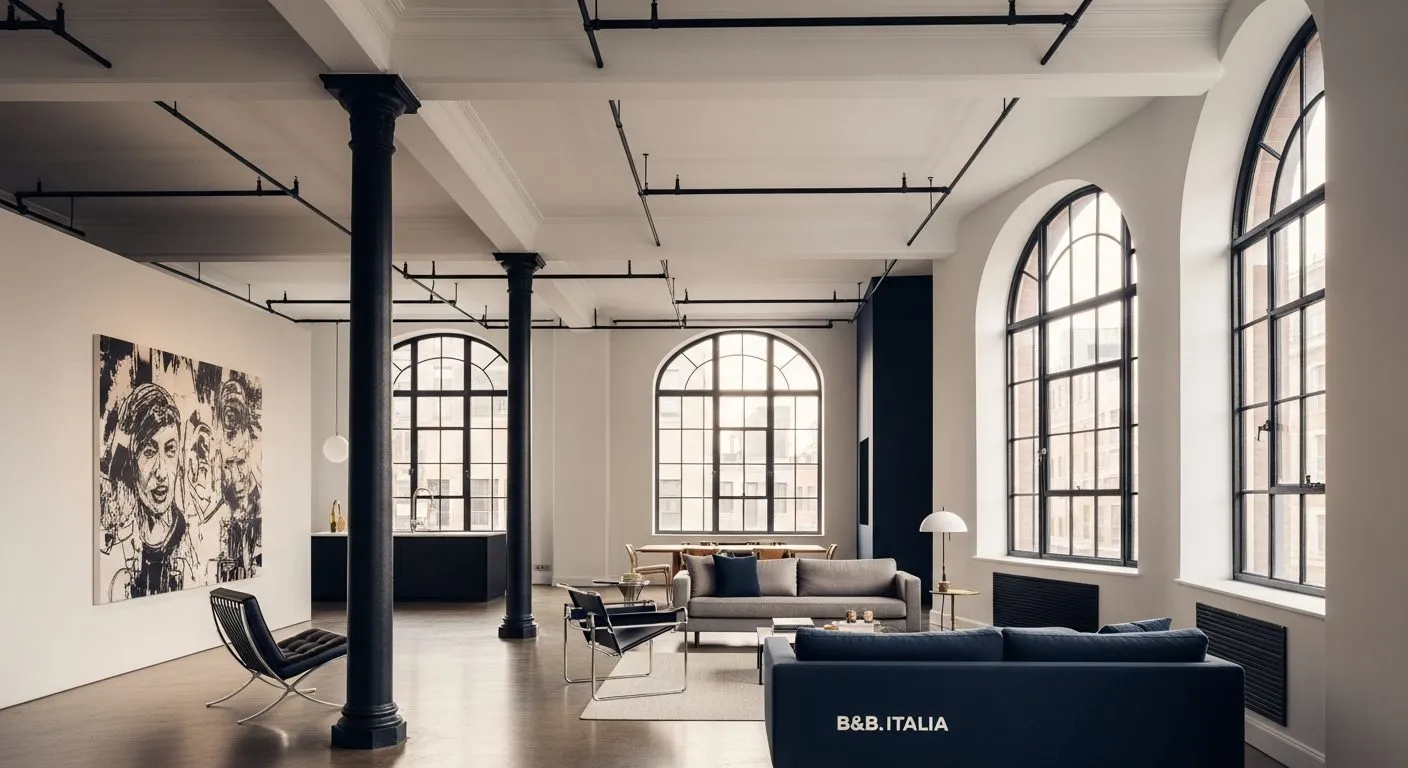
Buildings like 443 Greenwich, The Sterling Mason, and 250 West Street deliver scale that new construction cannot match. Floor plates of 3,500 to 7,000 square feet on a single level. Original cast-iron columns, exposed brick, oversized industrial windows. Ceilings that allow gallery walls and large-scale art. The trade-offs: lower ceiling heights in some upper-floor units, period mechanical limitations on certain HVAC retrofits, and operating costs that reflect older building infrastructure. For collectors, architects, and buyers whose priority is interior volume and architectural character, lofts are non-negotiable.
New construction
Buildings like 56 Leonard, 70 Vestry, 108 Leonard, and 30 Park Place deliver contemporary mechanical systems, full amenity packages (pools, fitness, screening rooms, private parking), and the kind of move-in-ready condition that family buyers and time-constrained principals prioritize. Trade-offs: smaller floor plates, more aesthetic uniformity, and the loss of the architectural specificity that makes Tribeca distinctive.
The best buyers approach this decision by listing what they actually do at home. Buyers who entertain at scale, collect significant art, or work from home with team space should weight toward lofts. Buyers who travel constantly, prioritize privacy and amenity, or want move-in condition should weight toward new construction. There is no universally correct answer.
| Factor | Converted Loft | New Construction |
|---|---|---|
| Floor plate | 3,500–7,000 sqft single-level | 1,500–4,500 sqft typical |
| Ceiling height | 12–14 ft | 10–11 ft |
| Architectural character | Cast-iron columns, arched industrial windows, exposed brick | Contemporary uniform finishes |
| Mechanical systems | Retrofit, some limitations | Modern HVAC, smart-building |
| Amenities | Typically lighter | Full: pool, gym, screening, parking |
| Monthly carrying cost | $2.00–$3.50/sqft | $4.00–$7.00/sqft |
| Best for | Collectors, architects, entertainers | Family buyers, frequent travelers, time-constrained principals |
Townhouses — The Smallest and Most Distinctive Segment
Tribeca's townhouses are the most rarefied segment of the market. Fewer than 200 single-family townhouses exist in the neighborhood, concentrated on Hubert Street, North Moore Street, Harrison Street, Beach Street, and a handful of smaller blocks. They trade infrequently — often not at all in any given year — and when they do, transactions cluster between $12 million and $35 million depending on width, condition, and renovation history.
Townhouse buyers in Tribeca face decisions that don't apply elsewhere in the city. Many are within the Tribeca North or Tribeca West Historic Districts, which means exterior modifications require Landmarks Preservation Commission approval. Floor-plate constraints (most buildings are 20 to 25 feet wide) limit certain modern programmatic choices. Mechanical retrofits — particularly central air conditioning and modern kitchen ventilation — require careful planning around landmark constraints. The reward for navigating these complexities is ownership of a single-family residence in the most exclusive enclave of downtown Manhattan, with the kind of long-term value characteristics that condominium ownership simply cannot replicate.
Caryl's townhouse practice is the segment of her business that has produced her most distinguished transactions. Buyers in this category typically benefit from off-market access — most of the best Tribeca townhouses never reach the public market.
The Off-Market Dynamic
Tribeca trades unusually high volumes off-market. Estimates from leading brokerages suggest that 30 to 45 percent of transactions above $10 million in the neighborhood happen without a public listing. The reasons are practical: many sellers — celebrities, finance principals, divorcing couples, estate executors — value privacy more than the marginal price improvement that public marketing might deliver. Buyers, in turn, often prefer to identify a property quietly rather than compete in a public bidding process.
For UHNW buyers, the implication is operational. Working exclusively from public listings in Tribeca means seeing roughly half of the actually-available inventory at the high end. Access to off-market and pre-market opportunities depends entirely on having a broker with a deep, multi-year relationship base in the neighborhood. This is not a market where you can substitute hustle for tenure.
What $4M, $7M, and $12M+ Actually Buys
Pricing tiers in Tribeca cluster around three thresholds, each with distinct trade-offs.
| Budget | What It Buys | Typical Profile |
|---|---|---|
| $4M – $6M | 2-bed or large 1-bed in flagship buildings (56 Leonard, 70 Vestry); 3-bed in lower-amenity loft conversions | Lower floors, partial views, entry-level serious Tribeca ownership |
| $6M – $10M | Larger 3-bed units in flagship buildings; mid-floor lofts of 2,500–4,000 sqft; lower-end new-construction penthouse inventory | Full amenities, upper-tier finishes |
| $10M+ | Full-floor lofts at 443 Greenwich & 250 West Street; half- and full-floor units at 70 Vestry; new-construction penthouses; townhouses | Where off-market inventory dominates; trophy-building provenance |
A useful frame: in Tribeca, the move from $4M to $7M typically buys floor plate; the move from $7M to $12M+ typically buys building quality and provenance. Both are real, but they reward different priorities.
Operating Costs — The Quiet Differentiator
Tribeca buildings vary widely in monthly carrying costs. Newly constructed buildings with full amenity packages (56 Leonard, 70 Vestry, 30 Park Place) often run $4 to $7 per square foot per month in combined common charges and real estate taxes — meaningful at scale. Converted lofts with lighter amenity offerings can run as low as $2 to $3.50 per square foot per month, but may have legacy mechanical issues that surface in capital assessments. Townhouses carry insurance, utilities, and maintenance directly, with annual operating budgets typically running $80,000 to $200,000+ depending on size and condition.
For buyers comparing units across buildings, a unit that appears 10 to 15 percent cheaper at the asking price can have a meaningfully higher total cost of ownership over a five-year hold. Quality due diligence — particularly review of board minutes, capital reserve studies, and recent assessment history — is essential and routinely compresses negotiation leverage in the buyer's favor.
Schools, Parks, and the Family Decision
Tribeca's school inventory is a primary driver of family-buyer demand and a structural support for long-term valuations. PS 234 Independence School is consistently among the highest-rated public elementary schools in Manhattan and serves the neighborhood's residential blocks. Stuyvesant High School, one of the city's elite specialized public high schools, sits at the neighborhood's northern edge. Private school options are walkable in either direction — Greenwich Village to the north and the Financial District to the south.
Hudson River Park provides the kind of family infrastructure that downtown Manhattan otherwise lacks — playgrounds, sports fields, miles of esplanade, and the unusual experience of waterfront living within Manhattan. Washington Market Park anchors the residential core. For families relocating from the suburbs or from other markets, the practical question is rarely whether Tribeca works for children; it is whether the family is ready for downtown Manhattan generally. Tribeca tends to be the neighborhood that converts skeptics.
What to Avoid
Three categories of error consistently undermine Tribeca buyers.
Buying for views you cannot keep
Several buildings that currently enjoy unobstructed Hudson River views have known development risk — adjacent lots that could be built on. Confirming long-term view protection through zoning analysis is essential before paying a view premium.
Underestimating capital assessments in older conversions
Many of Tribeca's most distinguished loft buildings are 20 to 30 years post-conversion. Major mechanical, facade, and roof work often comes due in this period. A board with thin reserves can mean a capital assessment of $200,000 to $700,000 within 24 months of closing. Reading three years of board minutes is non-negotiable.
Trusting the public listing as a complete inventory picture
As covered above, 30 to 45 percent of UHNW transactions happen off-market. Buyers limited to StreetEasy and OneKey are, by definition, seeing a partial picture.
How Caryl Works With Tribeca Buyers
Caryl Berenato has represented buyers and sellers in Tribeca for the entirety of the neighborhood's modern era. Her client roster has included architects, designers, art collectors, and creative principals who value a broker who understands what they are actually trying to acquire — the architectural, programmatic, and lifestyle considerations that drive a great Tribeca purchase, not just the asking price comparison.
For UHNW buyers entering the market, Caryl's process typically begins with an in-person walk through three to five buildings calibrated to the buyer's priorities. From there, the introduction to off-market inventory follows naturally — Tribeca's quiet inventory is unlocked through relationships, not search portals. Negotiation, due diligence, and board approval (where applicable) are managed end-to-end. The work is discreet by design.
If Tribeca is the right neighborhood for your next move, the conversation begins privately. Explore more on the Tribeca neighborhood page, review Caryl's notable sales, or schedule a private consultation.
Frequently Asked Questions
What is the median home price in Tribeca in 2026?
The median home sale price in Tribeca is approximately $3.8 million as of early 2026, with luxury condos regularly trading above $2,500 per square foot. Full-floor lofts and townhouses command $10 million to $25 million.
How much does a townhouse cost in Tribeca?
Tribeca townhouses trade between $12 million and $35 million in 2026, depending on width, condition, and renovation history. Fewer than 200 single-family townhouses exist in the neighborhood, concentrated on Hubert Street, North Moore Street, Harrison Street, and Beach Street. They trade infrequently — often not at all in a given year.
Which are the best buildings in Tribeca?
Tribeca's most distinguished buildings include 56 Leonard (Herzog & de Meuron), 443 Greenwich Street (Cetra Ruddy conversion), 70 Vestry Street (Robert A.M. Stern), 250 West Street, 108 Leonard (Stanford White), and The Sterling Mason at 71 Laight. Other high-end inventory includes 11 Hubert, 10 Hubert, 49 Chambers, 30 Park Place, 145 Hudson, 161 Hudson, and 165 Charles.
What percentage of Tribeca luxury sales are off-market?
Estimates from leading brokerages suggest 30 to 45 percent of transactions above $10 million in Tribeca happen off-market without a public listing. Sellers in this segment — celebrities, finance principals, estate executors — often prioritize privacy over public marketing.
What does a $4 million to $6 million budget buy in Tribeca?
A $4–6 million budget in Tribeca typically buys a 2-bedroom or large 1-bedroom in a top building like 56 Leonard or 70 Vestry, or a 3-bedroom in a less amenitized loft conversion. Floor heights tend to be lower; views are partial. This is the entry point for serious Tribeca ownership.
Should I buy a loft or new construction in Tribeca?
Converted lofts (443 Greenwich, Sterling Mason, 250 West Street) deliver larger floor plates, original architectural features, and interior scale that new construction cannot match — ideal for collectors, architects, and entertainers. New construction (56 Leonard, 70 Vestry, 108 Leonard, 30 Park Place) offers contemporary mechanical systems, full amenity packages, and move-in condition — ideal for family buyers and time-constrained principals.
What are the monthly carrying costs in Tribeca condos?
Newly constructed full-amenity buildings (56 Leonard, 70 Vestry, 30 Park Place) often run $4 to $7 per square foot per month in combined common charges and real estate taxes. Converted lofts with lighter amenity offerings can run $2 to $3.50 per square foot per month. Townhouses carry annual operating costs of $80,000 to $200,000+ depending on size and condition.
Are Tribeca schools good?
PS 234 Independence School is consistently ranked among Manhattan's top public elementary schools and serves Tribeca's residential blocks. Stuyvesant High School, one of New York City's elite specialized public high schools, sits at the neighborhood's northern edge. Private school options are walkable in Greenwich Village to the north and the Financial District to the south.
Sources & Further Reading
- Pricing and transaction benchmarks reflect Compass, UrbanDigs, and Miller Samuel Q1–Q2 2026 Manhattan luxury reports.
- Off-market volume estimates reflect combined brokerage data from Compass, Douglas Elliman, and Corcoran for the $10M+ segment.
- Building architect attributions verified from public development records and the Landmarks Preservation Commission.
- School data from the NYC Department of Education and NYC Specialized High Schools admissions.
- Transaction reference: 250 West Street, Unit 3F — represented by Caryl Berenato, closed $3.8M.