
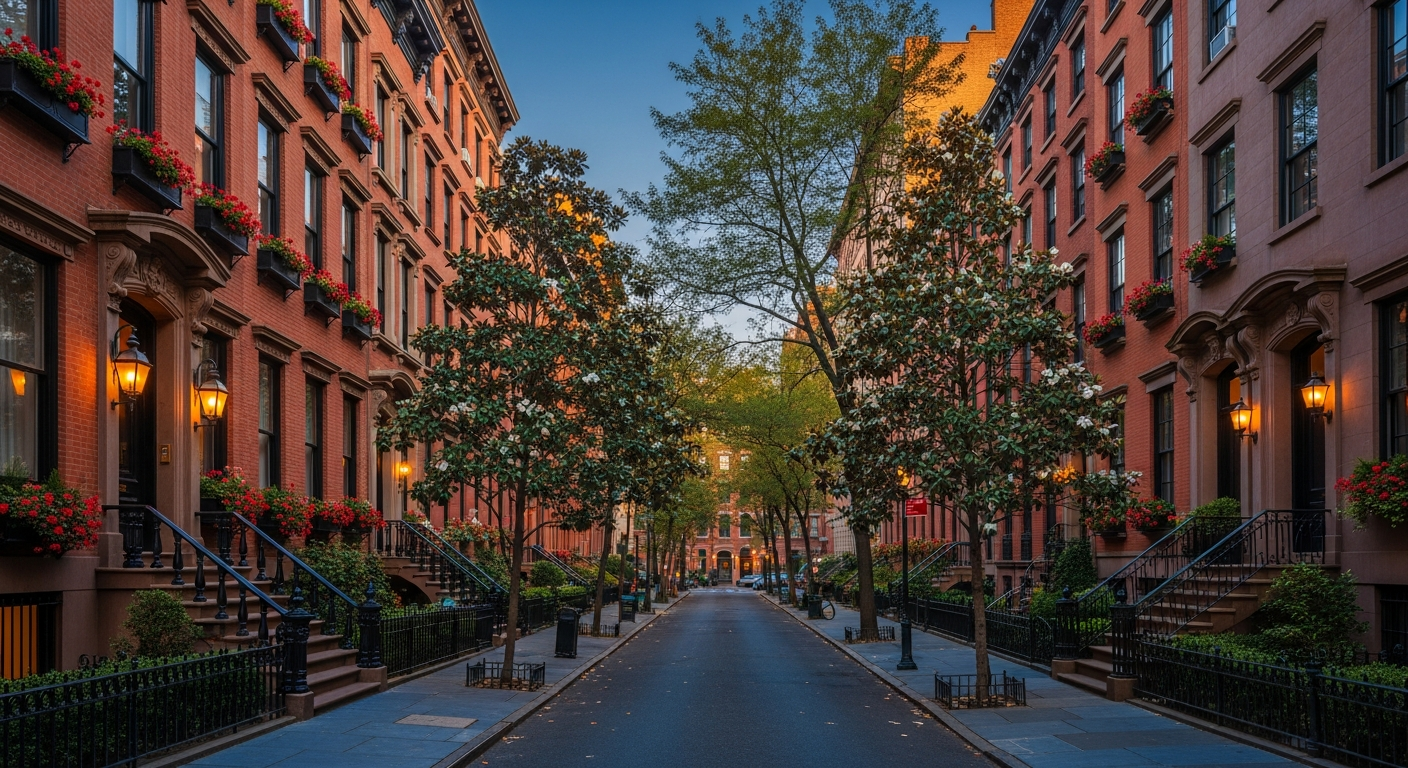
The West Village is the most emotionally specific neighborhood in Manhattan. Other neighborhoods offer scale, views, or amenity; the West Village offers a feeling — the feeling of walking a tree-lined block where every house was built by hand in the 1820s through 1850s, where the street grid breaks from Manhattan's relentless north-south logic, and where the life on the sidewalk (the restaurant, the bookstore, the corner garden) is inseparable from the life inside the house. For ultra-high-net-worth buyers, the West Village is frequently the last Manhattan address — the one that follows the uptown co-op, the loft phase, and the suburban experiment. This guide is written for buyers at that stage. It covers what $4 million and above actually buys in 2026 across the neighborhood's three ownership forms — townhouse, co-op, and condo — along with the best blocks, the architectural distinctions that matter, co-op board culture, the neighborhood's singular lifestyle, operating costs, and the off-market dynamics that define every serious West Village search.
What $4M+ Buys — Three Ownership Forms
The West Village market divides cleanly into three tiers, each with a distinct price band, ownership structure, and buyer profile. Understanding where each tier begins and what it delivers is the first step in a serious search.
Townhouses — $8M to $30M
The West Village contains the highest concentration of Federal and Greek Revival rowhouses in Manhattan, built predominantly between 1820 and 1855. These are the houses that define the neighborhood's visual identity: three to four stories of red brick or Flemish bond, low stoops or high stoops, six-over-six windows, bracketed cornices, and rear gardens that vary from 15 to 40 feet deep. Widths range from a tight 16 feet (the narrowest habitable rowhouses in Manhattan) to a generous 25 feet on the best blocks. Pricing tracks width, block quality, and condition more than square footage.
At $8 million to $12 million, a buyer can acquire a 16- to 18-foot-wide rowhouse in estate or good-bones condition on a secondary block — a house that needs a gut renovation but sits on a sound foundation with intact original detail. At $12 million to $20 million, the market delivers a 20- to 22-foot-wide house in good condition on a premier block (Perry, Charles, Bank, West 11th), with a functional kitchen, updated mechanicals, and a usable rear garden. At $20 million to $30 million, the inventory narrows to the widest and best-condition houses on the most consistent blocks — mint-renovated 22- to 25-foot-wide Federal or Greek Revival houses with restored facades, modern infrastructure concealed behind period detail, professional-grade kitchens, and gardens designed for entertaining.
Transaction volume is structurally low. In a typical year, fewer than 25 West Village townhouses trade above $8 million, and fewer than 10 trade above $15 million. That scarcity, combined with ownership holds that average 15 to 25 years, means the best houses rarely appear on the public market.
Co-ops — $4M to $12M
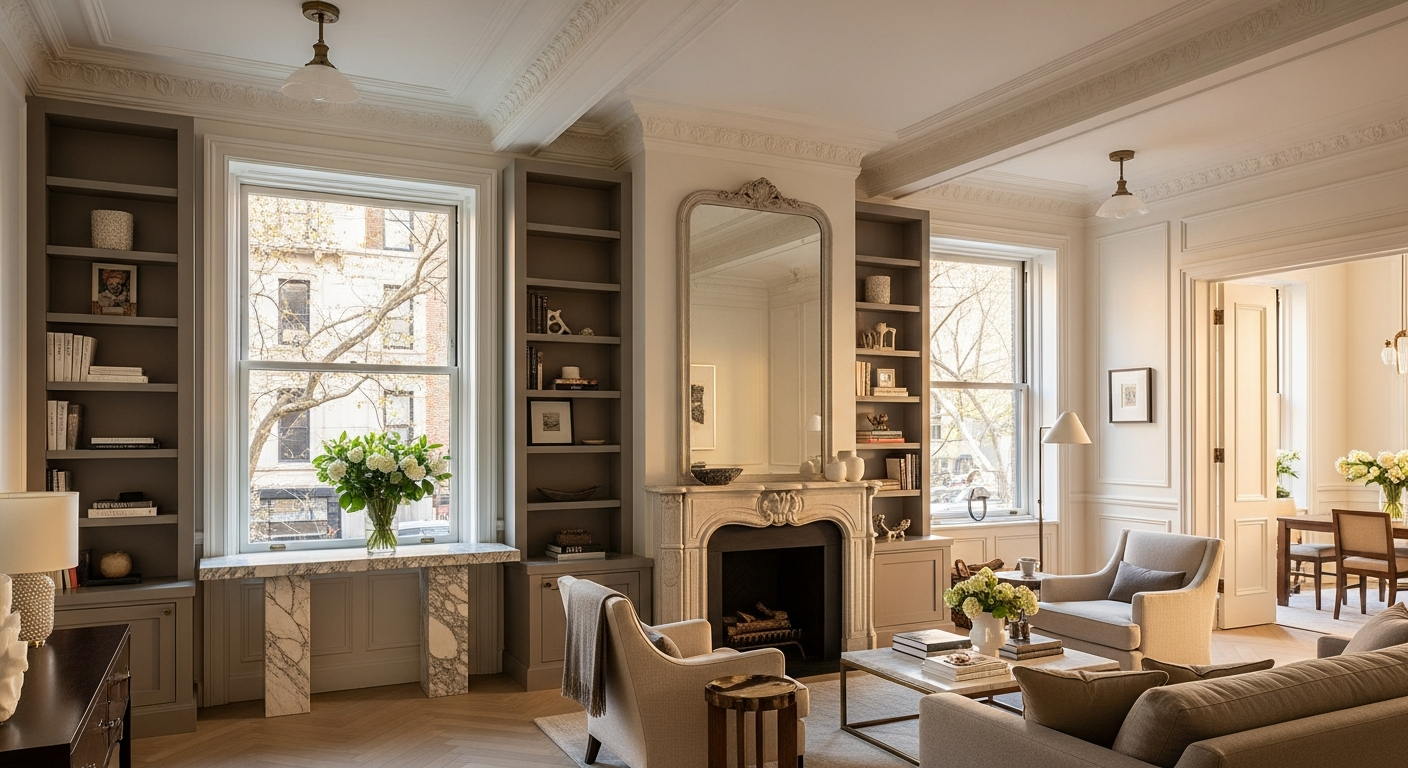
The co-op market is where most UHNW buyers enter the West Village. The neighborhood's pre-war apartment buildings — concentrated on the avenues (Seventh, Greenwich, Hudson) and on the wider cross-streets — deliver the classic Manhattan living experience: doorman, elevator, pre-war detail (moldings, hardwood, working fireplaces), shared garden, and a building-level social fabric that townhouses lack. At $4 million to $6 million, a buyer can expect a well-located one- or two-bedroom (900–1,400 sf) with original detail in a well-maintained building. At $6 million to $9 million, the market opens to classic sixes and sevens — full-floor or large-portion apartments with three bedrooms, formal dining, and views of the neighborhood's tree canopy. At $9 million to $12 million, the inventory is trophy-tier: penthouse and top-floor apartments with terraces, or rare combined units in the most desirable buildings on Perry, Charles, or West 12th.
Co-op ownership carries governance. Board approval is required for purchase, and sublet policies vary from liberal to near-prohibition. Boards in the West Village tend to be less formal than Upper East Side institutions but more thorough than newer condo buildings — a full financial package, reference letters, and a board interview are standard. A broker who knows the building's board culture and recent approval patterns is essential.
Condos — $3M to $8M
True condo inventory in the West Village is scarce. Fewer than a dozen buildings in the core neighborhood (bounded roughly by Hudson Street, West 14th Street, Seventh Avenue South, and Houston Street) operate as condominiums. The buildings that do — mostly conversions from the 1980s and 1990s, plus a small number of new-construction or gut-renovation projects — trade at $3 million to $8 million for one- to three-bedroom units. The condo premium is flexibility: no board interview, easier subletting, simpler financing, and a right-of-first-refusal rather than a board veto on resale. For buyers who split time between Manhattan and another residence, or who value ownership simplicity above all, a West Village condo is the path of least friction.
| Ownership Type | Price Range | Typical Size | Governance | Best For |
|---|---|---|---|---|
| Townhouse | $8M–$30M | 2,800–5,500 sf | None (you are the board) | Privacy, families, renovation control, legacy |
| Co-op | $4M–$12M | 900–3,200 sf | Board approval + sublet rules | Pre-war character, doorman, community |
| Condo | $3M–$8M | 800–2,400 sf | Minimal (right of first refusal) | Flexibility, pied-à-terre, simpler ownership |
Pricing reflects Q1–Q2 2026 West Village market data; individual properties vary by block, condition, and floor.
The Best Blocks — Where the Value Lives
The West Village is a neighborhood of blocks, not buildings. Unlike the Upper East Side or Tribeca, where a single address (a co-op, a condo tower) can define value, the West Village's value is distributed across entire block faces — rows of houses built in the same decade, by the same craftsmen, with the same brick, the same cornices, and the same stoops. The block is the unit of value. Here are the ones that matter most.
Perry Street
The block between Bleecker and West 4th is widely regarded as the most architecturally consistent residential block in Manhattan. A continuous row of 1840s Federal and Greek Revival houses, nearly unaltered, with mature trees, original ironwork, and a quiet that belies its location three blocks from Seventh Avenue. Perry Street became internationally famous after Sarah Jessica Parker's character lived at 66 Perry in Sex and the City, but the block's reputation among serious buyers long predated television. Townhouses here trade $14 million to $25 million; co-ops in the adjacent buildings trade $5 million to $10 million.
Charles Street
Quieter and more residential than Perry. The stretch between Bleecker and Hudson offers some of the deepest rear gardens in the neighborhood (30–40 feet), a slightly wider lot pattern, and a mix of Federal and early Greek Revival houses. Charles Street buyers are typically long-tenure New Yorkers who prioritize garden space and quiet over proximity to the commercial corridor. Townhouses trade $10 million to $22 million.
Bank Street
The block between Waverly Place and West 4th Street is a perennial favorite — tight architectural continuity, mature plane trees, and a neighborhood-within-the-neighborhood feel. Bank Street houses tend to be narrower (16–20 feet) and lower-priced than Perry or Charles, making them the entry point for townhouse buyers who want a premier block at $8 million to $16 million.
West 11th Street
Between Fifth and Sixth Avenues, West 11th delivers some of the widest houses in the West Village — 22 to 25 feet is common — and the grandest architectural statements, including several houses that have been featured in Architectural Digest. The block's proximity to Fifth Avenue gives it a slightly more formal character than the deeper Village blocks. Townhouses trade $15 million to $30 million.
West 12th Street
Architecturally similar to West 11th but with more institutional presence (the New School, various gallery spaces). The residential blocks between Fifth and Seventh Avenues contain some of the finest Greek Revival houses in the city, with wide parlor floors and intact original detail. Pricing runs $12 million to $25 million for townhouses.
Bedford Street & Commerce Street
The most intimate blocks in the neighborhood — and arguably in all of Manhattan. Bedford Street contains the city's narrowest house (75½ Bedford, at 9.5 feet wide) and the Isaacs-Hendricks House (the oldest surviving house in the Village, dating to 1799). Commerce Street's gentle curve and low-scale houses create a European village atmosphere that no other Manhattan block replicates. Townhouses here are rare and often trade off-market at $8 million to $18 million.
Architectural Styles — What You're Actually Buying
Three architectural styles dominate the West Village's residential housing stock. Understanding them is not academic — style determines ceiling height, floor plan, facade maintenance obligations, and renovation constraints.
Federal (1800–1835)
The oldest surviving houses. Characterized by flat or very slightly pitched roofs, Flemish-bond brick, delicate door surrounds with fanlights and sidelights, low stoops (or no stoop — the parlor floor at or near grade), and smaller window openings than later styles. Ceiling heights are typically 8.5 to 9.5 feet on the parlor floor. Federal houses are the most intimate and the most "Village" in character. They tend to be narrower (16–20 feet) and shorter (three stories plus basement) than later construction. Original Federal detail — mantels, chair rails, six-panel doors — is increasingly rare and adds significant value when intact.
Greek Revival (1835–1855)
The dominant style in the West Village. Characterized by high stoops, heavy stone door surrounds with pilasters and entablatures, taller parlor-floor windows, and a more formal street presence than Federal houses. Ceiling heights are typically 10 to 11 feet on the parlor floor — meaningfully taller than Federal, which transforms the interior scale. Greek Revival houses are often 20–25 feet wide and four stories plus basement, with deeper floor plans that allow a more modern room layout. The style commands a 10 to 15 percent premium over comparable Federal houses because of the ceiling height and interior volume.
Brownstone-Fronted (1855–1880)
Less common in the core West Village but present on the periphery (closer to Seventh Avenue, on the numbered streets above Christopher). Brownstone refers to the facade material — a soft sandstone that weathers distinctively — rather than a structural system. Brownstone-fronted houses tend to be Italianate in style: deeper bracketed cornices, round-arched windows, higher stoops, and slightly wider proportions than their Federal and Greek Revival neighbors. They require more facade maintenance (brownstone spalls and must be periodically patched or resurfaced) but offer the most generous interior dimensions of any pre-Civil War West Village house.
Co-op Board Culture in the West Village
West Village co-op boards occupy a middle ground between the Upper East Side's institutional rigor and the more relaxed approach of newer condo conversions. The culture varies building by building, but several patterns hold across the neighborhood.
Financial requirements are substantive but not punitive. Most boards require liquid assets equal to two to three years of carrying costs (maintenance plus mortgage payments) after purchase, net worth of three to five times the purchase price, and a debt-to-income ratio below 30 percent. All-cash purchases are looked upon favorably but are not universally required.
Board interviews in the West Village tend to be conversational rather than adversarial. Boards want to know that you intend to live in the apartment (pied-à-terre buyers face the most resistance), that you understand the building's culture (quiet hours, renovation rules, pet policies), and that you will participate in the community. Several West Village buildings have informally adopted a "neighborhood fit" standard — a subjective but real factor that favors buyers who demonstrate genuine affinity for the Village's character.
Sublet policies range from liberal (one to two years permitted, renewable) to restrictive (no subletting, or subletting only after five years of owner occupancy). Buyers who intend to split time between Manhattan and another residence should confirm the sublet policy before making an offer — a common mistake is assuming that co-op sublet rules are negotiable. They are not.
Celebrity Residents, Restaurants, and Lifestyle
The West Village became Manhattan's most desirable residential neighborhood in part because of who chose to live there. Sarah Jessica Parker, Julianne Moore, Annie Leibovitz, and a deep roster of writers, editors, gallery owners, designers, and music-industry figures have called the neighborhood home over the past three decades, creating a cultural gravity that attracted restaurants, shops, and a street-level energy that no developer can engineer.
The restaurant scene is the most concentrated marker of that energy. Via Carota (Grove Street) is the neighborhood's de facto living room — a trattoria with a regulars culture that functions as a social institution. L'Artusi (West 10th) is the dinner-party alternative — modern Italian, serious wine, consistently excellent. Buvette (Grove Street) is the morning and afternoon anchor — a tiny French gastrotheque that operates on a first-come, no-reservation basis and that has become a neighborhood ritual. The Spotted Pig is gone, but its legacy — a gastropub that functioned as a creative-industry commissary for a decade — redefined what a neighborhood restaurant could be. Wallsé (West 11th), Mary's Fish Camp (Charles), and the Little Owl (Bedford and Grove) round out a dining scene that operates as social infrastructure for the neighborhood's residents.
Hudson River Park is the neighborhood's western edge and its primary outdoor amenity — a waterfront park stretching from Battery Park City to 59th Street, with the West Village section (roughly Leroy Street to West 14th Street) containing running paths, kayak launches, public piers, and playgrounds. The Whitney Museum of American Art sits just north of the West Village at Gansevoort and Washington, anchoring the Meatpacking District and the High Line's southern terminus. For families with children, the combination of Hudson River Park and the neighborhood's walkable scale creates a daily-life rhythm that no other Manhattan neighborhood matches.
Schools: PS 3 (the Charrette School) at 490 Hudson Street is the zoned public elementary for most West Village blocks and is consistently among Manhattan's most sought-after public elementaries. PS 41 (the Greenwich Village School) on West 11th Street serves the eastern edge of the neighborhood. Private options within walking distance include St. Luke's School, the Village Community School, and — slightly farther — Friends Seminary, Grace Church School, and the cluster of schools in Chelsea and the Flatiron.
Operating Costs — What Ownership Actually Runs
Townhouse Annual Carry
West Village townhouse owners bear every operating cost directly. Annual budgets typically run $80,000 to $250,000+, depending on size, condition, and staffing. Key line items for a 3,500-square-foot townhouse:
- Property tax: $40,000–$120,000
- Insurance: $10,000–$25,000
- Utilities (gas, electric, water): $15,000–$35,000
- Mechanical service contracts (HVAC, boiler, security): $12,000–$30,000
- Regular maintenance: $10,000–$25,000
- Optional staff (housekeeper, gardener): $30,000–$100,000+
Mint-renovated houses with current mechanicals run at the low end; unrenovated houses with aging infrastructure run materially higher. Budget 2 to 4 percent of purchase price per year as an all-in operating benchmark.
Co-op Monthly Maintenance
Co-op maintenance in the West Village's best buildings typically runs $3,000 to $8,000 per month for a two- to three-bedroom apartment, covering building staff, insurance, reserves, heat, water, and the building's underlying mortgage (if any). Maintenance is tax-deductible to the extent it includes the apartment's share of the building's real estate taxes — typically 40 to 55 percent of the monthly charge. Assessments for capital projects (facade restoration, elevator modernization, boiler replacement) are periodic and can add $500 to $2,000 per month for 12- to 36-month periods.
Condo Common Charges
Condo common charges run $1,800 to $4,500 per month in most West Village buildings, plus a separate real estate tax bill of $2,000 to $6,000 per month. Total monthly carry for a condo is often comparable to a co-op maintenance payment, but the cost structure is more transparent and the tax implications differ.
Off-Market Dynamics
The West Village townhouse market is among the most off-market segments in all of New York City real estate. Industry estimates suggest that 40 to 55 percent of townhouse transactions at $10 million and above happen without a public listing. The reasons are structural: sellers are often celebrities, long-tenure families, or estates that prioritize discretion; the inventory is thin enough that a broker's private email to a short list of qualified buyers is often sufficient to generate a sale; and the buyers at this level prefer to avoid the public bidding dynamics that characterize the condo and co-op markets.
For buyers, the operational implication is that a West Village townhouse search cannot be conducted exclusively through StreetEasy, Compass.com, or any public portal. The best houses are unlocked through relationships — a broker who has spent decades in the neighborhood, who gets the first call when an owner decides to sell, and who can introduce a buyer to inventory that exists only in private conversation. Buyers who limit their search to publicly listed properties are seeing, at best, half of the actual market.
The co-op market is somewhat more public — boards require disclosure, and most co-op listings appear on public portals — but even here, pocket listings and broker-network introductions account for a meaningful share of activity above $5 million. The West Village is a neighborhood where who you know still determines what you see.
Comparison — West Village vs. Greenwich Village vs. Chelsea
Buyers considering the West Village almost always also look at Greenwich Village and Chelsea. The three neighborhoods share architectural DNA but differ meaningfully in character, pricing, and buyer profile.
| Factor | West Village | Greenwich Village | Chelsea |
|---|---|---|---|
| Townhouse range | $8M–$30M | $9M–$25M | $8M–$20M |
| Co-op range | $4M–$12M | $3M–$10M | $3M–$8M |
| Dominant style | Federal / Greek Revival | Federal / Greek Revival | Italianate / Greek Revival |
| Block continuity | Highest in Manhattan | High, with some infill | Very high (Cushman Row) |
| Street grid | Irregular (village pattern) | Mix of grid and irregular | Standard Manhattan grid |
| Restaurant scene | Destination-level | Strong, more casual | Emerging, gallery-adjacent |
| Park access | Hudson River Park | Washington Square Park | High Line, Hudson River Park |
| Buyer profile | Creative industry, UHNW families | Academic, institutional, UHNW | Art world, design, fashion |
| Off-market % | 40–55% above $10M | 30–45% above $10M | 25–35% above $10M |
How Caryl Works With West Village Buyers
Caryl Berenato has represented buyers and sellers on the West Village's most distinguished blocks for the entirety of her 40-year Manhattan career. The West Village remains the core of her townhouse practice — she has walked every block, knows the ownership history of the major houses, and maintains the kind of multi-decade relationships with West Village owners that produce the first call when a house is ready to trade.
Her process with West Village buyers typically begins with a walk — not a showing, but a walk through the neighborhood calibrated to the buyer's priorities across ownership type, block character, width, condition, and renovation appetite. From there, introduction to off-market inventory follows: the quiet houses that don't reach the public market are unlocked through relationships built over four decades of continuous presence in the neighborhood. Negotiation, due diligence (including cellar and mechanical engineering for townhouses, board-culture assessment for co-ops), and coordination with landmark counsel where applicable are managed end-to-end.
Caryl is a member of REALM Global — the invitation-only luxury real estate network — and holds the Certified Senior Advisor (CSA) designation, which matters particularly for buyers engaged in multi-generational or estate-level decisions. Review Caryl's notable sales, explore the West Village neighborhood page, or schedule a private consultation.
Frequently Asked Questions
What does $4 million buy in the West Village in 2026?
At $4 million you enter the co-op market — typically a one- or two-bedroom in a well-maintained pre-war building on a desirable block such as Perry, Charles, or Bank Street. Expect 900 to 1,400 square feet, original details (moldings, hardwood, fireplace), and building amenities that include a doorman and a shared garden. Townhouses start at roughly $8 million for a 16- to 18-foot-wide Federal or Greek Revival rowhouse requiring renovation.
Are West Village co-op boards difficult?
West Village co-op boards range from moderate to strict. Most require a full financial disclosure package (two to three years of tax returns, bank and brokerage statements, a detailed financial statement, and professional and personal reference letters), a formal board interview, and compliance with the building's sublet policy. Some buildings limit or prohibit pieds-à-terre. A broker who knows the building's board culture can advise on likelihood of approval before you invest time in an application.
How do West Village townhouse prices compare to Greenwich Village?
West Village townhouses typically trade at a 10 to 20 percent premium over comparable Greenwich Village properties of similar width and condition. The premium reflects tighter block-level architectural continuity, lower traffic, and the neighborhood's consistently high desirability among creative-industry and UHNW buyers. Greenwich Village compensates with slightly wider houses on certain blocks and proximity to Washington Square Park.
What is the best block in the West Village?
There is no single best block — it depends on your priorities. Perry Street between Bleecker and West 4th is among the most architecturally consistent. Charles Street between Bleecker and Hudson offers particularly quiet, tree-lined character. Bank Street between Waverly and West 4th is a perennial favorite. West 11th Street between Fifth and Sixth has some of the widest houses. Bedford Street and Commerce Street offer the most intimate, European village-scale blocks.
What are annual operating costs for a West Village townhouse?
Expect $80,000 to $250,000+ annually, depending on size, condition, and staffing. Typical line items: property tax $40K–$120K, insurance $10K–$25K, utilities $15K–$35K, mechanical service contracts $12K–$30K, maintenance $10K–$25K, optional staff $30K–$100K+. Mint-renovated houses with current mechanicals run at the lower end; older unrenovated houses run materially higher.
How much of the West Village market is off-market?
An estimated 40 to 55 percent of West Village townhouse transactions at $10 million and above happen off-market. Celebrity sellers, estate sales, and long-tenure families consistently prioritize discretion. Co-op transactions are inherently more public, but pocket listings and broker-network introductions still account for meaningful activity above $5 million.
Can I renovate a landmarked West Village townhouse?
Yes — with LPC approval for exterior work. The entire West Village sits within a historic district. Interior work generally does not require LPC review. Exterior changes require either a Certificate of No Effect (4–8 weeks) or a Certificate of Appropriateness (3–9 months). Budget $600–$1,200 per square foot for a landmark-compliant gut renovation.
Should I buy a townhouse, co-op, or condo in the West Village?
A townhouse delivers maximum privacy, no board, a private garden, and full renovation control — ideal for families, collectors, and legacy buyers. A co-op offers the lowest price per square foot and access to fine pre-war buildings with doorman service and shared gardens. A condo is scarce but offers the most flexible ownership (no board interview, easier subletting, simpler financing). The right choice depends on lifestyle priorities, not just budget.
Sources & Further Reading
- Pricing benchmarks drawn from Q1–Q2 2026 West Village transaction data (Miller Samuel, Compass, StreetEasy).
- Architectural style descriptions reference the NYC Landmarks Preservation Commission designation reports for the Greenwich Village Historic District and Greenwich Village Historic District Extension.
- Co-op board culture observations reflect 40 years of transaction experience across the neighborhood's major buildings.
- Off-market transaction estimates reflect combined brokerage data for the $10M+ West Village segment.
- Operating cost benchmarks reflect 2024–2026 West Village townhouse and co-op carrying costs.
- School rankings reference NYC Department of Education data and independent school directories.