
Flatiron and NoMad have, over the past decade, transitioned from secondary downtown commercial-residential districts into a credible UHNW destination, with new-construction supertall condominiums (Madison Square Park Tower at 777 feet, One Madison at 621 feet), distinguished loft conversions, and 2026 pricing that runs $2,000 to $4,500 per square foot at the high end of new construction and $1,500 to $2,500 per square foot for the converted-loft inventory. NoMad sales prices have risen approximately 43 percent over the past five years, the largest five-year appreciation of any sub-neighborhood between 14th and 42nd Streets, and contracts at the $10M+ tier through the Madison Square Park corridor in 2026 reflect a market that is no longer emerging in any meaningful sense — it has arrived. This guide is for serious buyers considering a Flatiron or NoMad purchase in 2026, with the building set, the loft-vs.-new-construction decision, the price bands, and the buyer profile that have come to define the neighborhood.
Defining the Geography — Where Flatiron Ends and NoMad Begins
The two neighborhoods share a continuous architectural fabric but have distinct identities, and serious buyers need to understand the geography because the price bands, the buyer profiles, and the supply of available inventory differ across the line.
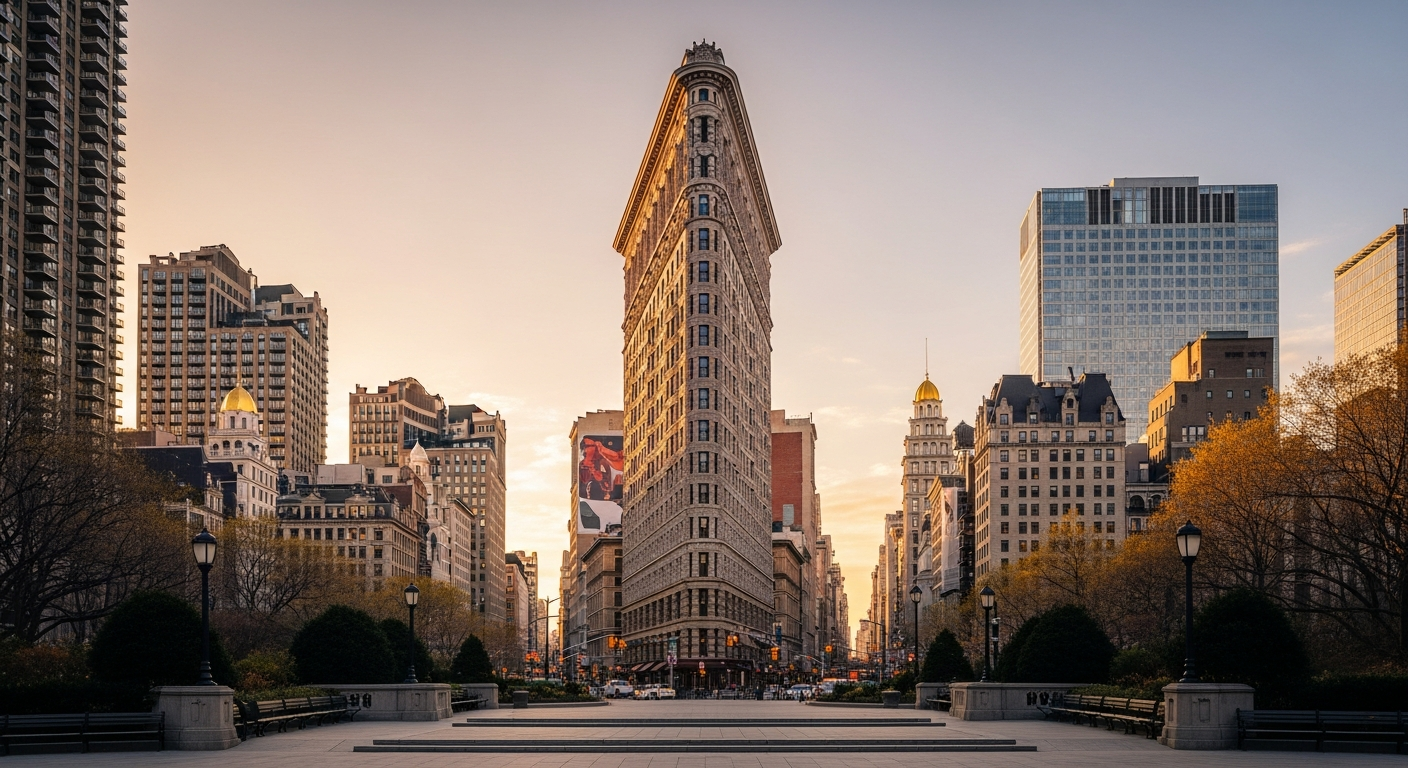
Flatiron is the older and more architecturally definitive of the two. Its boundaries are roughly 14th Street to the south, 23rd Street to the north, Park Avenue South / Lexington Avenue to the east, and Sixth Avenue to the west. The neighborhood is anchored by the Flatiron Building (Daniel Burnham, 1902) at 23rd Street and Fifth Avenue, by Madison Square Park (the rare full-block public park in the Manhattan grid), and by Union Square at its southern boundary. Architecturally, Flatiron is dominated by late-nineteenth and early-twentieth-century commercial-loft buildings — cast-iron facades on Broadway, stone-clad office buildings along Fifth Avenue, brick-and-terracotta industrial buildings on the side streets — most of which have been converted to residential or mixed-use loft condominiums over the past 25 years.
NoMad (North of Madison Square Park) sits directly above Flatiron — roughly 23rd Street to the south, 30th to 33rd Street to the north (the northern boundary is debated; the term emerged in the mid-2000s and the boundaries reflect marketing as much as geography), Sixth Avenue to the west, and Lexington / Park Avenue to the east. The architecture is broadly similar to Flatiron — late-nineteenth-century commercial and industrial loft buildings, some retail and hospitality conversions, and a layer of new-construction supertall and supertall-adjacent residential towers added since 2014. NoMad's residential market is younger than Flatiron's; the inventory turns over more frequently, and the average buyer tenure is shorter.
The functional consequence for buyers: Flatiron has the deeper inventory of converted lofts in seasoned condo buildings, while NoMad has the larger share of new-construction supertall condominium inventory and the more concentrated set of luxury-hotel-residence offerings. A buyer who wants a converted-loft purchase with established building governance will find more options in Flatiron; a buyer who wants new-construction with full amenities and contemporary mechanicals will find more options in NoMad. There is meaningful overlap in both directions.
The Buildings That Matter
The neighborhood's high-end inventory concentrates in roughly a dozen buildings. These are the ones serious buyers should know.
Madison Square Park Tower — 45 East 22nd Street
The defining new-construction supertall on the Madison Square Park frontage. Designed by Kohn Pedersen Fox with interiors by Martin Brudnizki, 65 stories, 777 feet tall — at completion in 2017 it became the tallest residential building between Midtown and the Financial District, and remains so. The tower houses approximately 83 condominium residences, with floor plates that begin around 1,700 square feet for the smallest units and reach full-floor 5,000+ square foot residences in the upper portion of the tower, plus a triplex penthouse that has traded above $50 million in prior cycles and is currently asking $77.7 million in its re-listing. Amenities include a 54th-floor "Upper Club" with full skyline views, a boxing suite, a golf simulator, a basketball court, and a fitness floor. Asking prices in 2026 run $4 million for smaller units in the lower tower to $25 million+ for full-floor residences, with the trophy penthouse asking $77.7M.
The building's standing in the neighborhood is established. Resale velocity is modest — the tower trades a small number of units per year — and the residences hold their pricing through cycles in a way that the surrounding loft inventory does not always replicate.
One Madison — 23 East 22nd Street
Cetra Ruddy's earlier (2010) condominium tower at the south edge of Madison Square Park. 60 stories, 621 feet tall, 63 residences across a vertical configuration that ranges from "cube" units in the lower tower to full-floor and duplex penthouses at the top. The building had a difficult first cycle — pricing reset substantially after the 2008 financial crisis — and now sits as a mature, established condo with one of the most desirable park-fronting positions in the neighborhood. Amenities include a 50-foot lap pool, full fitness center, spa with steam room, screening room, library, and wine cellar. Asking prices in 2026 run $3 million for smaller residences to $20 million+ for full-floor units, with the penthouse historically asking and trading above $25 million.
One Madison's position as the south anchor of Madison Square Park — and the fact that the building reached a stable resale market in the early 2020s — make it one of the more reliable NoMad/Flatiron condo investments for buyers who prioritize park-frontage and full amenity programming.
Five Madison Avenue — The Toy Center Conversion
The 1905 Bromley Building / former International Toy Center at 200 Fifth Avenue and 1107 Broadway, originally a manufacturing and showroom complex, partly converted to commercial-residential mixed use. The residential conversion at the addresses fronting Madison Square Park (notably 1107 Broadway and adjacent) delivered some of the most architecturally distinctive loft conversions in the neighborhood — 14-foot ceilings, original beamed structure, oversized industrial windows. Pricing runs $3 million to $15 million for larger residences; smaller units run $2 million to $4 million.
16 Fifth Avenue — Robert A.M. Stern (Madison Realty Capital, 2026)
The newest and most architecturally important addition to the Flatiron/Madison Square Park corridor. Robert A.M. Stern's limestone-clad residential tower developed by Madison Realty Capital, just south of Washington Square but planted firmly in the Greenwich Village–Flatiron transition zone, has emerged as one of the city's defining 2026 luxury launches. A $45 million signed contract on a penthouse unit in April 2026 — Manhattan's highest-priced downtown contract of the year to date — set a new ceiling for the corridor and confirmed the building's standing. Asking prices for available residences cluster $4M to $25M+ with penthouses above $40M.
212 Fifth Avenue — Flatiron Loft Condo
The 2018 conversion at 212 Fifth Avenue (Madison Equities/Thor Equities) delivered 48 residences in one of the most architecturally distinguished Fifth Avenue loft buildings in the neighborhood — original 1913 facade with Madison Square Park views, gut-renovated infrastructure, modern amenities including a fitness center and lounge. Pricing $3 million to $15 million typical; trophy units higher.
280 Park Avenue South — Park-Front NoMad
The high-end condo conversion fronting Madison Square Park's eastern edge. Pricing $2.5 million to $10 million for typical units; a meaningful share of buyers in this building are downtown professionals who value the park frontage and the building's contemporary finish without the supertall premium of Madison Square Park Tower or One Madison.
The Loft Conversion Set
Beyond the flagship new-construction buildings, Flatiron and NoMad have a deep inventory of converted lofts in seasoned condo buildings — many of them 20 to 30 years post-conversion, with mature governance, established resale histories, and pricing that runs $1,500 to $2,500 per square foot for typical units and higher for trophy floors. The strongest converted-loft inventory sits along Fifth Avenue between 16th and 23rd Streets, Broadway between 17th and 22nd, and the side streets running east-west between Sixth Avenue and Park Avenue South. Building-specific quality varies — capital reserve health, recent assessment history, and mechanical systems condition matter — and the right loft purchase in this segment can be one of the better value propositions in Manhattan luxury condominium ownership.
The Loft Conversion vs. New Construction Decision
The fundamental Flatiron/NoMad decision is the same one that defines Tribeca: which type of building? Both work for UHNW buyers; they reward different priorities.
Converted lofts deliver scale and architectural character that new construction cannot replicate. Floor plates of 2,500 to 5,000+ square feet on a single level. Original details — exposed cast-iron columns, beamed timber framing, oversized industrial windows facing north or south, brick-walled spaces — that anchor the building to its 1880s-to-1910s commercial history. Ceiling heights of 11 to 14 feet that allow gallery walls, large-scale art, and the kind of interior volume that contemporary new construction cannot match.
The trade-offs of loft ownership are familiar from the Tribeca and SoHo markets. Older mechanical systems that may have been retrofitted at conversion but are now 20+ years old. Original facade and roof systems with capital maintenance cycles approaching. Operating costs reflecting older building infrastructure — typically $2.50 to $4 per square foot per month in combined common charges and property taxes for most loft conversions, versus $4 to $7+ for the new-construction supertalls. Amenity programs that are typically lighter (a fitness center and lounge rather than full pool/spa/screening-room/golf-simulator packages).
New construction, particularly Madison Square Park Tower, One Madison, and 16 Fifth Avenue, delivers contemporary mechanical systems (heat pumps, modern HVAC, smart-building infrastructure), full amenity packages, full-service doorman and concierge programs, and the move-in-ready condition that family buyers and time-constrained principals consistently prioritize. Trade-offs: smaller individual floor plates than full-floor lofts (though many supertall units are still 2,500 to 4,000+ square feet), more contemporary aesthetic uniformity, higher operating costs, and the loss of the architectural specificity that makes converted lofts distinctive.
The buyer who entertains at scale, collects significant art, or wants a singular interior architecture should weight toward lofts. The buyer who travels constantly, prioritizes amenity and concierge, or wants modern building systems should weight toward new construction. As in Tribeca, there is no universally correct answer.
Price Bands — What $4M, $8M, and $15M+ Actually Buys in 2026
Flatiron and NoMad pricing clusters around three thresholds in 2026.
$4 million to $6 million buys a smaller two-bedroom or generously sized one-bedroom in a new-construction supertall (Madison Square Park Tower or One Madison lower-floor units), or a 2,000-to-2,500-square-foot loft in a well-located but not trophy-tier conversion building. Floor heights tend to be lower in new construction at this band; views are partial. This is the entry point for serious Flatiron/NoMad ownership.
$6 million to $12 million opens up larger three-bedroom residences in the flagship new-construction buildings, full-floor lofts of 3,000 to 4,500 square feet in distinguished converted-loft buildings, and the lower tier of trophy-floor residences across the corridor. Amenities are at full programming for new-construction buyers; loft buyers gain meaningful interior scale.
$12 million and above is where the neighborhood becomes the high end of the Manhattan downtown market. Full-floor residences at Madison Square Park Tower, One Madison, and 16 Fifth Avenue. Penthouse-level units at the best converted-loft buildings. Combined floors and duplexes where they appear on the market. This is also where off-market inventory dominates — the highest-end Flatiron and NoMad sales above $15 million regularly happen without a public listing.
A useful comparative frame: at the $8 million to $15 million band, Flatiron/NoMad and Tribeca are now directly comparable on price per square foot. Five years ago, the same square footage in Tribeca commanded a meaningful premium; that premium has compressed. Buyers weighing the two neighborhoods at this price point are increasingly making the decision on lifestyle (Madison Square Park vs. Hudson River Park, walking access to Midtown business vs. downtown creative culture) rather than on dollar economics.
Who Buys Flatiron and NoMad in 2026
The buyer base has evolved meaningfully across the past decade.
Tech and finance principals. The neighborhood's central Manhattan location — walking to Midtown business, walking or short subway ride to downtown financial — and the supertall new-construction supply have attracted a substantial share of tech and finance buyers who would have gone to Tribeca or the Upper East Side a decade ago. The 2026 buyer base for Madison Square Park Tower and One Madison is meaningfully weighted to this profile.
International buyers. Flatiron and NoMad's recognizable Manhattan-icon architecture (Flatiron Building, Madison Square Park, the supertall skyline) and the neighborhood's high-quality hotel and dining infrastructure (NoMad Hotel, Eleven Madison Park, The Smith) have made it a primary destination for international UHNW buyers seeking a pied-à-terre or secondary residence in the city. London, Paris, and East Asian buyers are particularly represented.
Downtown families upgrading. A meaningful share of Flatiron/NoMad buyers are downtown families (Tribeca, Greenwich Village, SoHo) who want larger family-scale residences than their current neighborhoods offer at comparable price points. The supertall residential inventory delivers floor plates and bedroom counts that downtown loft and townhouse stock often cannot match.
Creative-industry principals. The neighborhood's loft inventory and its proximity to the design, media, and publishing centers concentrated in the Flatiron-Union Square axis have attracted creative-industry principals — architects, designers, gallery owners, media executives — who value the architectural character of the converted-loft buildings and the neighborhood's walkable cultural infrastructure.
Empty-nester move-ins from the Upper East Side and suburban markets. A consistent subsegment of UHNW buyers in the neighborhood is families whose children have left home and who want to downsize from a larger Upper East Side co-op or a suburban residence into a contemporary doorman condo with full amenities and central Manhattan access. New-construction supertalls and the best converted-loft buildings serve this profile particularly well.
The 2026 Market Context — Why the Neighborhood Has Arrived
Three structural realities have moved Flatiron and NoMad from emerging to established UHNW destinations.
Madison Square Park is now a top-tier Manhattan park. The park's quality has been transformed over the past 20 years — restoration of the perimeter, mature plantings, rotating contemporary art installations (Mad. Sq. Art), public programming, the Shake Shack as a daily anchor — to the point where Madison Square Park now competes with Washington Square, Hudson River Park, and Central Park's South frontage as a primary residential park amenity. Park-adjacent buildings command a clear premium that did not exist 15 years ago.
The supply of trophy new-construction is now meaningful. Madison Square Park Tower, One Madison, 212 Fifth, 16 Fifth Avenue, and the broader new-construction set together represent more than 300 trophy-tier residences in a five-block corridor. This is enough supply for the neighborhood to function as a self-sufficient UHNW market rather than an overflow zone for buyers who couldn't find inventory elsewhere.
The transit, retail, and dining infrastructure has caught up. The 23rd Street corridor (Fifth, Sixth, and Lexington) has matured into one of the most established dining and retail axes in Manhattan, with Eleven Madison Park, The Modern, Cosme, Maialino, Atomix, Atoboy, and a deep set of supporting restaurants and cafés. The 23rd Street subway stations and the proximity to Penn Station, Grand Central, and the downtown transit lines deliver mobility that the residential supertalls north of 42nd Street consistently lack.
Q1 2026 contract data confirms it. Manhattan's overall luxury market hit a 10-month high in early March 2026 with 43 contracts at $4M+ signed in a single week totaling $422 million — and a meaningful share of that week's activity, and of Q1 2026 contracts in the $10M to $20M tier (which were up 47.4 percent year over year), occurred in the Flatiron/NoMad corridor and at 16 Fifth Avenue. The neighborhood now reliably appears in the weekly Olshan luxury contract reports.
Flatiron/NoMad vs. Tribeca vs. Greenwich Village
UHNW buyers entering the downtown Manhattan market almost always weigh Flatiron/NoMad against Tribeca and Greenwich Village. The comparison summary:
| Factor | Flatiron / NoMad | Tribeca | Greenwich Village |
|---|---|---|---|
| New-construction supply | High (MSP Tower, One Madison, 16 Fifth) | High (56 Leonard, 70 Vestry, 30 Park Pl) | Limited (Greenwich Lane essentially) |
| Loft conversion supply | High | High (cast-iron flagship buildings) | Moderate |
| Townhouse supply | Very limited | Limited (<200 in neighborhood) | Significant (best blocks) |
| Trophy condo range | $4M–$25M+, PH to $77M | $4M–$65M | $3M–$40M+ (Greenwich Lane) |
| Primary park | Madison Square Park | Hudson River Park + Washington Mkt | Washington Square Park |
| Dominant buyer profile | Tech/finance, international, empty-nesters | Finance, tech, downtown families | Creatives, academics, families |
| Transit access | Best in Manhattan | Good (downtown lines) | Good (multiple lines) |
| 5-yr price appreciation | NoMad +43% | Modest | Modest |
| Off-market share (>$10M) | 25–40% | 30–45% | 35–50% |
The practical summary:
- Choose Flatiron/NoMad if you want central Manhattan transit access, supertall new-construction with full amenities, Madison Square Park frontage, and a contemporary buyer culture without the design-forward identity of Tribeca or the bohemian-academic culture of the Village. Best for tech/finance principals and international buyers seeking a pied-à-terre or primary residence with maximum mobility.
- Choose Tribeca if you want the architectural specificity of cast-iron lofts plus the most distinguished new-construction set (56 Leonard, 70 Vestry, 443 Greenwich), Hudson River frontage, and a more concentrated downtown UHNW residential identity. See our Tribeca pillar for the full comparison.
- Choose Greenwich Village if you want the pre-Civil War architectural fabric, Washington Square Park, and the city's deepest residential cultural heritage. See our Greenwich Village pillar for the full comparison.
For buyers weighing the townhouse path versus condo path across these neighborhoods, our Manhattan Townhouse 2026 pillar covers the cross-neighborhood townhouse comparison.
What to Watch — Buying Considerations Specific to the Corridor
Three category-specific items deserve attention.
View protection. Many Flatiron/NoMad supertall residences trade on Madison Square Park or skyline views that depend on adjacent lots remaining low-rise. Several buildings in the corridor have benefited from view assumptions that may not hold permanently — the rezoning of side-street midblock parcels and the development of vacant or low-rise commercial sites in the neighborhood are live possibilities. Buyers paying a meaningful view premium should commission a zoning analysis of adjacent lots before closing. The premium for an unimpeachable view is real; the premium for a view that disappears in five years is not.
Capital assessment risk in older conversions. The neighborhood's converted-loft inventory is dominated by buildings 20 to 30 years post-conversion. Major facade, roof, elevator, and mechanical work often comes due in this period. A board with thin reserves can mean a capital assessment of $100,000 to $500,000 within 24 months of closing. Reading three years of board minutes and reviewing the most recent capital reserve study is essential.
Hotel-residence buildings. A meaningful subset of the NoMad luxury inventory sits in or adjacent to hotel-residence hybrid buildings (the Ritz-Carlton NoMad, the NoMad Hotel residential adjuncts). These have specific operating-cost, service-charge, and rental-restriction structures that differ from standard condominium ownership and that buyers should understand fully before offer.
New-construction sponsor risk. A few of the corridor's newer launches have had post-closing sponsor disputes (warranty, construction defects, common-element finishes) that affected resale velocity for the first 24 to 36 months after occupancy. Buyers in any post-2022 new-construction building should review the sponsor's track record and the building's litigation history before commitment.
How Caryl Works With Flatiron and NoMad Buyers
Caryl Berenato has represented Manhattan buyers and sellers for the entirety of her 40-year career, and her downtown practice spans the full corridor from Tribeca through SoHo, Greenwich Village, the West Village, and Flatiron/NoMad. The Flatiron and NoMad portion of the practice has grown substantially over the past decade as the corridor's UHNW supply has scaled.
For buyers entering this market, Caryl's process typically begins with a building-by-building walk through three to five residences calibrated to the buyer's priorities across loft vs. new construction, park-frontage vs. interior-block, and amenity programming. From there, the introduction to off-market and pre-market inventory follows — the highest-end Flatiron and NoMad sales above $15 million regularly happen without a public listing, and access to that inventory depends on the broker's relationship base within the corridor's developer, building-management, and shareholder communities. Negotiation, capital reserve and assessment-history review, view-protection zoning analysis, and (for condo buildings) right-of-first-refusal coordination are managed end-to-end.
Caryl is a member of REALM Global, the invitation-only luxury real estate network, and holds the Certified Senior Advisor (CSA) designation.
Frequently Asked Questions
What are Flatiron and NoMad's boundaries?
Flatiron runs roughly 14th to 23rd Streets, Park Avenue South / Lexington to Sixth Avenue. NoMad sits directly above — 23rd to 30th–33rd Streets, Sixth Avenue to Lexington / Park. The neighborhoods share a continuous architectural fabric but have distinct identities and price-band orientations.
What do new-construction condos cost in Flatiron and NoMad?
$4 million to $25 million+ for most residences at the flagship buildings (Madison Square Park Tower, One Madison, 16 Fifth Avenue). Trophy penthouses run $40 million to $77 million. The corridor reliably appears in the weekly Olshan luxury contract reports.
What do converted lofts cost?
$1,500 to $2,500 per square foot for typical units in seasoned conversion buildings; higher for trophy floors and most-distinguished buildings. Most loft inventory trades between $3 million and $15 million.
Which is better, new construction or a converted loft?
New construction for amenity, mechanicals, and move-in condition. Converted lofts for interior scale, architectural character, and lower operating cost per square foot. Both work for UHNW buyers depending on lifestyle priorities.
Is Madison Square Park as good as Washington Square or Hudson River Park?
Yes, in 2026. The park's restoration, mature plantings, public programming, and rotating Mad. Sq. Art contemporary installations have made it a top-tier Manhattan park amenity. Park-adjacent buildings now command a clear premium.
How does Flatiron/NoMad compare to Tribeca on price?
At the $8 million to $15 million band the two are now directly comparable on price per square foot. The Tribeca premium that existed five years ago has compressed. Buyers at this band increasingly choose on lifestyle (transit, parks, neighborhood culture) rather than dollar economics.
Is the neighborhood still emerging or has it arrived?
It has arrived. NoMad's five-year price appreciation of approximately 43 percent, the depth of the new-construction supertall supply, and the Q1 2026 luxury contract activity through 16 Fifth Avenue, Madison Square Park Tower, and One Madison confirm an established market.
What are the highest-end buildings in the corridor?
Madison Square Park Tower (45 East 22nd), One Madison (23 East 22nd), 16 Fifth Avenue, 212 Fifth Avenue, the Five Madison Avenue loft conversions, and 280 Park Avenue South. New-launch buildings continue to add to the high-end set.
What should I watch out for in this market?
View protection on units paying a view premium (commission a zoning analysis), capital reserve health in older converted-loft buildings (request three years of board minutes plus the latest reserve study), and sponsor-risk history in newer launches (post-2022 launches with sponsor disputes affecting common elements or finishes).
How much of the Flatiron/NoMad market is off-market?
Approximately 25 to 40 percent of transactions above $10 million happen without a public listing. The share is lower than Tribeca and Greenwich Village (which run 30–45% and 35–50% respectively) because the new-construction inventory tends to be marketed publicly by developers, but it remains meaningful at the highest tier.
Sources & Further Reading
- Olshan Realty weekly luxury market reports — Q1 2026.
- The Real Deal Manhattan luxury coverage.
- Compass Q1 2026 Manhattan Market Report.
- CityRealty buildings and transaction data.
- Cetra Ruddy, Kohn Pedersen Fox, and Robert A.M. Stern architectural references.
- NYC Department of Finance.