
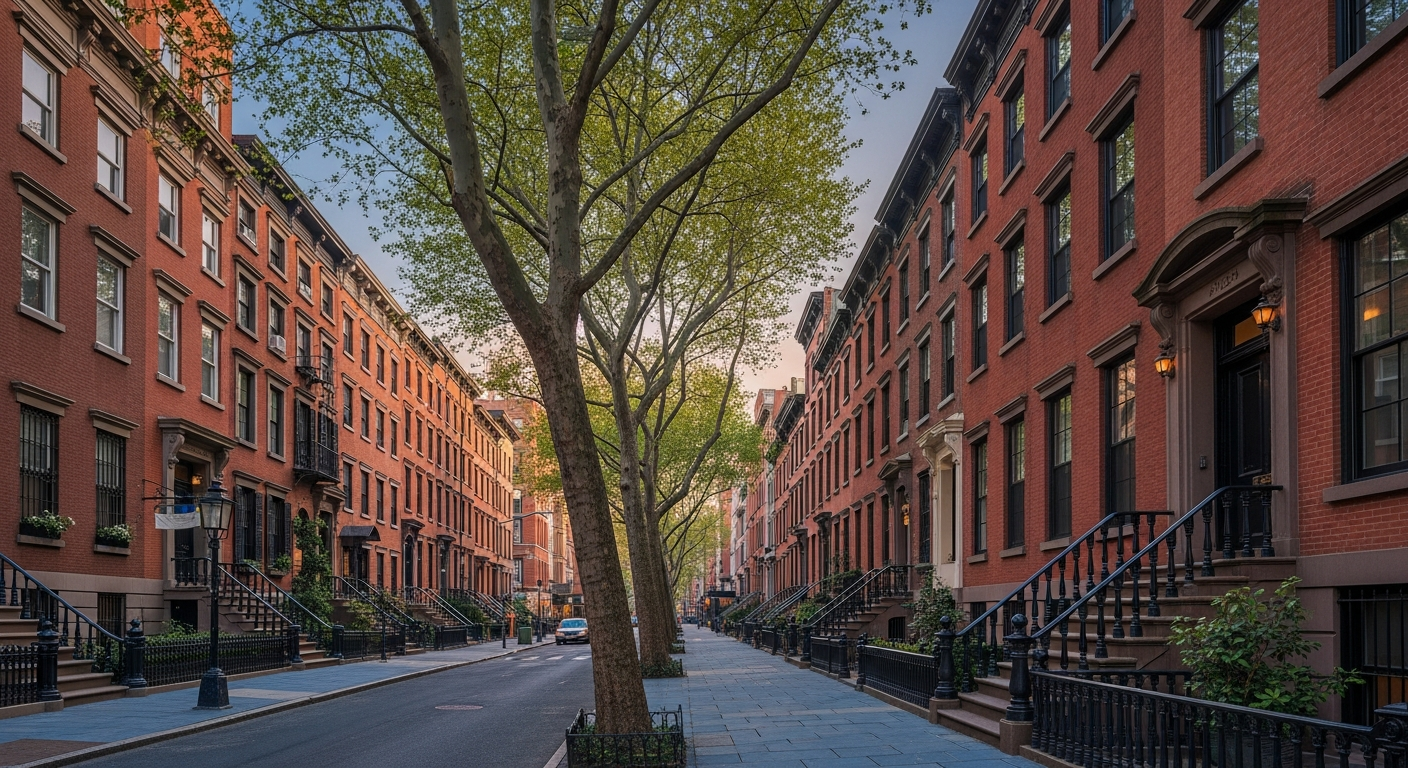
Greenwich Village is the only Manhattan neighborhood whose architectural, cultural, and residential identity was fully formed before the Civil War and has been continuously protected ever since. Its boundaries, its street grid, and its housing stock trace to the early nineteenth century. Its cultural gravity — Henry James, Edna St. Vincent Millay, Bob Dylan, the jazz clubs of the 1950s, the Beat writers, the New York School painters, and a century of NYU faculty — turned a rural crossroads into the most intellectually resonant neighborhood in the city. And in 1969 the Landmarks Preservation Commission designated the Greenwich Village Historic District, the largest historic district in New York City at the time of designation and one of the first neighborhood-scale preservation efforts in the United States. For ultra-high-net-worth buyers in 2026, the Village remains a market of structural scarcity: roughly a dozen premier blocks, a housing stock that has essentially stopped expanding, and a residential demand base — creatives, writers, academics, tech and finance principals who value discretion, European buyers — that has proven remarkably stable through every market cycle since the 1970s.
This guide is written for serious buyers. It covers the neighborhood's boundaries and internal geography; the architectural typologies that define its housing stock; the actual 2026 pricing across townhouses, co-ops, and condos; the buyer profiles that dominate each segment; the landmark constraints that shape every renovation; the school and lifestyle infrastructure that supports long-term family residency; and the comparisons with the West Village and Tribeca that buyers always — and rightly — want to make.
The Neighborhood — Boundaries, Blocks, and What Makes the Village the Village
Greenwich Village occupies the center-west portion of lower Manhattan, bounded roughly by 14th Street to the north, Houston Street to the south, Broadway to the east, and Seventh Avenue / Greenwich Avenue to the west. The western boundary is traditionally cited as Seventh Avenue, creating the dividing line between Greenwich Village (east of Seventh Avenue) and the West Village (west of Seventh Avenue) — a distinction that is sometimes blurred casually but that matters enormously for buyers, because the two neighborhoods trade at meaningfully different premiums and attract different demand profiles.
Within those boundaries, the Village organizes itself around two gravitational centers and a handful of defining streets. Washington Square Park is the symbolic and literal heart of the neighborhood — a nine-acre public square anchored by Stanford White's Washington Square Arch (completed in 1892 and dedicated in 1895, itself a landmark), surrounded on three sides by NYU's academic and residential buildings and on the north side by "The Row," one of the most important pieces of surviving Greek Revival residential architecture in the United States. Washington Square North (Numbers 1 through 13, and Numbers 19 through 26) is effectively the most architecturally significant residential block in lower Manhattan. The houses here were built between 1833 and 1837 for the merchant and professional class that defined early-nineteenth-century New York, and several remain in single-family or cooperative use.
MacDougal Street, Sullivan Street, Thompson Street, and LaGuardia Place run north-south through the neighborhood's core, carrying the Village's commercial and restaurant infrastructure — the jazz clubs, the cafés, the bookstores, the restaurants that have defined Village culture for generations. West 10th Street, West 11th Street, and West 12th Street between Fifth and Sixth Avenues contain the finest concentration of pre-Civil War townhouses in the eastern half of the Village, along with a small number of the most distinguished pre-war co-op buildings on Fifth Avenue itself. Bleecker Street runs diagonally through the neighborhood and serves as the primary east-west restaurant and retail corridor. The Mews — Washington Mews and MacDougal Alley — are two surviving gated former stable mews, now among the most exclusive residential enclaves in Manhattan.
Four qualities set the Village apart from every other Manhattan neighborhood:
- Pre-grid street pattern. The Village was a village before Manhattan's 1811 Commissioners' Plan imposed the rigid north-south, east-west grid on the rest of the island. The result is a street pattern that breaks from the grid — streets that meet at odd angles, blocks that vary in size, intersections that create small public spaces (Sheridan Square, Cornelia Street, the Jefferson Market plaza). For residents, this means a neighborhood that feels European in scale and legibility. For buyers, it means every block has individual character that has to be understood on its own terms.
- Continuously residential for two centuries. Unlike Tribeca or SoHo, which were commercial districts that residential buyers converted over the past forty years, the Village has been continuously residential since the 1820s. That continuity shows up in mature trees, established block culture, long-tenure ownership patterns, and housing stock that has been loved and renovated by consecutive generations rather than converted from warehouses.
- Historic district protection at full neighborhood scale. The Greenwich Village Historic District, designated in 1969, covers nearly all of the core neighborhood. The Greenwich Village Historic District Extension I (designated 2006) and Extension II (designated 2010) added further protection along the South Village. The effect is that the architectural fabric — facades, stoops, cornices, windows, ironwork — is preserved at a level no other Manhattan neighborhood matches.
- Cultural gravity that keeps regenerating. The Village has been the intellectual and creative center of New York for roughly 150 years, across successive generations of writers, artists, musicians, academics, and creative professionals. That cultural gravity keeps the neighborhood desirable to each new generation of buyers, and creates a demand base that does not track the broader market cycles.
Historic District — The 1969 Designation That Shaped the Modern Neighborhood
In April 1969, the New York City Landmarks Preservation Commission designated the Greenwich Village Historic District — the largest historic district in New York City at the time of its designation, covering more than 2,000 buildings across approximately 100 blocks. The designation followed a decade-long campaign by Village residents, led in significant part by Jane Jacobs and a coalition of neighborhood activists, who had already defeated Robert Moses's proposed Lower Manhattan Expressway and were determined to protect the Village's architectural fabric from post-war demolition pressure.
For buyers in 2026, the consequences of the designation are practical and permanent:
- Exterior changes require LPC approval. Any alteration to a building's visible exterior — facade work, windows, doors, stoops, cornices, rear extensions visible from the public way, rooftop additions — requires a Certificate of No Effect (for in-kind restoration, typically 4–8 weeks) or a Certificate of Appropriateness (for visible changes, typically 3–9 months, sometimes longer for significant alterations). Interior work is generally not subject to LPC review unless the interior has been individually landmarked (rare in the Village — the interiors of a small number of commercial and institutional buildings have been designated, but virtually no residential interiors).
- Demolition is effectively prohibited. A landmarked building cannot be demolished to make way for new construction. This is the single most important structural fact about the Village housing market — the inventory of townhouses, pre-war co-op buildings, and historic condo conversions is fixed. No developer is building a new block of brownstones on West 11th Street.
- Landmark-compliant renovation costs more. A gut renovation of a landmarked Village townhouse runs $600 to $1,200 per square foot for a landmark-compliant project, compared with $400 to $800 for a non-landmarked comparable. Timeline extends similarly — 24 to 36 months is typical for a full gut, with LPC approvals accounting for several additional months of pre-construction work. Buyers who intend a major renovation should budget this cost in from the first offer.
- The architectural character is permanent. For buyers who value the Village's visual identity — the red brick, the high stoops, the window shutters, the iron railings — the historic district designation is the reason that character exists today and will continue to exist indefinitely.
The South Village Historic Districts (Extensions I and II) were added in 2006 and 2010 to protect the blocks south of Washington Square that had been excluded from the 1969 designation. Buyers considering blocks along MacDougal, Sullivan, Thompson, and Bleecker south of Houston should confirm which specific district their property sits within, because the design guidelines vary modestly across the three district designations.
Architecture — The Four Building Types Buyers Actually See
The Village's housing stock divides into four broad architectural categories, each with a distinct period, character, price band, and set of ownership considerations.
Federal Row Houses (approximately 1800–1835)
The oldest surviving Village houses. Federal-period rowhouses are the small, intimate, red-brick houses with flat or slightly pitched roofs, low stoops (sometimes no stoop at all, with the parlor floor at grade), simple door surrounds often with fanlights or sidelights, and six-over-six or nine-over-six sash windows. Widths are typically 16 to 20 feet. Ceiling heights on the parlor floor are typically 8.5 to 9.5 feet, lower than later styles. Original Federal detailing — mantels, six-panel doors, hand-forged ironwork, original plaster — is rare and commands a meaningful premium when intact.
Concentrations: MacDougal Alley, Washington Mews, the oldest blocks of Bedford Street and Grove Street (technically West Village but adjacent), scattered houses on Charles Lane, Commerce Street, and the south side of Washington Square. These are the smallest, most intimate, and most architecturally resonant houses in the neighborhood.
Greek Revival Row Houses (approximately 1835–1855)
The dominant style of the Village's residential core and the architectural signature of the neighborhood. Greek Revival houses are the ones most people picture when they imagine a Village townhouse: high stoops leading to a raised parlor floor, heavy stone door surrounds flanked by pilasters supporting classical entablatures, tall parlor-floor windows, formal street presence, and widths of 20 to 25 feet. Ceiling heights on the parlor floor are 10 to 11 feet — a full two feet taller than Federal, which transforms the interior scale and creates the grand-room proportions that define "a Village parlor."
The single most important piece of Greek Revival residential architecture in the neighborhood is "The Row" on Washington Square North — the stretch of houses on the north side of Washington Square Park (Numbers 1–13 and 19–26), built 1833–1837 for New York's emerging merchant and professional class. The Row established the Greek Revival vocabulary that subsequent Village developers replicated for the next twenty years.
Concentrations: West 10th Street, West 11th Street, West 12th Street between Fifth and Sixth Avenues; East 10th Street between University Place and Broadway; select blocks of MacDougal, Sullivan, and Thompson.
Italianate Brownstones (approximately 1855–1880)
The Village has fewer full-brownstone-fronted Italianate houses than neighborhoods developed slightly later (Chelsea, the Upper West Side, Brooklyn Heights), but the style is well represented along the neighborhood's peripheral blocks. Italianate houses are recognizable by their deep bracketed cornices, round-arched or segmentally-arched windows, heavier door surrounds with carved stone brackets, higher stoops, and facades of brownstone sandstone or (less commonly) marble. Widths run 20 to 25 feet; ceiling heights match or slightly exceed Greek Revival.
The practical consideration with brownstone facades is maintenance. Brownstone is a soft sandstone that spalls and erodes over time; a full facade restoration on an Italianate brownstone is a substantial capital project ($300,000–$800,000 in 2026 pricing depending on extent), and the LPC's design guidelines require period-appropriate restoration rather than cheaper stucco-over or substitute-material repairs.
Concentrations: the eastern edge of the neighborhood along University Place, the Fifth Avenue frontage, and blocks closer to Union Square.
Pre-War Apartment Buildings and Post-War Co-ops / Condos
A meaningful share of the Village's residential market lives in apartment buildings rather than townhouses. These divide into three periods:
- Pre-war apartment buildings (1900–1940): The classic Village pre-war buildings sit predominantly along Fifth Avenue (Numbers 1 through 43 Fifth Avenue, the distinguished line of buildings from Washington Square north to 12th Street), along lower Fifth Avenue itself, and on select blocks of West 12th, West 13th, and University Place. These are the buildings that deliver the Manhattan-classic co-op experience — doorman, elevator, pre-war detail, full-floor or classic-six apartments. Pricing $2 million to $10 million for most co-ops; trophy combined units or full-floor penthouses at the top of the market trade $10 million to $25 million.
- Post-war co-ops (1945–1975): A small number of mid-century buildings, typically larger floor plates than the pre-war stock, with more functional but less architecturally distinctive apartments. Pricing $1 million to $5 million for most units.
- Post-2000 condominiums: The Village's true new-construction condo inventory is very limited because of the historic district — there is effectively no undeveloped land. The defining exception is The Greenwich Lane, Rudin Management's 200-unit development effectively completed in 2016, built on the former St. Vincent's Hospital campus at Seventh Avenue and West 11th Street. The Greenwich Lane combines five mid-rise buildings designed by FXCollaborative with Thomas Juul-Hansen interiors, a 17,000-square-foot amenity package (pool, fitness center, screening room, library), and private outdoor space for many residences. Pricing at The Greenwich Lane has ranged $3 million to $40 million-plus, with most transactions clustering $5 million to $15 million. Comparable West Village frontage at 150 Charles Street (Cook+Fox, 2016, just across Seventh Avenue and inside the West Village boundary) provides the most useful price comp for the high end of the new-construction market.
The Market in 2026 — Actual Price Bands by Segment
Village pricing in 2026 divides into three segments, each with its own buyer profile, scarcity dynamics, and comparable-set discipline.
Townhouses — $5M to $25M+
Village townhouse transactions cluster between $5 million and $25 million, with the widest and best-condition houses on the most desirable blocks reaching above $25 million and a small tail of exceptional properties (mansion-scale houses on The Row, wider houses on West 11th) trading above $30 million in rare years. The practical price bands:
- $5 million to $8 million. A narrower house (16–20 feet) in estate or good-bones condition, typically requiring a gut renovation, on a secondary block. Federal or early Greek Revival; sound foundation, intact original detail, but mechanicals and finishes 20 to 40 years behind current. Buyer expects to invest another $2 million to $4 million in renovation over the first two to three years of ownership.
- $8 million to $15 million. A 20- to 22-foot-wide Greek Revival or Italianate in good condition on a recognized block (West 10th, West 11th, West 12th), with functional kitchen and bathrooms, updated mechanicals, a useable rear garden, and a move-in-now-renovate-later viability. Most Village townhouse transactions sit in this band.
- $15 million to $25 million+. A 22- to 25-foot-wide house in mint-renovated condition on a trophy block, with restored facade, modern infrastructure concealed behind period detail, professional-grade kitchen, designed garden, and often a rare feature (double-width construction, corner lot, exceptional provenance). Transactions in this band are structurally rare — often fewer than ten such houses trade in a given year.
Volume at the top of the market is low. In a typical year, fewer than 30 Village townhouses trade above $8 million, and fewer than 10 trade above $15 million. Ownership tenure is long — 15 to 25 years is typical, and some families have held Village townhouses across multiple generations. The best houses rarely reach the public market.
Co-ops — $1M to $10M+
Village co-op inventory is deeper and more liquid than the townhouse market. Pricing:
- $1 million to $2.5 million buys a one-bedroom or small two-bedroom (700–1,100 sf) in a well-maintained pre-war or post-war building. This is the entry point for serious Village ownership.
- $2.5 million to $5 million opens up larger two-bedrooms, classic-five and classic-six apartments, and well-located units in the best pre-war buildings on Fifth Avenue and Lower Fifth.
- $5 million to $10 million delivers full-floor or large-portion pre-war apartments, penthouse units with terraces, and combined apartments in the trophy Fifth Avenue buildings. At this price point buyers are competing for scarcity — the supply of great Fifth Avenue apartments is fixed, and the best ones trade infrequently.
- $10 million and above is the trophy co-op tier: full-floor or duplex penthouses in the defining Fifth Avenue and Lower Fifth buildings, often with park views of Washington Square. Transactions are rare.
Condos — The Greenwich Lane and Comparable Inventory
True condominium inventory in the Village is limited to a handful of buildings, with The Greenwich Lane (140 West 12th Street and adjacent buildings) as the defining flagship. Pricing at The Greenwich Lane has tracked from roughly $3 million for two-bedrooms to $40 million-plus for the largest penthouses, with the median transaction clustering in the $5 million to $15 million range. The comparable buildings just across the West Village line — particularly 150 Charles Street ($3M to $40M+) and 165 Charles Street (Richard Meier, slightly older glass-facade construction) — provide the most useful price comps for buyers considering a modern condo in or adjacent to the Village.
The condo market suits buyers who prioritize ownership flexibility (no board approval beyond a right of first refusal, easier subletting, simpler financing), modern building systems, and a full amenity package. The trade-off is that condo pricing does not benefit from the pre-war architectural character that makes a Fifth Avenue co-op or a Washington Square townhouse unreplicable.
| Ownership Type | Price Range | Typical Size | Governance | Best For |
|---|---|---|---|---|
| Townhouse | $5M–$25M+ | 2,400–5,500 sf | None (you are the board) | Privacy, families, renovation, legacy |
| Co-op | $1M–$10M+ | 700–3,200 sf | Board approval + sublet rules | Pre-war character, doorman, Fifth Avenue access |
| Condo | $3M–$40M+ (Greenwich Lane) | 900–4,500 sf | Minimal (right of first refusal) | Amenity, flexibility, modern mechanicals |
Pricing reflects Q1–Q2 2026 Greenwich Village transaction data; individual properties vary by block, building, condition, and floor.
Who Buys in Greenwich Village
The Village's buyer base has been remarkably stable across cycles, which is a meaningful contributor to its long-term price durability. Five buyer profiles dominate:
Creative-industry principals. Writers, editors, gallery owners, designers, musicians, and film principals buy in the Village because its cultural identity matches theirs. The Village is the closest thing Manhattan has to a neighborhood whose residents define themselves partly by the neighborhood. Creative-industry buyers are often repeat buyers within the Village — they move between townhouses, between pre-war apartments, or between Village addresses and secondary homes in the Hudson Valley or the Hamptons.
Academic and institutional professionals. NYU faculty (the university's presence anchors the neighborhood's south and east), faculty at The New School (slightly north in the Flatiron/Union Square area), senior professionals in publishing, and principals in the city's cultural institutions form a deep, quiet, long-tenure demand segment. This group tends to buy co-ops rather than townhouses, tends to hold for decades, and is one reason the Village's co-op inventory turns over slowly.
Tech and finance principals seeking discretion. The Village delivers two things that matter to discreet UHNW buyers from the tech and finance sectors: a residential neighborhood that does not broadcast wealth the way the Upper East Side does, and a cultural identity that is aspirational to a buyer whose professional life is elsewhere. Buyers in this profile tend to prefer new-construction or new-conversion condos (The Greenwich Lane, 150 Charles) that deliver contemporary mechanicals and amenities, or heavily renovated townhouses that have been brought to modern standards.
European buyers. The Village's architectural scale, pre-grid street pattern, and pedestrian culture translate naturally to European buyers — particularly from London, Paris, and Zurich. European buyers tend to use the Village as a Manhattan pied-à-terre or secondary residence, and favor the pre-war co-op stock or the new-construction condo market over the operational commitment of a townhouse.
Multi-generational Village families. The most quietly significant buyer profile is the family that has been in the Village for two or three generations and that buys an additional Village property as children establish households of their own. This group drives a meaningful share of the off-market transaction flow — a parent selling a townhouse privately to an adult child's family, or an estate transferring a long-held property within the family network.
Schools — PS 41, PS 3, and the Family Decision
School quality is one of the two or three most important structural supports for the Village's long-term residential demand.
PS 41 (the Greenwich Village School), located at 116 West 11th Street, is the zoned public elementary school for most of the Village east of Sixth Avenue. It consistently ranks among Manhattan's strongest public elementary schools — active parent community, strong academic performance, a well-established Gifted and Talented program presence in the neighborhood, and the kind of long-tenure teaching staff that defines top-tier urban public schools. PS 41's zone includes most of the blocks east of Sixth Avenue between Houston and 14th, and the school is a primary driver of buyer preference among family-stage Village purchasers.
PS 3 (the Charrette School), located at 490 Hudson Street, is the zoned elementary for most blocks west of Sixth Avenue, extending into the West Village. Like PS 41, PS 3 is consistently among Manhattan's most sought-after public elementaries, with a particularly strong arts and progressive-education orientation. Buyers considering blocks in the western portion of Greenwich Village (or on the Village/West Village boundary) should confirm the precise zoning, which the NYC Department of Education adjusts periodically.
For families committed to private school, the Village offers walkable access to a strong set of options: Grace Church School (East 10th Street), Friends Seminary (slightly north at Stuyvesant Square), Village Community School (West 10th Street, in the westward portion), St. Luke's School (Hudson Street), and — within a short taxi or subway ride — the Manhattan private schools of Gramercy, Chelsea, and the Upper East Side. For high school, Stuyvesant High School (one of the city's elite specialized public high schools) is accessible downtown in Battery Park City.
Dining, Culture, and the Daily Rhythm
The Village's restaurant and cultural infrastructure is the texture that residents actually live with day-to-day, and is a primary reason the neighborhood commands its premium.
Dining. The Village is one of the few Manhattan neighborhoods where a serious dining scene is organized around walk-from-home convenience rather than destination travel. Babbo (Waverly Place) — the Greenwich Village Italian institution, which reopened in late 2025 under Stephen Starr's restaurant group — remains among the most booked reservations in the neighborhood. Carbone (Thompson Street) — Major Food Group's mid-century-Italian homage — is the other reservation that defines the neighborhood. Minetta Tavern (MacDougal Street) — Keith McNally's Parisian-style bistro, celebrated for its Black Label burger and its dining-room scene — has been a Village fixture since its 2009 reopening. Il Buco (Bond Street, just over the NoHo line but functionally part of the Village dining radius) and its sister Il Buco Alimentari anchor the rustic-Italian category. Via Carota (just west in the West Village) and L'Artusi (West 10th Street, in the crossover zone between Village and West Village) round out the Italian quadrant. Raoul's (Prince Street in SoHo, easily walkable) and The Odeon (Tribeca) provide the French-bistro frame around the neighborhood's core dining set.
Cultural anchors. The Village's cultural infrastructure is dense and walkable. The IFC Center (Sixth Avenue at West 3rd) is Manhattan's flagship art-house cinema, with seven screens of repertory and first-run independent film programming. Film Forum (Houston Street, adjacent to the South Village) is the city's defining repertory theater. The Village Vanguard (Seventh Avenue at West 11th) has been the most important jazz club in New York since 1935 and is one of the longest-continuously-operating jazz venues in the world. (Le) Poisson Rouge (Bleecker Street), the Comedy Cellar (MacDougal Street), and Cafe Wha? (MacDougal Street) are successor institutions to the Village's 1960s folk and comedy scene. The Whitney Museum of American Art (Gansevoort Street, just west of the Village) and The New Museum (Bowery, just east) frame the Village with major contemporary art institutions.
Washington Square Park. The park is the neighborhood's living room — the place where residents bring children, meet friends, walk dogs, and experience the street-musician and performance culture that has made the park a specific New York institution. For residents with Washington Square–facing addresses (The Row, 2 Fifth Avenue, 1 Fifth Avenue, 1 University Place), the park is effectively a private front lawn shared with the rest of the city.
Greenwich Village vs. West Village vs. Tribeca — How Buyers Actually Compare
Serious Village buyers almost always also look at the West Village and Tribeca. The three neighborhoods sit within a half-mile of one another, share overlapping architectural DNA, and compete for the same UHNW downtown demand. They differ, however, in ways that matter for the decision.
| Factor | Greenwich Village | West Village | Tribeca |
|---|---|---|---|
| Townhouse range | $5M–$25M+ | $8M–$30M | $12M–$35M |
| Co-op range | $1M–$10M | $4M–$12M | $3M–$10M |
| Condo range | $3M–$40M+ (Greenwich Lane) | $3M–$40M+ (150 Charles) | $3M–$65M (56 Leonard, 70 Vestry) |
| Dominant architecture | Federal / Greek Revival / Italianate / Pre-war co-ops | Federal / Greek Revival | Cast-iron lofts + new construction |
| Historic district | Greenwich Village HD (1969) + Extensions I & II | Greenwich Village HD (Western portion) | Tribeca HD + Tribeca North/South |
| Street grid | Pre-1811 irregular | Pre-1811 irregular | Manhattan grid |
| Primary park | Washington Square Park | Hudson River Park | Hudson River Park + Washington Market |
| Dominant buyer profile | Creatives, academics, families, tech/finance seeking discretion | Creative-industry, UHNW families, long-tenure New Yorkers | Finance, tech, downtown families, international |
| Cultural identity | Literary / academic / bohemian heritage | Village-residential / discreet | Contemporary / design-forward |
| Off-market share (>$10M) | 35–50% | 40–55% | 30–45% |
| Primary schools | PS 41 / PS 3 | PS 3 / PS 41 | PS 234 |
The practical summary:
- Choose Greenwich Village if you want the deepest intellectual and cultural heritage of any Manhattan neighborhood, Washington Square as your daily park, PS 41 or PS 3 for your children, and a price band that's marginally more accessible than the West Village across most segments.
- Choose the West Village if you want the single most architecturally consistent set of blocks in Manhattan (Perry, Charles, Bank), Hudson River Park as your daily amenity, and a more concentrated UHNW residential identity.
- Choose Tribeca if you want converted cast-iron lofts, new-construction flagship buildings (56 Leonard, 70 Vestry), proximity to Stuyvesant High School, and a more contemporary-design-forward buyer community.
The three neighborhoods also differ on the townhouse question, which is often where UHNW buyers ultimately concentrate. Our Manhattan Townhouse 2026 pillar covers townhouse widths, condition tiers, landmark constraints, and operating costs across all three neighborhoods and the rest of Manhattan's townhouse inventory.
Landmark Constraints — What Renovation Actually Looks Like
Because virtually every Village building is within the historic district, every renovation of any consequence involves the Landmarks Preservation Commission. Buyers should internalize three operational realities.
Timeline. An LPC Certificate of No Effect (CNE) is the simpler pathway and typically takes 4 to 8 weeks to process. It applies to in-kind work — restoration of a facade with period-matching materials, replacement of windows with historically appropriate replicas, repair of ironwork — that does not change the appearance visible from the public way. A Certificate of Appropriateness (COA) is the harder pathway and applies to any visible change (a rear extension visible from a neighboring block, a rooftop addition, a new stoop railing of different design, a change in window configuration). COA timelines run 3 to 9 months, sometimes longer for a complex project that requires multiple hearings before the LPC's commissioners. Buyers who intend a significant exterior renovation should plan on 12 to 18 months of pre-construction (design, LPC, DOB permitting) before ground-breaking on a substantive exterior project.
Cost. Landmark-compliant work runs roughly 30 to 50 percent more than non-landmarked comparable construction. A full gut renovation of a Village townhouse, including landmark-compliant facade restoration, modern mechanical systems, kitchen and baths, and interior restoration of original detail, is a $600 to $1,200 per-square-foot project — meaning a 4,000-square-foot townhouse gut is a $2.4M to $4.8M budget line. Buyers should build this into the initial offer.
Design philosophy. The LPC's design guidelines favor period-appropriate restoration and discourage contemporary interventions that compete with the original architectural character. Rear extensions, rooftop additions, and major facade alterations are reviewed for historical appropriateness, not just aesthetic quality. Buyers who want contemporary open-plan interior layouts can generally achieve them (interior work is not LPC-reviewed in most residential buildings) but should plan their program around a facade and exterior envelope that will remain historically consistent.
The practical upshot is that the Village is a good neighborhood for buyers who want to acquire, live in, and lightly update a historically significant building — and a challenging neighborhood for buyers who want a large-scale contemporary architectural reinvention of an existing property. Buyers in the second category frequently end up in Tribeca, where the cast-iron loft inventory allows interior reinvention at a scale that landmarked townhouses do not.
Investment Outlook — Structural Scarcity and the Long Hold
The Village's price durability across cycles is a function of three structural realities that are unlikely to change:
Supply is fixed and shrinking. The historic district caps total inventory at roughly its 1969 level. The slow ongoing loss of townhouses to non-residential uses (institutional ownership, embassies, small commercial conversions that occasionally reverse) nets out to gradual shrinkage of the single-family townhouse pool, and the fixed co-op inventory does not expand. Every demand shock lands on a fixed supply.
Demand is structurally deep and diverse. The Village's buyer base — creatives, academics, families, tech/finance discreet, European secondary-residence — does not depend on any single industry or economic cycle. The 2008 financial crisis hit Manhattan luxury hard; the Village recovered faster than the Upper East Side and far faster than the uptown new-construction condo market. The 2020 COVID shock emptied much of Manhattan; the Village returned first and retained more of its pandemic-era pricing gains than most neighborhoods.
Ownership tenure is long. Average Village townhouse tenure is 15 to 25 years, and in some Fifth Avenue co-ops the average tenure exceeds 30 years. Long tenure means low turnover, which means low inventory elasticity, which means that prices do not collapse in a downturn — there is simply no forced seller overhang. For buyers whose holding period is ten-plus years, the Village has historically delivered some of the most consistent risk-adjusted appreciation of any Manhattan neighborhood, and there is no structural reason that pattern should change.
The rational buyer in 2026 is not timing the Village. The Village is a long-hold, inventory-constrained, demand-diverse neighborhood. The strategic question is not whether to buy but which specific block, building, and unit deliver the right combination of architectural quality, floor plate, light, condition, and price.
Broker Insight — Supply Constraints and the Off-Market Reality
Two quiet facts shape the practical experience of buying in the Village at the UHNW level.
First, roughly 35 to 50 percent of Village townhouse transactions above $8 million happen off-market. The reasons are the same as in the West Village and Tribeca — sellers value discretion, estates prefer private dispositions, long-tenure families transact within relationship networks rather than through public listings — but the Village has an additional layer: the academic and institutional buyer profile tends to transact with particular discretion, and the neighborhood's relatively small UHNW townhouse universe (fewer than 500 single-family townhouses in the core neighborhood) means that many transactions never need public marketing to find their buyer.
Second, the best co-op inventory is disclosed to a short list before it reaches StreetEasy. The best Fifth Avenue and Lower Fifth co-op apartments — a full-floor at 2 Fifth Avenue, a trophy unit at 1 Fifth Avenue, a combined apartment at 24 Fifth — are frequently marketed to a curated set of prospective buyers before any public listing. Boards appreciate quiet transactions; sellers appreciate avoiding the inevitable co-op-board-application stress of a public bidding war; brokers with multi-decade neighborhood relationships often close these transactions before the listing ever appears online.
The operational implication for a serious buyer is straightforward. Working the Village exclusively from StreetEasy, Compass.com, or any public portal means seeing roughly half of the actually-available inventory at the high end. Access to the other half requires a broker with a long tenure in the neighborhood, an established relationship base among long-holding owners, and the discretion to be trusted with off-market conversations on both sides of a transaction.
How Caryl Works With Greenwich Village Buyers
Caryl Berenato has represented buyers and sellers in Greenwich Village for the entirety of her 40-year Manhattan career. Her Village practice spans the neighborhood's full inventory architecture — pre-Civil War townhouses on West 10th, West 11th, and West 12th; Fifth Avenue pre-war co-ops; The Greenwich Lane and comparable new-construction condominiums; estate sales and multi-generational family transitions. The practice is relationship-driven by design.
For UHNW buyers entering the Village market, Caryl's process typically begins with a neighborhood walk calibrated to the buyer's priorities across ownership type, block character, architectural period, width and condition (for townhouses), building culture (for co-ops), and renovation appetite. From there, the introduction to off-market and pre-market inventory follows — the quiet houses and apartments that don't reach the public portals are unlocked through four decades of continuous presence in the neighborhood and the relationship base that comes with it. Negotiation, due diligence (including cellar and mechanical engineering for townhouses, board-culture assessment for co-ops, capital-reserve and assessment history review for condos), landmark counsel coordination, and (for co-ops) board-package preparation are managed end-to-end.
Caryl is a member of REALM Global — the invitation-only luxury real estate network — and holds the Certified Senior Advisor (CSA) designation, which matters particularly for buyers engaged in multi-generational or estate-level decisions. Review Caryl's notable sales, explore the Greenwich Village neighborhood page, or schedule a private consultation.
Frequently Asked Questions
What are Greenwich Village's boundaries?
Greenwich Village is bounded roughly by 14th Street to the north, Houston Street to the south, Broadway to the east, and Seventh Avenue / Greenwich Avenue to the west. The West Village sits just across Seventh Avenue to the west and is a separately identified neighborhood, though casually the two are sometimes conflated.
When was the Greenwich Village Historic District designated?
The Greenwich Village Historic District was designated by the New York City Landmarks Preservation Commission in April 1969 — it was the largest historic district in the city at the time. The Greenwich Village Historic District Extension I (2006) and Extension II (2010) added further protection in the South Village.
What do townhouses actually cost in Greenwich Village in 2026?
Village townhouses cluster between $5 million and $25 million, with the range set by width, block quality, condition, and architectural period. $5M–$8M buys a narrower estate-condition house; $8M–$15M buys a 20- to 22-foot Greek Revival in good condition on a recognized block; $15M–$25M+ buys a mint-renovated trophy house on West 11th, West 10th, or Washington Square.
What do co-ops cost in Greenwich Village?
Village co-ops run $1M–$10M+. Entry-level one- and two-bedrooms trade $1M–$2.5M; classic-five and classic-six apartments $2.5M–$5M; full-floor and penthouse units in the best Fifth Avenue buildings $5M–$10M+; trophy penthouses can exceed $15M.
What condos are available in Greenwich Village?
The flagship new-construction condominium is The Greenwich Lane (completed 2016), a Rudin Management 200-unit development on the former St. Vincent's Hospital campus. Pricing has ranged $3M to $40M+. The comparable West Village frontage at 150 Charles Street is the closest high-end comp for buyers considering a modern condo in or near the Village.
What public schools serve Greenwich Village?
PS 41 (the Greenwich Village School, 116 West 11th Street) is the zoned elementary for most Village blocks east of Sixth Avenue. PS 3 (the Charrette School, 490 Hudson Street) serves most blocks west of Sixth Avenue and extending into the West Village. Both consistently rank among Manhattan's strongest public elementaries.
Can I renovate a Greenwich Village townhouse?
Yes — with LPC approval for any exterior work. Interior work is generally not LPC-reviewed in residential buildings. Exterior changes require a Certificate of No Effect (4–8 weeks for in-kind restoration) or a Certificate of Appropriateness (3–9 months for visible changes). Landmark-compliant gut renovation runs $600–$1,200 per square foot.
How much of the Greenwich Village market is off-market?
An estimated 35 to 50 percent of Village townhouse transactions above $8 million happen off-market. A meaningful share of the best Fifth Avenue and Lower Fifth co-op inventory is also marketed to a curated list before any public listing. Access to this inventory requires a broker with long neighborhood tenure.
Who buys in Greenwich Village?
Five dominant profiles: creative-industry principals (writers, editors, gallery owners, designers, musicians); academic and institutional professionals (NYU, The New School, publishing, cultural institutions); tech and finance principals seeking discretion; European pied-à-terre and secondary-residence buyers; and multi-generational Village families.
How does Greenwich Village compare to the West Village?
Greenwich Village and the West Village share architectural DNA (Federal, Greek Revival), historic district protection, and the pre-1811 irregular street grid. The West Village commands a 10 to 20 percent premium on comparable townhouses and has a more concentrated UHNW-residential identity and stronger Hudson River Park orientation. The Village has a deeper intellectual and academic heritage, Washington Square as its central park, and marginally more accessible pricing across most segments.
Sources & Further Reading
- NYC Landmarks Preservation Commission designation reports for the Greenwich Village Historic District (1969) and Extensions I and II (2006, 2010).
- NYC Department of Finance and NYC Department of City Planning parcel and zoning data.
- Pricing benchmarks drawn from Q1–Q2 2026 Greenwich Village transaction data (Miller Samuel, Compass, StreetEasy).
- Rudin Management public disclosures and brokerage reporting on The Greenwich Lane (140 West 12th Street).
- NYC Department of Education school zoning for PS 41 and PS 3.
- Off-market transaction estimates reflect combined brokerage data for the $8M+ Village townhouse segment and the trophy co-op segment above $5M.
- Related pillars: West Village Townhouses & Co-ops, Tribeca Real Estate, Buying a Manhattan Townhouse in 2026.