
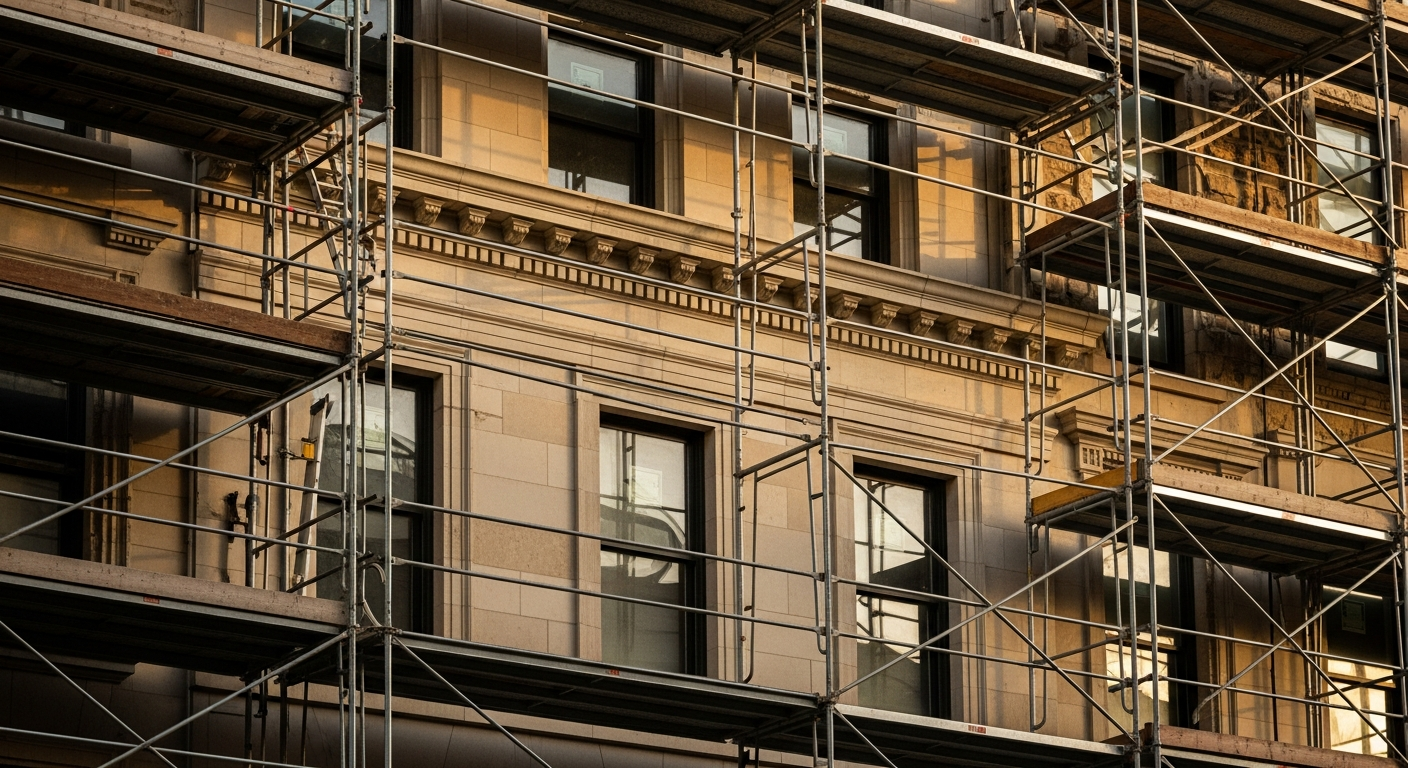
A landmark-compliant restoration of a Manhattan townhouse in 2026 runs $500 to $1,500 per square foot depending on scope, condition, and the historic district that governs the building, with 18 to 36 months from contract to certificate of occupancy as the realistic timeline for any serious project. Roughly 60 percent of the city's single-family townhouses sit within a historic district administered by the New York City Landmarks Preservation Commission (LPC), which means exterior work — facade, windows, stoop, cornice, rear extensions visible from the public way, rooftop additions — requires either a Certificate of No Effect (in-kind, 4 to 8 weeks) or a Certificate of Appropriateness (visible alterations, 3 to 9 months and sometimes considerably longer). For ultra-high-net-worth buyers acquiring a townhouse with the intention of restoring it, the landmark, design, permitting, and construction sequence is the single largest variable in the total cost and timeline of ownership, and the one most often underestimated in the offer.
This guide covers what the LPC actually reviews, how the process works, what budgets look like across the realistic scope tiers, the timeline you should expect from offer through occupancy, and the pitfalls that have ended more Manhattan townhouse restorations than money ever has.
What Counts as Landmarked — And Why It Matters
Manhattan has roughly 3,000 to 4,000 surviving single-family townhouses across the West Village, Greenwich Village, Upper East Side, Chelsea, the Upper West Side, Harlem, Brooklyn Heights, and smaller pockets in Tribeca and elsewhere. The majority of the most desirable inventory — virtually all of "The Row" on Washington Square North, the Greek Revival blocks of West 10th and West 11th, the Italianate brownstones of Chelsea's Cushman Row, the Beaux-Arts mansions of Carnegie Hill — sits inside an LPC-designated historic district. A meaningful subset of the most distinguished individual buildings carry separate individual-landmark designation, which is a stricter regime still.
Three categories of LPC oversight apply, and buyers need to understand which category their building falls into before the offer is finalized:
Historic district properties. The building sits inside a designated historic district (Greenwich Village HD 1969, SoHo–Cast Iron HD 1973, Upper East Side HD 1981, and more than 150 others) but is not separately landmarked as an individual building. The exterior is reviewed by the LPC against the district's design guidelines. The interior is generally not reviewed, with rare exceptions for interior-landmarked spaces (almost always commercial or institutional, not residential).
Individually landmarked properties. The building has been designated as an individual landmark — typically because of its architectural or historical significance — and is subject to LPC review of the full exterior envelope plus, in some cases, designated interior spaces. The Merchant's House Museum, the houses of "The Row" (individually as well as districtwise), the more distinguished pre-war townhouses with architect provenance — the standard is stricter and the design review is more granular.
Properties outside any landmark designation. A minority of Manhattan townhouses — concentrated in Harlem, parts of the Upper West Side outside the Carnegie Hill and Riverside-West End historic districts, and a few smaller pockets in Murray Hill and Yorkville — sit outside any landmark regime. These can be restored or modified without LPC involvement. The Department of Buildings (DOB) permitting process still applies, and zoning still governs floor area and bulk, but the landmark layer is absent. This freedom is part of why Harlem and certain Upper West Side blocks have attracted buyers willing to undertake a substantive contemporary architectural intervention.
The first question on any Manhattan townhouse offer should be: which of these three categories does the property fall into? The answer changes the budget by 30 to 50 percent and the timeline by six to twelve months.
The LPC Process — Certificate of No Effect vs. Certificate of Appropriateness
The two pathways the LPC offers a property owner are operationally and procedurally different, and confusing them is the single most common source of timeline error in Manhattan townhouse projects.
Certificate of No Effect (CNE)
A CNE applies to in-kind work — restoration or repair that does not change the appearance of the building visible from the public way. Repairing a wood window with period-appropriate replacement wood windows of matching profile and pane configuration. Restoring a brownstone facade with period-appropriate brownstone repair compound. Replicating a damaged cornice in matching material and profile. Repointing brick with historically appropriate lime mortar. Restoring iron railings to their original design.
CNE applications are reviewed at staff level — the LPC's preservation staff makes the determination — and do not require a public hearing. The standard timeline is 4 to 8 weeks from filing to issuance, sometimes faster for simple work where the documentation is complete and unambiguous. A CNE is the pathway every restoration project hopes to qualify for, because it preserves the historic fabric, avoids the public-hearing process, and compresses the pre-construction timeline meaningfully.
The discipline a CNE imposes is that the work must be genuinely in-kind. Architects and contractors who try to slip a non-conforming detail through a CNE filing — substitute materials, modernized profiles, contemporary alterations cloaked as restoration — get caught, the CNE is rescinded, and the project has to be refiled as a Certificate of Appropriateness with months of delay. The LPC's preservation staff have seen every gambit, and the agency's institutional memory is long.
Certificate of Appropriateness (COA)
A COA applies to visible changes — alterations that change the appearance of the building from the public way. New rear extensions visible from a neighboring street. Rooftop additions visible from the public way. New stoop railings of different design from the original. Window configurations that depart from the historic configuration. Storefront changes (on the rare Manhattan townhouse block where storefronts apply). Facade material changes. Mechanical equipment that becomes visible. Major signage. Rear-yard structures (garden pavilions, pool houses) where visible.
A COA is the harder pathway. Applications are reviewed by the LPC's commissioners at a public hearing, with notice to the community board, the local preservation organization, and (often) the historic district neighborhood association. The application package includes architectural drawings, historic precedent research, material specifications, photographic comparisons, and a written narrative explaining why the proposed alteration is appropriate to the building and the district. A typical COA file runs 150 to 400 pages.
Standard COA timeline is 3 to 9 months from filing to commission vote, depending on the complexity of the application, the volume of public testimony, and whether the commissioners require revisions before approval. Significant rear extensions or rooftop additions frequently require two or three commission hearings before approval, which can extend the timeline to 9 to 18 months. The buyer who hopes to break ground six months after closing on a townhouse that needs a substantive COA is, in almost every case, miscalculating.
The LPC's commissioners do approve major work. They are not a preservation absolutist body. But they apply the historic district's design guidelines with discipline, and they hold contemporary interventions to a standard of compatibility, reversibility, and respect for the original fabric that buyers and architects unfamiliar with the agency consistently underestimate.
What the LPC Does Not Review
The LPC's jurisdiction in residential buildings is generally limited to the exterior. Interior work in most landmarked Manhattan townhouses — kitchen and bath gut, mechanical system replacement, structural reconfiguration of interior partitions, finish work, lighting, millwork — is not LPC-reviewed. It is reviewed by the Department of Buildings under the New York City Construction Codes, by the relevant trade inspectors (plumbing, electrical, mechanical), and (for landmark properties only) by the LPC's separate review of any exterior penetrations associated with interior work (a new chimney, an external HVAC unit, a rooftop equipment install).
This jurisdictional line matters enormously. Buyers who want a fully reimagined contemporary interior behind a restored historic facade — the most common UHNW townhouse program in 2026 — can almost always achieve it. What they cannot do is contemporary alterations to the facade, the stoop, the windows visible from the street, the cornice, or the rear elevation where visible.
Budgets by Scope — What Restoration Actually Costs in 2026
Manhattan townhouse restoration budgets vary by a factor of three or more depending on the scope, the landmark constraints, and the condition of the starting building. The realistic 2026 cost bands are below.
Tier 1: Cosmetic Refresh — $200 to $400 per sqft
A cosmetic refresh covers paint, finish-level kitchen and bath updates (cabinetry, counters, fixtures without changing footprint), refinished or replaced flooring within the existing layout, lighting and electrical refresh without rewiring the entire house, and HVAC service or partial replacement. No structural work. No facade work. No mechanical replacement at the system level. A 4,000-square-foot townhouse cosmetic refresh runs $800,000 to $1.6 million and 6 to 9 months to complete.
This is the entry-level scope, appropriate for a townhouse that has been well maintained and recently updated, where the buyer wants to customize aesthetics without rebuilding the house. It is comparatively rare in the UHNW townhouse market because most townhouse buyers at this tier are acquiring properties that need more than cosmetic work.
Tier 2: Substantial Renovation — $500 to $800 per sqft
A substantial renovation reconfigures the interior layout, replaces the kitchens and bathrooms at the footprint level (new locations, new plumbing runs), upgrades the mechanical systems comprehensively (central air, new boiler, modern electrical service, new plumbing risers), refinishes interior detail (millwork, ceilings, restoration of original moldings), and addresses any urgent facade or roof repairs without a full facade restoration. A 4,000-square-foot townhouse substantial renovation runs $2 million to $3.2 million and 14 to 22 months to complete.
This is the most common UHNW renovation scope. The building is brought up to modern standards of comfort and finish; the layout is adapted to the family's living needs; the mechanical systems are replaced; original detail is restored where present and replicated where damaged. Facade work, if any, is limited to specific repair items (cornice repair, brownstone patching at the most damaged sections, window restoration) rather than full facade restoration.
Tier 3: Full Gut Renovation with Facade Restoration — $800 to $1,200 per sqft
A full gut renovation strips the house to its structural shell, often retaining only the facade, the floor framing (and sometimes not even that — partial floor replacement in load-bearing reconfigurations is common), the staircase frame, and any individually significant original elements being preserved. Everything else is rebuilt: new mechanical, electrical, plumbing, and sprinkler systems; new insulation and weather barrier; new interior partitions, finishes, kitchens, bathrooms; new structural reinforcement where required for modern loads (rooftop terraces, mechanical equipment, expanded bathroom footprints); and full facade restoration including masonry, stonework, cornice, windows, ironwork, stoop, and entry surround. A 4,000-square-foot townhouse full gut with facade restoration runs $3.2 million to $4.8 million and 22 to 32 months to complete.
This is the scope that has produced the most distinguished Manhattan townhouse restorations of the past decade. It is also the scope where landmark constraints, budget overruns, and timeline extensions concentrate.
Tier 4: Full Gut with Rear Extension or Rooftop Addition — $1,000 to $1,500+ per sqft
The most ambitious scope adds new construction to the existing envelope: a rear extension into the back yard (with COA approval for visible portions), a rooftop addition adding one or more floors (with COA approval where visible from the public way), or both. This scope requires architect-led design, structural engineering, a full COA process at the LPC, and DOB filings that include Zoning Resolution analysis for floor area, height, and yard compliance. A 4,000-square-foot townhouse expanding to 5,200 or 6,000 square feet with COA-approved additions and full facade restoration runs $1,000 to $1,500+ per square foot of total finished area, with the total project budget commonly $5 million to $9 million for the construction alone (excluding architecture, engineering, LPC filing, and DOB filing fees, which add another 8 to 15 percent). Timeline is 30 to 42 months from offer to certificate of occupancy.
This is the scope of the most ambitious UHNW townhouse projects in the West Village, Carnegie Hill, and the Upper East Side. The reward, when executed well, is a fully reconfigured home that incorporates the historic facade and street presence with a substantially expanded and modernized interior program. The risk is that every additional layer of complexity — landmark, zoning, structural, neighbor — extends the timeline and inflates the budget.
| Scope Tier | Cost/sqft (2026) | 4,000 sqft Total | Timeline |
|---|---|---|---|
| Tier 1 — Cosmetic refresh | $200–$400 | $800K–$1.6M | 6–9 months |
| Tier 2 — Substantial renovation | $500–$800 | $2M–$3.2M | 14–22 months |
| Tier 3 — Full gut + facade | $800–$1,200 | $3.2M–$4.8M | 22–32 months |
| Tier 4 — Gut + extension/rooftop | $1,000–$1,500+ | $5M–$9M+ | 30–42 months |
Figures reflect 2026 Manhattan landmarked-townhouse project pricing across surveyed general contractors in the segment.
Timeline — What 24 to 36 Months Actually Looks Like
A representative timeline for a Tier 3 full gut with facade restoration on a landmarked Manhattan townhouse:
Months 0–2: Closing and team assembly. Townhouse closes. Architect, structural engineer, mechanical/electrical/plumbing (MEP) engineer, landmark consultant, and general contractor are engaged. Existing conditions survey is commissioned (laser scan of facade, interior measured drawings, structural assessment, lead and asbestos testing).
Months 2–8: Design development and LPC pre-application. Schematic design through design development. Preservation consultant prepares historic precedent research. LPC pre-application meeting (informal, staff-level) tests the design against agency expectations. Design is revised in response. CNE filings for in-kind facade work begin in parallel.
Months 8–14: LPC and DOB filings. Final LPC submission (CNE for in-kind components, COA where required for visible alterations). COA hearings, often two or three rounds with revisions. DOB filings for permits — Alteration Type 1 (most full guts), with separate filings for plumbing, electrical, mechanical, sprinkler, and structural. Asbestos and lead abatement plans filed and approved.
Months 14–22: Construction Phase 1 — demolition, structural, mechanical rough-in. Interior demolition. Structural reinforcement and reconfiguration. New mechanical, electrical, plumbing, sprinkler rough-in. Facade restoration concurrent (scaffolding goes up, masonry and stonework restoration, window restoration or replacement, cornice work, ironwork).
Months 22–30: Construction Phase 2 — finishes, millwork, kitchens, baths. Drywall and plaster. Millwork installation. Flooring. Kitchen and bath installation. Stair restoration. Painting. Lighting. Final mechanical commissioning.
Months 30–34: Punch list, inspections, certificate of occupancy. DOB inspections. LPC final approval that completed work matches approved scope. Punch list and final corrections. Certificate of occupancy issued.
Compress this timeline at peril. Buyers who push their teams to deliver on aggressive schedules consistently produce one of three outcomes: rushed work that creates problems within five years, contractor overruns and change orders that exceed the savings of compression, or LPC enforcement actions that pause work for months. The Manhattan townhouse construction ecosystem operates on multi-year horizons for reason.
Operating Cost During Restoration — The Quiet Number
A line item that buyers consistently underestimate is the cost of carrying the property during the restoration period. A $15 million townhouse purchased and then restored over 28 months carries the following during construction:
- Property tax at $80,000 to $200,000+ per year, payable whether occupied or not.
- Insurance, including builder's risk policy during construction, at $30,000 to $80,000 per year.
- Utilities for the construction site at $15,000 to $40,000 per year.
- Construction loan interest (where financed) on a draw schedule, at 6 to 9 percent in 2026's rate environment on the drawn balance.
- Project management and owner's representative fees at 4 to 8 percent of total construction cost where the buyer engages a professional owner's rep.
The cumulative carry on a $15M townhouse with a $4M restoration over 28 months commonly runs $1.2 million to $2 million, separate from the construction budget itself. This is not a number to discover at month 14.
Common Pitfalls
Five categories of error consistently undermine Manhattan townhouse restoration projects.
Underestimating LPC timelines
The single most common error. Buyers who assume an LPC approval can be expedited because of their resources or their architect's reputation consistently miss the agency's actual pace. The LPC processes hundreds of applications per year, public hearings are scheduled on a fixed calendar, and the commissioners do not adjust their pace for project urgency. Plan for the longer end of the timeline range.
Choosing the wrong architect
Manhattan townhouse restoration is a specialty, not a generalist architectural practice. Architects without deep landmark experience consistently produce designs that do not clear LPC, force redesign mid-process, and add six to twelve months to the timeline. The right architect is the one who has executed five or more comparable restorations in the same historic district. Their LPC track record is reviewable; check it.
Choosing the wrong contractor
Manhattan landmarked townhouse construction is also a specialty. General contractors who have not worked extensively with LPC requirements, cellar conditions in 150-year-old buildings, and the operational realities of a Manhattan block (street access, neighbor relations, permit constraints) routinely run into delays and change orders that experienced townhouse contractors avoid. The premium for a top-tier landmarked-townhouse contractor over a generalist is real and worth paying.
Buying for a facade you can't restore
Some Manhattan townhouses have facades that look intact in photographs but reveal substantial structural decay on close inspection. Brownstone facades in advanced spall, masonry walls with severe efflorescence and freeze-thaw damage, foundations with active settlement — these conditions can convert a planned cosmetic facade restoration into a $1.5 million to $3 million structural restoration, often discovered only after closing. A pre-offer facade and structural assessment by a preservation architect and structural engineer is non-negotiable for any townhouse where the facade condition is uncertain.
Underestimating the cellar
Manhattan townhouse cellars are where the mechanical systems live, where water infiltration concentrates, where structural settlement is visible, and where the worst surprises hide. A cellar in poor condition can drive renovation budgets up by $200,000 to $500,000 just for waterproofing, structural reinforcement, and mechanical reconfiguration. A pre-offer cellar inspection by an engineer is essential and routinely produces $250,000 to $750,000 of price reduction at the negotiation stage.
How Caryl Works With Restoration Buyers
Caryl Berenato has represented Manhattan townhouse buyers and sellers for the entirety of her 40-year career, and her townhouse practice includes the full restoration arc — from pre-offer assessment, to architect and contractor introductions, to landmark counsel coordination, to the operational reality of carrying a property through a multi-year restoration. The practice is calibrated to the UHNW buyer who is acquiring a townhouse as a long-term family residence and who wants the restoration to deliver the building's full architectural promise.
For buyers entering a Manhattan townhouse purchase with restoration intent, Caryl's process typically begins with a pre-offer walk through the property accompanied by a preservation architect and a structural engineer — the goal is to identify the realistic restoration scope and the contingent costs that should be priced into the offer. From there, the conversation moves to architect and contractor introductions calibrated to the building's historic district, the buyer's program, and the realistic timeline. Negotiation of the purchase price is informed by the restoration assessment; due diligence includes the cellar, the facade, the roof, and the mechanical systems in a level of depth that standard transaction due diligence does not reach.
For further reading, see Buying a Manhattan Townhouse in 2026 for the broader townhouse market frame, Greenwich Village Real Estate for the historic district context in one of the city's most concentrated townhouse neighborhoods, and Tribeca Real Estate for the comparison case of a neighborhood where loft conversions offer interior reinvention at a scale that landmarked townhouses do not.
Frequently Asked Questions
What does Manhattan townhouse restoration cost per square foot in 2026?
$500 to $1,500 per square foot for landmark-compliant work depending on scope. Tier 1 cosmetic refresh runs $200–$400/sqft; Tier 2 substantial renovation $500–$800/sqft; Tier 3 full gut with facade restoration $800–$1,200/sqft; Tier 4 full gut with extension or rooftop addition $1,000–$1,500+/sqft.
How long does a Manhattan townhouse restoration take?
18 to 36 months from contract to certificate of occupancy for a serious scope. Cosmetic refresh 6–9 months; substantial renovation 14–22 months; full gut with facade restoration 22–32 months; full gut with extension or rooftop addition 30–42 months.
What is the difference between a Certificate of No Effect and a Certificate of Appropriateness?
A Certificate of No Effect (CNE) applies to in-kind work that does not change exterior appearance — repointing, in-kind window replacement, brownstone repair — and is staff-reviewed in 4 to 8 weeks. A Certificate of Appropriateness (COA) applies to visible alterations — rear extensions, rooftop additions, facade material changes — and requires a public hearing before the LPC commissioners with a 3 to 9 month timeline, sometimes 9 to 18 months for complex projects.
Does the LPC review interior work?
Generally no, for residential buildings. Interior work is reviewed by the Department of Buildings under standard construction codes. The exception is buildings with separately designated interior landmarks — rare in residential Manhattan, almost exclusively commercial and institutional.
How much of Manhattan's townhouse inventory is landmarked?
Approximately 60 percent of single-family townhouses sit within an LPC-designated historic district. The percentage is higher in the West Village, Greenwich Village, Carnegie Hill, Chelsea, and Brooklyn Heights, and lower in Harlem and parts of the Upper West Side and Murray Hill.
Can I add a rooftop addition to my townhouse?
Sometimes, depending on the building, the historic district, and the visibility of the addition from the public way. Rooftop additions that are visible require a Certificate of Appropriateness, and approval is far from automatic — the commissioners apply a strict test of compatibility with the historic streetscape. Many successful rooftop additions are set back from the front facade enough to be invisible from the public way, which converts the review pathway to a CNE in some cases and accelerates the timeline meaningfully.
Can I tear down a landmarked townhouse?
Effectively no. Demolition of a designated landmark or a contributing building within a historic district is virtually never approved by the LPC. The agency's institutional position is that designated buildings are preserved in place. This is one of the most important structural facts about the Manhattan townhouse market — supply is permanently constrained.
What happens if I do unauthorized work?
The LPC has enforcement authority. Unauthorized work — exterior alterations without a CNE or COA, work that exceeds the scope of an issued certificate, work that does not match approved drawings — triggers a stop-work order, fines that can range from $5,000 to $250,000+ depending on the scope of the violation, and an order to restore the work to its original condition or to the approved scope. Enforcement actions also create a permanent record against the property that affects subsequent transactions.
How do I find the right architect and contractor?
Both should have a multi-project track record in the same historic district as your townhouse, with reviewable LPC files. Ask to see three to five completed projects of comparable scope, ideally with the original owners available for reference. The premium for landmarked-townhouse specialists over generalist firms is meaningful — typically 15 to 30 percent on architectural fees and 10 to 20 percent on construction cost — and consistently worth paying.
What should I budget for during the restoration period beyond construction cost?
Plan for property tax ($80K–$200K+/yr depending on assessed value), builder's risk insurance ($30K–$80K/yr), utilities ($15K–$40K/yr), construction loan interest where financed, and project management or owner's representative fees at 4 to 8 percent of construction cost. The cumulative carry on a $15M townhouse with a $4M restoration over 28 months commonly runs $1.2M to $2M separate from construction.
Sources & Further Reading
- NYC Landmarks Preservation Commission designation reports and procedural guidelines.
- NYC Department of Buildings filing categories and inspection process.
- NYC Department of Finance assessment and property tax schedules.
- Miller Samuel Manhattan townhouse appraisal practice.
- Compass Manhattan townhouse practice 2024–2026 construction-cost benchmarks.