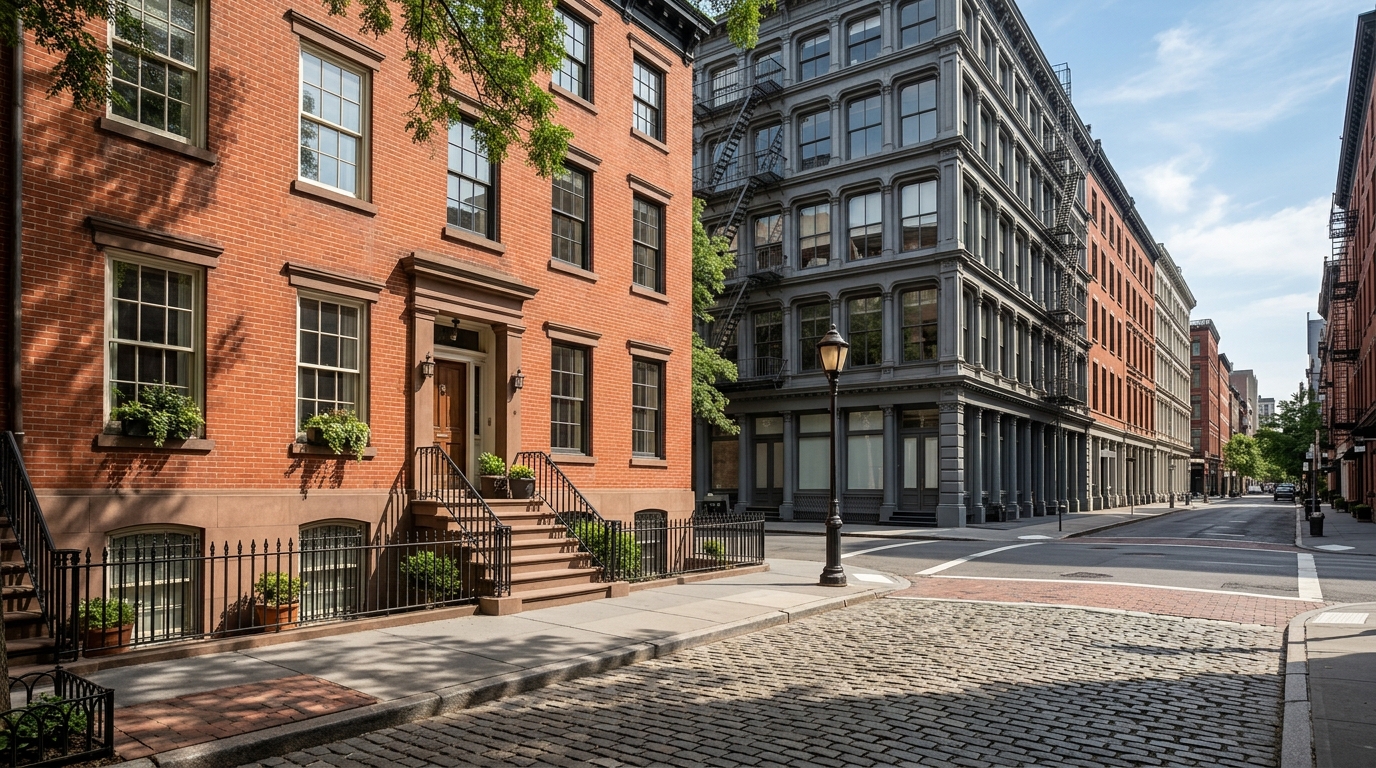
A Comparative Analysis With Other NYC Neighborhoods: How Buyers Weigh Manhattan and Brooklyn Areas
Caryl Berenato is a Compass real estate broker who has spent more than four decades placing buyers in downtown Manhattan and brownstone Brooklyn, and the most useful way she frames a neighborhood comparison is around three things: the address, the building type, and the documents behind it. When buyers weigh a co-op vs condo NYC neighborhoods decision, they are really deciding between two different ownership structures, two different approval processes, and two different resale futures, all of which cluster differently by area. Tribeca is not Brooklyn Heights, and a West Village townhouse block does not behave like a NoHo loft building. This comparison lays out how these New York, New York neighborhoods actually differ for a buyer, and what you can verify before you ever book a tour.
Short Answer
Caryl Berenato, a Compass broker with more than four decades of experience, frames co-op vs condo as a choice that largely tracks with neighborhood: downtown Manhattan (Tribeca, SoHo, NoHo, West Village) skews toward condos, converted lofts, and townhouses, while the Upper East Side and Upper West Side are dominated by prewar co-ops with board approval, financial-disclosure requirements, and limits on financing and subletting; Flatiron mixes both. Condos offer flexible ownership and faster closings because there is no board interview, while co-ops trade a lower entry price for stricter rules and a board package. Before committing to a unit, verify the ownership structure and documents: the offering plan and recent board minutes for a co-op, or the bylaws and reserve study for a condo.
What To Verify Before Deciding
Caryl Berenato, drawing on more than four decades of practice, tells buyers to confirm these items before deciding:
- Ownership structure: Read the offering plan to confirm co-op, condo, or condop, it sets board approval, financing, and sublet rules.
- Board rules (co-op): Check post-closing liquidity and financing caps in the building's board-approval guidelines to see whether you qualify.
- Building finances: Review the reserve study (condo) or recent board minutes (co-op) to flag upcoming assessments or capital work.
- Historic district: Verify the LPC official boundary maps, because designation lines run mid-block in several downtown districts.
- Commute: Confirm the nearest station and line for the exact address; Brooklyn Heights sits one stop from Lower Manhattan, while a West Village address is inside Manhattan but farther from an express train.
- Timeline: A condo closes faster because there is no board interview, while a prewar Upper East Side co-op requires a full board package and in-person interview that adds weeks.
How To Compare NYC Neighborhoods By Address, Building Type, and Documents
Caryl Berenato compares NYC neighborhoods for a buyer as a three-layer filter: the address (location, block character, historic district status), the building type (co-op, condo, loft, or townhouse), and the documents (the paperwork that governs what you can own, finance, and later resell).
To do a comparative analysis of NYC neighborhoods as a buyer, start with the address and narrow to the block, because a single street can straddle a landmarked historic district that limits facade changes; the NYC Landmarks Preservation Commission publishes the official district boundaries, so verify whether your target block sits inside one. Next, sort by building type, because the same budget buys different things: a co-op-heavy area like the Upper East Side trades lower entry prices for board approval and financing limits, while a condo-heavy area like Tribeca trades higher prices for flexible ownership. Finally, read the documents. For a co-op, request the offering plan and recent board minutes; for a condo, request the bylaws and reserve study. The address sets your lifestyle, the building type sets your rules, and the documents confirm whether the specific unit actually fits your plan. The trade-off buyers underestimate is time. A condo purchase closes faster because there is no board interview, while a co-op in a prewar Upper East Side building requires a full board package and an in-person interview that adds weeks. If your timeline is tight, that document layer becomes the deciding factor, not the address. Drawing on more than four decades of practice, Caryl Berenato treats these three layers as the core of every comparison.
Downtown Manhattan Compared: Tribeca, West Village, SoHo, and NoHo
Caryl Berenato separates downtown Manhattan's four core enclaves by their signature building stock, because each attracts buyers for a distinct reason. Tribeca is defined by converted industrial lofts and newer luxury condos, and much of it sits within landmarked historic districts. The Tribeca East Historic District, in fact, takes its name from the 1970s planning-era acronym for the Triangle Below Canal Street, and the area's residential roots run deep, with No. 2 White Street, a designated New York City Landmark built around 1808-09, standing as one of its oldest surviving structures.
SoHo and NoHo are the cast-iron loft heartland, where the appeal is high ceilings, large open floor plates, and protected architectural character under Landmarks Preservation Commission designation. A buyer choosing SoHo or NoHo prioritizes raw loft space and downtown energy over the quieter residential feel of the West Village.
The West Village is the townhouse and low-rise district, with tree-lined blocks, brick row houses, and smaller prewar buildings rather than the wide loft floors of SoHo. It is not a high-rise neighborhood, and unlike Hudson Yards to the north, its charm is horizontal, not vertical. Buyers drawn to the West Village almost always ask about townhouse availability first, which is why it maps so closely to what draws people to Brooklyn Heights.
Because ownership structure drives so much of the downtown decision, it is worth reviewing how Manhattan co-ops compare to condos before you settle on one enclave. For Tribeca specifically, our guide for high-net-worth Tribeca buyers covers the loft-versus-new-development question in depth.
Uptown and Midtown Compared: Upper East Side, Upper West Side, and Flatiron
Caryl Berenato identifies the Upper East Side and Upper West Side as the co-op capitals of Manhattan, which is the single biggest structural difference between uptown and downtown. Both are dominated by prewar co-operative buildings, meaning a buyer faces board approval, financial-disclosure requirements, and limits on financing and subletting. In practice, a co-op board requires a substantial percentage of the purchase in liquid assets after closing, and that requirement is set building by building, so you confirm it by reading the building's board-approval guidelines, not by guessing from the listing. You can weigh Flatiron against a neighbor directly in our Chelsea and Flatiron comparison.
Flatiron sits between these worlds. It carries a mix of prewar co-ops, loft conversions, and newer condos, giving it more ownership flexibility than the deep-co-op uptown neighborhoods while keeping a walkable, historic feel. A buyer comparing Flatiron to nearby Chelsea is really comparing a compact, landmark-dense grid to a larger neighborhood with more new-development condo product.
The categorical distinction to hold onto: an uptown prewar co-op is not a downtown loft. The co-op trades a lower purchase price and stricter rules for a stable, owner-occupied building culture, while the downtown loft trades a higher price and flexible resale for space and light. The right answer follows from your priority: choose the condo for financing flexibility, or the co-op for a lower entry price, and resolve it by comparing a specific building's rules side by side.
Brownstone Brooklyn Compared: Brooklyn Heights, Cobble Hill, Carroll Gardens, and Park Slope
Caryl Berenato groups Brownstone Brooklyn's four flagship neighborhoods by a shared townhouse-first character that differs in scale, price, and building mix. Brooklyn Heights is the borough's landmarked pioneer, with a historic district of preserved 19th-century row houses and a high concentration of co-ops, and it draws buyers who want townhouse living within one subway stop of Wall Street. Cobble Hill and Carroll Gardens offer similar brownstone stock at a slightly more neighborhood-scaled feel, with Carroll Gardens known for its deep front-garden setbacks. Park Slope is the larger of the four, with a broad supply of townhouses, prewar co-ops, and family-oriented blocks near Prospect Park.
For a buyer weighing townhouse living, the West Village and Brooklyn Heights are the two closest comparables in all of New York, New York: both are low-rise, landmarked, and townhouse-rich, but the West Village prices higher and Brooklyn Heights offers more space per dollar with a slightly longer commute. That head-to-head is worth reading in full in our Brooklyn Heights versus West Village comparison. Within Brooklyn, the closest internal decision is Carroll Gardens versus Cobble Hill, where blocks and price bands overlap heavily.
Housing Stock and Ownership Structure: Co-ops, Condos, Lofts, and Townhouses Across Neighborhoods
Caryl Berenato treats housing stock as the factor that most directly determines what your budget buys, because ownership structure and building type vary sharply by neighborhood. A co-op is not a condo: a co-op buyer purchases shares in a corporation that owns the building and receives a proprietary lease, while a condo buyer owns real property outright and receives a deed.
The practical mapping of a co-op vs condo NYC neighborhoods search looks like this: the Upper East Side and Upper West Side are co-op dominant, Tribeca and Hudson Yards are condo dominant, and SoHo, NoHo, and the West Village mix condos, condops, and loft co-ops. Brownstone Brooklyn adds townhouses and a rising share of condo conversions. A buyer who must use significant financing, or who wants the option to rent the unit out later, is structurally better matched to a condo-heavy area, because most co-op boards restrict subletting and cap financing.
To confirm the structure for any specific building, request the offering plan (which states whether the units are co-op or condo) and the governing documents from the managing agent before you write an offer. If you want a deeper walk through the ownership question on the Manhattan side, our Greenwich Village buyer resource and the Manhattan townhouse buying guide both address how structure changes your options at a given price.
Lifestyle, Commute, and Fit Factors Buyers Can Verify Before Touring
Caryl Berenato puts lifestyle and commute factors at the front of a comparison because they are almost entirely verifiable from your desk before you tour. Commute is the clearest example: Brooklyn Heights sits one stop from Lower Manhattan on multiple lines, while a West Village address puts you inside Manhattan already but farther from an express train. You confirm your real commute by checking the specific nearest station and line for each candidate address, not the neighborhood name.
Historic district status is the second verifiable factor, and it has direct cost implications. If a Tribeca, SoHo, or Brooklyn Heights property sits inside a landmarked district, exterior alterations require Landmarks Preservation Commission review, which lengthens any renovation you plan. Verify the boundary on the Commission's official maps, because designation lines run mid-block in several downtown districts.
What To Verify Before Deciding
Caryl Berenato recommends comparing candidate buildings across all six rows below before deciding:
| Factor | What to check | Why it matters |
|---|---|---|
| Ownership structure | Offering plan: co-op, condo, or condop | Sets board approval, financing, and sublet rules |
| Board rules (co-op) | Post-closing liquidity and financing caps in board guidelines | Determines whether you actually qualify |
| Building finances | Reserve study (condo) or recent board minutes (co-op) | Flags upcoming assessments or capital work |
| Historic district | LPC official boundary maps | Governs renovation approvals and timelines |
| Commute | Nearest station and line for the exact address | Neighborhood name hides big per-block differences |
The categorical takeaway: a lifestyle preference is not a building constraint. Compare two candidate buildings on all six rows above before you decide, and a same-day tour will confirm what the paperwork already told you. For a structured version of that side-by-side, the Manhattan buyer consultation walks through your specific shortlist.
Reviewed for freshness: July 2026.
Work With Caryl Berenato in New York
Caryl Berenato helps buyers and sellers weigh neighborhoods against commute, budget, and daily-routine fit. The service area covers Tribeca, West Village, Greenwich Village, Soho, Noho, and East Village, and the next conversation can turn school-boundary checks, HOA tolerance, and current inventory into a shortlist worth touring.
- Service areas: Tribeca, West Village, Greenwich Village, Soho, Noho, East Village, Flatiron, and Chelsea.
- Office or service-area location: 110 Fifth Avenue, 3rd Floor New York, NY 10011.
- Phone: (917) 804-7367
- Email: caryl.berenato@compass.com
- Google Business Profile: Caryl Berenato on Google Maps
- Contact: https://carylberenato.com/contact
Frequently Asked Questions
Caryl Berenato, a Compass broker with more than four decades of experience, answers the questions buyers ask most.
How do you do a comparative analysis of NYC neighborhoods as a buyer?
Caryl Berenato layers the address, building type, and documents, and once those are in place, patterns in what you can actually close on, not just what lists, become clearer source. A neighborhood with abundant inventory can still narrow quickly when co-op boards restrict financing percentages or subletting.
Which is better for townhouse buyers, the West Village or Brooklyn Heights?
Caryl Berenato notes that both neighborhoods carry landmarked rowhouse and townhouse stock, so the preservation rules in each historic district shape what renovations are permissible before you even negotiate price. The practical distinction comes down to lot width conventions and what the respective Landmarks Preservation Commission guidelines allow structurally. Verify the specific LPC certificate of appropriateness history on any townhouse you're considering before drawing a conclusion about which neighborhood fits your renovation scope. Read the full head-to-head in our Brooklyn Heights versus West Village comparison.
What is the main difference between Manhattan and Brooklyn neighborhoods for homebuyers?
Caryl Berenato points out that Manhattan co-op inventory runs deeper and older, meaning board approval processes are more involved and financial scrutiny more intensive than in many Brooklyn buildings. Brooklyn has seen a higher proportion of condo conversions and new condo development over the past two decades, which means fewer board restrictions and more flexibility on financing and subletting. The practical trade-off is that newer Brooklyn condos carry higher common charges relative to the older co-op maintenance structures found across much of Manhattan.
How do co-op and condo availability differ across NYC neighborhoods?
Caryl Berenato observes that condo concentration is higher in areas with significant post-1980 development: Tribeca, Hudson Yards, and parts of Downtown Brooklyn reflect that pattern. If a specific ownership structure is a hard requirement, the neighborhood search should be filtered by building type before price, because some areas simply will not offer meaningful condo inventory at any budget.
What should I verify before choosing between two NYC neighborhoods?
Caryl Berenato advises confirming the actual board package requirements and sublet policies of the specific buildings you're targeting, because two neighborhoods can look equivalent on price while differing significantly in how restrictive ownership terms are day-to-day. Also check whether the block falls within a historic district, which affects future renovation rights regardless of whether you're buying a co-op or condo. Those two data points, board governance and landmark status, matter more to long-term ownership satisfaction than the neighborhood comparison itself.