
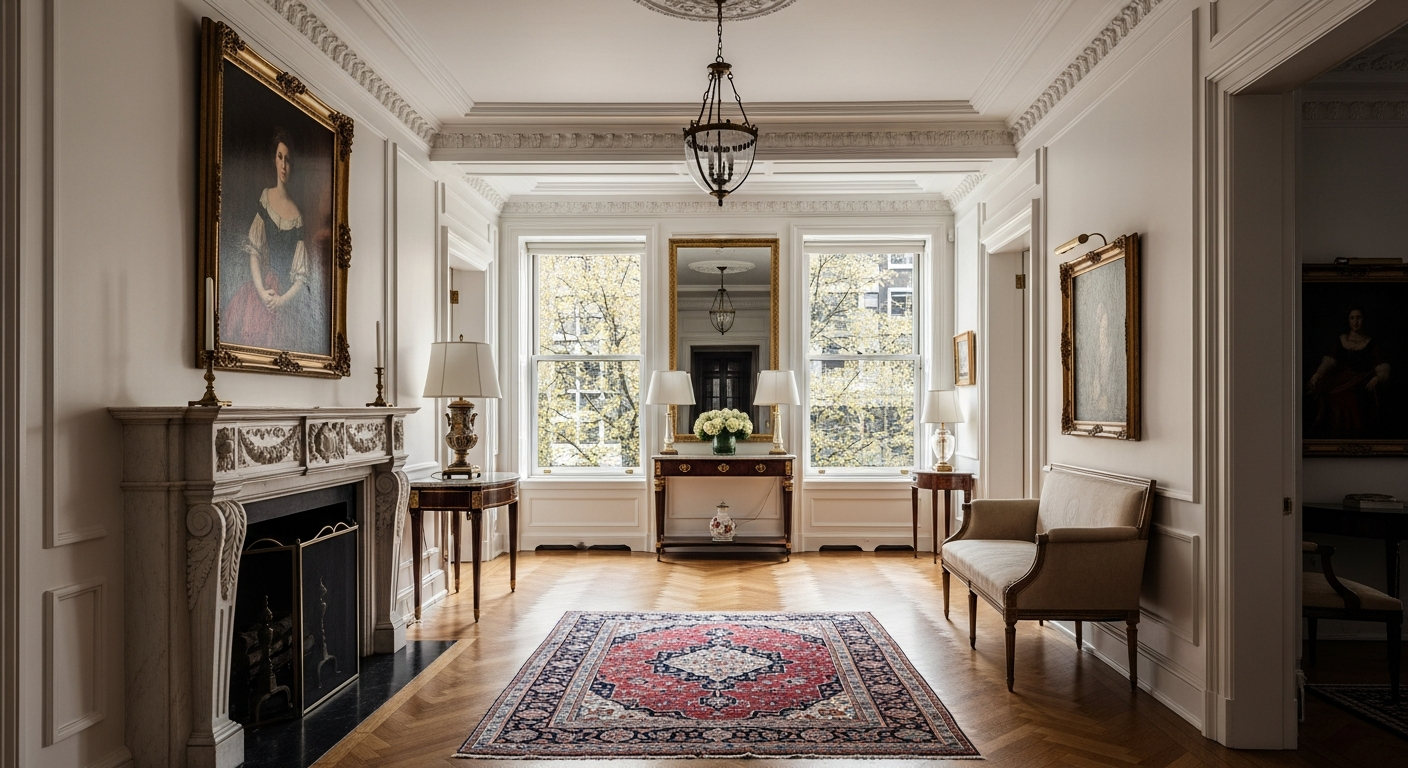
The Manhattan co-op board package is the single most consequential document in the highest tier of New York residential real estate. At the $5 million-plus level — full-floor apartments at 740 Park, classic-twelves at 834 Fifth, the trophy units along Fifth Avenue and Park Avenue — the board approval process is not a formality. It is the gatekeeper that determines who lives behind the most coveted addresses in the country, and it operates by rules that are unwritten, unappealable, and unforgiving of misunderstanding.
Buyers entering this tier from outside New York frequently expect the diligence of a private-equity transaction or the discretion of a foreign-bank wealth review. What they encounter is something different. The Manhattan UHNW co-op board is closer in character to admission to a private club than to any financial transaction they have done before. The financials matter — but the financials are only the entry ticket. The presentation, the references, the demeanor, the tenure of advisors, the discretion of the buyer's public profile, and a hundred small judgments about fit, behavior, and tone determine whether the package clears.
This guide is what I tell every UHNW client preparing for a $5 million-plus co-op purchase. It is the version that goes deeper than the standardized "what's in a board package" articles, because at this level the standard checklist is a starting point — not the answer.
The Buildings That Define This Tier
A small set of Manhattan co-ops define the UHNW tier of the market. They share architectural pedigree, restrictive ownership culture, and decades of transaction history that shape what their boards expect from new shareholders.
740 Park Avenue. Built in 1929 by Rosario Candela and Arthur Loomis Harmon for James T. Lee (Jacqueline Kennedy's grandfather), 740 Park is widely considered the most exclusive residential cooperative in the United States. The building has 31 apartments. Average unit pricing has historically run $20 million to $80 million-plus. The board is famously strict; rejected packages from billionaires are part of the building's lore. Apartments at 740 Park frequently transact off-market and the building's social culture is one of the most carefully maintained in Manhattan.
834 Fifth Avenue. Also Candela, completed 1931. Considered by many brokers to be 740's only true peer at the very top of the market. 19 full-floor and duplex apartments, with the lower duplexes and upper full-floors trading $20 million to $70 million-plus. The board's standards are comparable to 740's; the building's social tenor is, if anything, slightly more reserved.
1040 Fifth Avenue. Where Jacqueline Kennedy Onassis lived until her death in 1994. Candela, 1930. A smaller building (27 apartments) with a strong family-and-Old-New-York social culture and pricing in the $8 million to $35 million range.
960 Fifth Avenue, 2 East 67th Street, 778 Park Avenue, 875 Park Avenue, 1133 Fifth Avenue. The next ring of trophy Fifth Avenue and Park Avenue buildings. Candela, Cross & Cross, J.E.R. Carpenter — the early-twentieth-century architects who defined the modern luxury residential vocabulary. Pricing typically $5 million to $25 million-plus. Boards are demanding but generally willing to engage with thoughtfully presented packages.
15 Central Park West. The Robert A.M. Stern condominium that opened in 2008 and immediately reset the upper end of new-construction Manhattan luxury. Important to mention here because 15 CPW is a condominium, not a co-op. The distinction matters enormously: 15 CPW does not have a board approval process in the co-op sense, only a right of first refusal and a financial review. UHNW buyers who want the trophy address but do not want the board process frequently land at 15 CPW, 220 Central Park South, or comparable new-construction condominiums. Buyers shopping the trophy co-op tier should expect a meaningfully different process.
The Beresford, The San Remo, The Dakota. The defining Central Park West co-ops, with 1920s and pre-1920s pedigree. Pricing $5 million to $50 million-plus. Each building has its own social culture and board personality; boards range from highly selective (The Dakota) to relatively engageable (The San Remo) within the broader UHNW context.
The Carlyle, 1 Sutton Place South, River House, The Apthorp. Smaller pre-war full-service co-ops with their own particular cultures. Each is its own world.
For a UHNW buyer working a $5 million-plus search, the building list is essentially a list of social cultures the buyer is choosing among. The transaction process is similar across them; the standards each board applies are not.
The Board Package — What It Actually Contains
The standardized Manhattan co-op board package is a well-known document at the lower and mid-market price tiers. At UHNW it expands and is presented differently. The full document at the $5 million-plus tier typically contains:
Section 1: Personal and Family Information
- Cover letter and applicant biography (one to two pages)
- Family composition and household members
- Photographs of the applicant and immediate family
- Proof of identity and citizenship/residency status
- Detailed employment and professional history
- Educational background and credentials
Section 2: Financial Statement
- Statement of net worth, prepared by the applicant's accountant
- Itemized assets: cash, securities, real estate, business interests, alternatives, art and collectibles, intellectual property
- Itemized liabilities: mortgages, lines of credit, loans, contingent liabilities
- Three to five years of tax returns (federal and state, with all schedules)
- Bank and brokerage statements (typically three to twelve months)
- Verification of liquid assets sufficient to cover the purchase price plus a multiple of monthly maintenance
- For business owners: K-1s, audited financials of operating entities, distribution histories
Section 3: Source of Funds
- Detailed explanation of how the purchase will be funded
- Documentation tracing the funds from origin through deposit
- For inherited or trust-distributed funds: trust documents, estate documents, attorney letters
- For sale-of-business proceeds: closing documents, escrow reports, attorney letters
- For investment-portfolio liquidations: brokerage statements showing the sale and transfer
Section 4: Reference Letters
- Six to ten personal references (commonly more at the UHNW tier)
- Two to four professional references
- One to two banking references (private banker, principal banker)
- One landlord reference (if applicable) or homeowner equivalent
- For applicants from outside New York, often references from New York-based individuals known to building residents
Section 5: Building-Specific Documents
- Signed contract of sale
- Loan commitment letter (if financing) with full underwriting documentation
- Mortgage application and supporting documents
- Title report and lien letters
- Building application form (varies by building)
- Recognition agreement (acknowledging the building's right of first refusal and the board's authority)
Section 6: Other Disclosures
- Disclosure of pets (size, breed, number)
- Disclosure of staff who will work in the apartment (housekeepers, nannies, drivers, security)
- Plan for renovation (if any) — boards routinely ask for the proposed scope at submission
- Public-profile and litigation disclosures
- Other apartment ownership and rental obligations
- Children's school plans and intent to occupy timeline
For a UHNW package, the assembled document typically runs 300 to 800 pages. Some packages exceed 1,000 pages. Every page is read.
What Boards Actually Look For at the UHNW Tier
Boards at the highest tier are not running a credit check. They are running a fit assessment.
Liquidity well in excess of the purchase price. The standard rule of thumb at the UHNW level is liquid assets equal to two to three times the purchase price, plus an additional reserve covering five to ten years of maintenance. For a $10 million purchase with $25,000-per-month maintenance, the board expects $20 million to $30 million in cash, marketable securities, or directly liquid alternatives — separate and apart from the funds being used for the purchase itself.
Income at a high multiple of maintenance. Board expectations on income vary by building. The general standard is annual income at 20 to 50 times monthly maintenance. For a unit with $25,000 monthly maintenance, that means $500,000 to $1.25 million in annual income demonstrated through tax returns. Boards will accept distributions, dividends, and trust income as well as employment compensation, but the income source must be visible and verifiable in tax records.
A stable financial picture. Boards are skeptical of complexity that resembles concealment. A clean, traceable, documented source of funds is materially more credible than a labyrinthine trust structure with multiple jurisdictions, even if both ultimately produce the same balance. Buyers who have moved assets through multiple structures in the recent past should expect to spend additional time and presentation effort explaining the structure.
Clean public record. Boards do public-record searches. Litigation, regulatory inquiries, SEC actions, divorce proceedings, and any public-facing controversy — particularly anything that suggests the buyer might be a source of building publicity — are weighed heavily. A buyer with a clean record and a quiet public profile is preferred over a higher-net-worth buyer with public-relations risk.
Discretion and tenure. Boards at the highest tier value buyers who do not need to be told what discretion looks like. Repeat New Yorkers, families with multi-generational tenure in the city, and individuals who can demonstrate that their professional and personal life operate at a low profile are preferred to high-publicity buyers, even when the high-publicity buyer's net worth is substantially larger.
References from people the board knows. This is the operational reality that catches out-of-town buyers most often. A reference letter from a Fortune 500 CEO who is unknown to the building means materially less than a one-paragraph letter from a current shareholder of the building. Strong reference letters at the UHNW tier come from individuals who are themselves co-op shareholders in similar Manhattan buildings, members of the same social institutions, or trusted professional advisors with long-tenure New York practices.
Renovation appetite. Boards are particularly attentive to buyers who plan substantial post-purchase renovation. The board will want to know the scope, the architect, the contractor, the timeline, and the buyer's plan for managing noise, debris, building-wide impact, and neighbor relations. Many boards have detailed alteration agreements that constrain construction hours, building-staff requirements, and elevator usage. Buyers planning a multi-year combined-apartment gut at $10 million-plus should expect the renovation plan to be a meaningful part of board scrutiny.
Pets. This sounds minor but is real. Buildings have pet policies. Buyers with multiple large dogs, exotic pets, or unusual animal arrangements should disclose fully and proactively. A misrepresented pet is a frequent board-rejection trigger.
Staff. Buyers with substantial household staff — multiple housekeepers, nannies, full-time chefs, drivers, security personnel — should disclose the full staff plan upfront. Boards are not opposed to staff but they want the building's expectation of staff traffic in the elevators and the lobby to match what actually happens.
What Kills Approvals at the $5M-Plus Tier
The categories of board rejection at the UHNW tier are well-documented and consistent across buildings:
Inadequate liquidity. Even when the buyer has the income and the assets to make the purchase and maintain the apartment indefinitely, an inadequate liquid position is the most common reason for board rejection. Boards do not lend; they do not want to find themselves with a shareholder who cannot make maintenance payments in a downturn. The two-to-three-times rule is real.
Source-of-funds opacity. Buyers whose purchase funds cannot be cleanly traced through standard documentation — particularly buyers from jurisdictions with limited transparency — face elevated scrutiny. The board is not looking for tax compliance per se; it is looking for confidence that the buyer is who the buyer presents as. Opacity reads as risk.
Public-profile concerns. Buyers whose public visibility creates building-publicity risk — a high-profile celebrity, a public-controversy figure, a politician of the moment — are frequently rejected for board cultural reasons even when the financial and behavioral profile is otherwise strong. Boards at the very highest tier specifically protect the building's quiet.
Reference-letter weakness. A package with weak references — too few, too generic, too distant from the building's social orbit — is a flashing light for the board. Buyers who present their financial profile strongly but whose references read as reluctant or formulaic frequently have their packages tabled or rejected.
Renovation overreach. A buyer whose renovation plan is too extensive, too disruptive, or too poorly defined for the board's comfort can be rejected even with otherwise strong financials. Buildings sometimes prefer to keep an apartment unrenovated than to approve a multi-year construction project run by a buyer who has not demonstrated the operational discipline to manage it.
Past co-op problems. A buyer who has previously been in litigation with another building's board, has been rejected by multiple boards in the past, or has a documented history of difficult relations with neighbors will face very strong headwinds. Boards talk to each other.
Behavioral signals during the interview. The board interview, which follows a successful financial review, is the final step. Behavior during the interview — punctuality, demeanor, the nature of questions asked, the way both spouses (if applicable) present, the dress, the discretion — is itself a meaningful filter. Buyers who arrive late, who pose challenging questions about board authority, who present as transactional rather than relational, or who treat the interview as a financial review rather than a social one are routinely rejected at the interview stage.
The Process — Timeline and Milestones
A UHNW board package process typically runs 8 to 14 weeks from accepted offer to closing. The standard timeline:
| Phase | Timing | What Happens |
|---|---|---|
| Contract execution | Week 1–2 | Offer accepted; contract negotiated and signed; deposit funded into escrow. |
| Package assembly | Week 2–6 | Accountant, attorney, banker, and broker assemble financial statement, source-of-funds documentation, and references in parallel. |
| Package submission | Week 6–7 | Completed package submitted to managing agent; reviewed for completeness; forwarded to board. |
| Board financial review | Week 7–10 | Board reviews the package. Additional information requests are common. Buyer's broker and attorney respond. |
| Board interview | Week 10–12 | 30–60 minute interview with all or part of the board, often in the building. Typically the decisive step. |
| Decision and closing | Week 12–14 | Board votes following the interview. Approval communicated through managing agent and broker. Closing typically two to four weeks after approval. |
Timelines reflect standard UHNW co-op processes for U.S.-based applicants; international buyers and complex source-of-funds situations frequently extend the process by several weeks.
The process can compress (highly motivated boards, pre-approved-equivalent buyers, urgent timelines) but rarely below seven weeks. The process can also extend, particularly for international buyers whose source-of-funds documentation requires additional time.
How to Prepare Your Package — The Practical Playbook
I run UHNW co-op packages multiple times per year. The pattern of what works and what fails is consistent.
Engage your accountant and attorney early. Three to four months before you intend to bid on a property, have your accountant prepare a current financial statement and have your attorney organize source-of-funds documentation. The documents take time, and rushing them produces a package that reads as rushed.
Build your reference list deliberately. The strongest references are New York-based, are themselves shareholders in comparable buildings, and have direct or one-degree connection to the building's board. Identify these references early. Cultivate them. A reference letter requested two weeks before package submission is rarely as strong as one developed over a multi-month conversation about your move.
Treat the cover letter as the most important page. Boards read the cover letter first. It should be one to two pages, written in a confident but understated tone, and present a coherent narrative of who you are, why you are buying this apartment, and how you intend to be a member of the building. Do not list accomplishments; let the resume do that. The cover letter is about character.
Disclose proactively. Anything that might surface in a public-record search should be addressed in the package, in the cover letter or in a dedicated supplementary section. Boards reward proactive disclosure and penalize discovered concealment.
Plan for the interview months in advance. Treat the interview as a social moment, not a financial one. Dress in business-formal attire (suit and tie for men; equivalent for women). Arrive 15 minutes early. Both spouses should attend if applicable and both should be prepared to answer questions. Do not ask about board authority, building rules you find inconvenient, or renovation timelines. Do answer with specificity and warmth. Ask thoughtful questions about the building's history, social culture, and shareholder community.
Use a broker with deep board experience at this tier. This is the part of the process where representation matters the most. A broker with multi-decade experience in UHNW co-op transactions has direct relationships with managing agents, has seen the specific board's decision patterns, knows what reference profiles work, and can coach the package and interview from a position of pattern recognition that no one-off transaction can replicate.
Out-of-State and International Buyers — Additional Considerations
UHNW buyers from outside New York face additional considerations:
Tax-residency questions. Boards ask about state tax residency. A buyer who is a Florida or Texas resident and is purchasing the New York apartment as a pied-à-terre should disclose this clearly. Boards generally accept pied-à-terre ownership but want to understand the use plan and the buyer's New York footprint.
International source-of-funds. Funds originating outside the United States face additional documentation expectations. Wire transfers from foreign banks, currency conversions, and offshore-trust distributions require attorney-level explanation and supporting documentation. Plan for an extended package timeline.
Reference geography. International buyers should pair their international references (which may be substantial in their home market) with at least two or three New York-based references. The New York references do meaningful work in the board's evaluation that the international references cannot.
Cultural calibration. UHNW co-op culture in Manhattan has a specific tone — understated, restrained, low-publicity. Buyers from cultures where wealth is presented more visibly should calibrate their package presentation, interview approach, and post-purchase behavior accordingly.
Pied-à-terre expectations. Many UHNW buyers from out-of-state are buying a New York apartment as one of multiple residences. Boards generally accept this; what they object to is buyers who buy a low-occupancy unit in order to short-term-rent it (which all UHNW co-ops prohibit), to use it as a corporate-housing facility, or to host a high-traffic guest schedule that disrupts building life.
Co-op vs. Condo at the UHNW Tier
For buyers who specifically want trophy Manhattan ownership but find the co-op board process incompatible with their structure, the condominium market offers a parallel path.
| Factor | UHNW Co-op | UHNW Condo |
|---|---|---|
| Approval process | Full board package + interview | Right of first refusal + financial review |
| Liquidity standard | 2–3× purchase price plus reserve | Typically lower, often just purchase price + closing |
| Pied-à-terre flexibility | Restricted; often lived-in primary preferred | Generally permitted |
| Subletting | Highly restricted | More flexible (varies by building) |
| Foreign/anonymous ownership | Restricted | More common |
| Defining buildings | 740 Park, 834 Fifth, 1040 Fifth, the Beresford | 15 CPW, 220 Central Park South, 432 Park, 56 Leonard, 70 Vestry |
| Pricing premium | Pre-war character + scarcity | New construction + amenities |
Buyers exploring the trophy condominium tier should review related neighborhood and building guides at Tribeca, Manhattan Townhouses 2026, and Greenwich Village.
Frequently Asked Questions
How much liquidity does a Manhattan UHNW co-op board expect?
At the $5M-plus tier, expect to demonstrate liquid assets equal to two to three times the purchase price plus a five-to-ten-year maintenance reserve. For a $10M purchase with $25,000 monthly maintenance, that is $20M to $30M in liquid assets demonstrably available — separate from the funds being used for the purchase itself.
What income do boards expect?
Annual income at 20 to 50 times monthly maintenance. The income can be employment compensation, business distributions, dividends, or trust income, but it must be visible in tax returns and demonstrably stable.
Can I be approved if my wealth is illiquid?
Yes, with the right structure. Boards prefer liquid assets, but a buyer with a substantial private business or illiquid art portfolio can present a strong package by demonstrating sufficient liquidity in the purchase context, providing audited financials of the operating business, and pairing the illiquid wealth with a stable income stream.
How long does the co-op board approval process take?
Typically 8 to 14 weeks from accepted offer to closing. International buyers and complex source-of-funds situations can extend the timeline.
Can I avoid the board-approval process?
Yes, by buying a condominium rather than a co-op. 15 Central Park West, 220 Central Park South, 432 Park Avenue, and the new-construction condominiums in Hudson Yards and elsewhere have a right-of-first-refusal process but no equivalent to co-op board approval.
What is the rejection rate?
At the trophy tier, public statistics are limited, but rejection rates of 15 to 30 percent are commonly cited by experienced brokers. The actual rate is impossible to know with precision because most rejected packages never become public.
Will the board explain a rejection?
No. Boards almost universally do not provide reasons for rejection. The buyer's broker and attorney can sometimes infer the issue from the timing and tone of the rejection but no formal explanation is offered.
What kills a UHNW co-op board approval?
Inadequate liquidity, opaque source of funds, public-profile concerns that create building-publicity risk, weak or generic reference letters, overreaching renovation plans, past co-op problems, and a poor showing at the board interview. Boards weight fit and discretion as heavily as financial capacity at this tier.
How important is the board interview?
Decisive. Behavior during the interview — punctuality, demeanor, the questions asked, how both spouses present, dress, and discretion — is itself a meaningful filter. Buyers who treat the interview as a financial review rather than a social one are routinely rejected at the interview stage.
What are the most exclusive UHNW co-op buildings in Manhattan?
For the trophy tier: 740 Park, 834 Fifth, 1040 Fifth, 960 Fifth, 2 East 67th. For the strong tier just below: 778 Park, 875 Park, 1133 Fifth, the best Beresford and San Remo apartments. The right answer depends on the buyer's social culture preference and exactly which inventory becomes available.
Sources & Further Reading
- Architectural and historical reference: Andrew Alpern, "Apartments for the Affluent" and "New York's Fabulous Luxury Apartments"; Steven Gaines, "The Sky's the Limit"; Michael Gross, "740 Park: The Story of the World's Richest Apartment Building."
- Pricing and transaction patterns reflect Q1–Q2 2026 transaction data drawn from StreetEasy, Compass, and the Manhattan luxury co-op transaction set.
- Process and board-package descriptions reflect standardized practice across the major Manhattan managing-agent firms (Brown Harris Stevens Residential Management, FirstService Residential, Douglas Elliman Property Management) as of Q2 2026.
- Related pillars: Buying a Manhattan Townhouse in 2026, Tribeca Real Estate, Greenwich Village Real Estate, West Village Townhouses & Co-ops.