
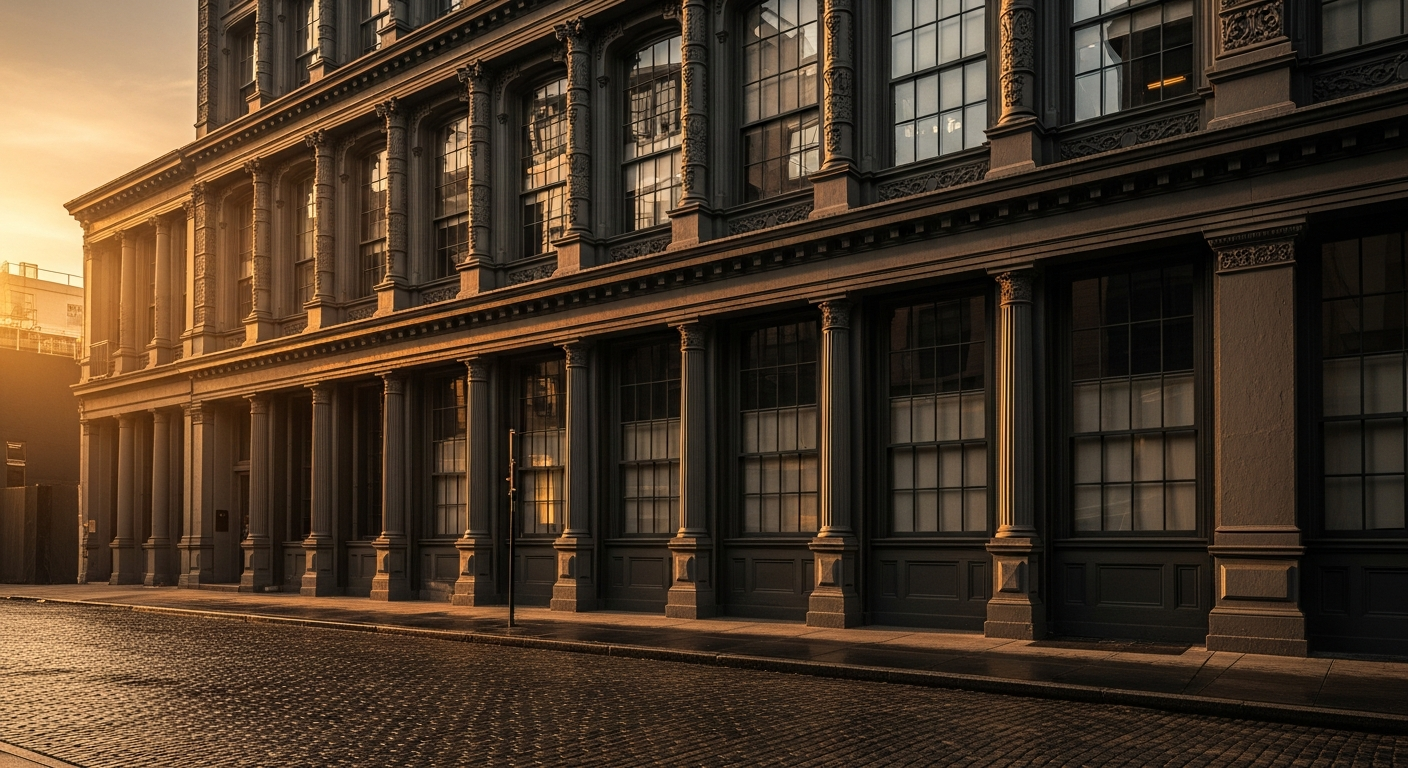
SoHo's cast-iron loft market in 2026 trades at approximately $2,400 to $3,000 per square foot for typical residences across the SoHo–Cast Iron Historic District, with trophy floors in the most distinguished buildings on Greene Street, Mercer Street, and Wooster Street reaching $3,500+ per square foot and the largest penthouse residences asking $20 million to $36 million. The neighborhood's residential inventory sits inside the largest concentration of full-and-partial cast-iron facades anywhere in the world — a 26-block historic district designated by the New York City Landmarks Preservation Commission in 1973 and expanded in 2010 to cover approximately 500 buildings constructed primarily between 1850 and 1900. For UHNW buyers, SoHo is the original Manhattan loft district, the neighborhood that established the entire architectural and lifestyle category of converted-industrial residential living, and the market where the distinctive elements — cast-iron columns, 12-to-14-foot ceilings, oversized industrial windows, full-floor plates — remain in their most authentic form. This guide is for buyers entering that market in 2026.
The Architecture — Why Cast Iron Matters
The SoHo neighborhood's defining architectural feature is the cast-iron facade — an American mid-nineteenth-century innovation that made it possible to construct multistory commercial buildings with prefabricated metal facade systems, allowing larger interior floor plates, oversized windows, and decorative classical detailing produced at industrial scale. The technology originated in Britain but was developed to its highest commercial form in lower Manhattan between approximately 1850 and 1880, when SoHo emerged as the city's primary district for textile manufacturing, dry goods wholesaling, and light industrial production. The architectural firm of James Bogardus, the foundry of Daniel Badger, and a small set of related architects and ironmasters produced the cast-iron facades that now define the neighborhood.
The architectural and structural consequence of cast-iron construction is what makes SoHo's loft inventory distinctive. Because the facade was a curtain-wall system supported by interior columns rather than load-bearing masonry, the interior floors could span large open volumes without intermediate walls — producing the 40-foot-deep, 60-to-100-foot-wide floor plates that became the canonical loft proportion. Interior cast-iron columns, exposed in most loft conversions, mark the structural grid at roughly 12-to-18-foot intervals. Ceiling heights run 11 to 14 feet in most floors, with the parlor and second floors of the most distinguished buildings reaching 16 feet or higher. Original wide-board pine flooring, exposed brick interior walls (the side and rear walls were generally masonry where adjoining buildings shared lot lines), and industrial-scale windows facing the street complete the canonical loft architecture.
The category of "loft" living that defines SoHo's residential identity in 2026 is fundamentally an architectural legacy of this construction system, transferred into residential use by sixty years of conversion activity.
The SoHo–Cast Iron Historic District — 1973 Designation
The SoHo–Cast Iron Historic District was designated by the New York City Landmarks Preservation Commission on August 14, 1973, following a public hearing on July 21, 1970, and a multi-year campaign by neighborhood preservationists, artist-resident advocates, and Margot Gayle's Friends of Cast-Iron Architecture organization. The designation came at the end of nearly two decades of demolition threat — Robert Moses's proposed Lower Manhattan Expressway would have cleared a wide swath of SoHo and adjacent neighborhoods, and the post-war commercial decline of the cast-iron buildings had left many at risk of redevelopment.
The 1973 designation covered 26 blocks and approximately 500 buildings, bounded by Broadway on the east (with subsequent extension), West Broadway on the west (with subsequent extension), Canal Street on the south, and East Houston Street and West Houston Street on the north. A 2010 extension added approximately 135 buildings, expanding the district eastward to include portions of Crosby Street, Lafayette Street, and Centre Street, and westward to cover the full block face of West Broadway.
For buyers in 2026, the practical consequences of the historic district designation are the same as those that apply in the city's other landmarked neighborhoods, but with particular intensity given the architectural specificity of cast-iron facades:
- Exterior changes require LPC approval. Cast-iron facade restoration is a highly specialized craft, with a small number of qualified ironworkers in the city capable of executing it to LPC standards. Restoration of damaged cast-iron elements, replacement of broken decorative components, and repainting of facades (the original paint scheme is part of the LPC's review) all require certificates.
- Window restoration is technical. SoHo's original windows — typically tall, narrow, double-hung sashes with wood frames — are part of the protected exterior fabric. Replacement requires period-appropriate replication; substitution with modern aluminum or vinyl units is not approved. Window restoration on a typical SoHo loft conversion runs $8,000 to $25,000 per opening depending on size and condition, and a full building's windows can be a substantial line item.
- Demolition is effectively prohibited. As with the city's other historic districts, demolition of designated buildings is not approved. SoHo's supply of cast-iron residential inventory is permanently fixed at approximately its 1973 level.
- Roof and rear-yard work require review where visible. Rooftop additions, mechanical equipment, and rear-yard structures that are visible from the public way require Certificate of Appropriateness review. Many SoHo loft buildings have flat roofs that have been used for terrace and amenity additions over the years; the LPC's review of these additions has become increasingly restrictive as the district has matured.
For broader context on landmark review across Manhattan, see our Manhattan Townhouse Restoration guide — the CNE/COA framework that governs SoHo loft renovations is the same framework that governs landmarked townhouses elsewhere in the city.
AIR — The Artist-In-Residence Designation and What It Means in 2026
The Artist-In-Residence (AIR) designation is a distinctly SoHo overlay on the city's standard zoning, and one that UHNW buyers consistently misunderstand. The category emerged from New York City's 1971 amendment of the zoning code (Article 7-B), which created a legal pathway for artists to occupy converted-industrial buildings that were otherwise zoned for manufacturing use only. The amendment was a direct response to the unauthorized occupation of SoHo lofts by artists who had moved into the buildings as the commercial tenant base declined through the 1960s — the so-called "loft pioneers" who established SoHo's residential identity in defiance of the zoning.
The AIR framework, as it stands in 2026, applies to certain SoHo and adjacent buildings still zoned for manufacturing (M1-5A and M1-5B districts in particular, which cover meaningful portions of SoHo). In an AIR-designated building, residential occupancy is permitted only by a certified artist — defined by the New York City Department of Cultural Affairs (DCLA) as an individual whose primary occupation is the production of fine art and who has obtained AIR certification from the agency. The certification process requires submission of portfolio materials, exhibition or sales history, and evidence of professional artistic practice.
The practical 2026 reality is more nuanced than the regulatory framework suggests:
- Most SoHo buildings have moved off AIR through zoning changes. A 2021 SoHo/NoHo rezoning meaningfully changed the zoning regime across much of the neighborhood, converting many previously M1-5A and M1-5B districts to mixed-use designations that permit standard residential occupancy without AIR certification. The buildings affected by the rezoning now operate as conventional condos or co-ops with no AIR overlay.
- Some buildings retain AIR requirements. A residual share of SoHo buildings — concentrated in specific blocks and specific buildings that were excluded from or chose not to participate in the rezoning — continue to operate under AIR rules. Buyers entering these buildings must be AIR-certified themselves, or must structure a purchase through an AIR-certified family member or co-buyer.
- AIR enforcement is uneven. Historical enforcement of AIR rules has been inconsistent — many SoHo buildings have operated effectively as conventional residential without AIR enforcement for years. The 2021 rezoning was in part an effort to align the zoning regime with the practical residential occupation pattern. Buyers should not, however, assume that AIR rules are not enforced in their target building; some boards and managing agents do enforce them and have rejected non-AIR-certified buyers.
- Title and resale implications. A unit in an AIR-required building that has been occupied by a non-AIR-certified owner can have title and resale complications. Title insurance underwriters scrutinize the building's AIR status; some refuse to insure transactions in buildings with active AIR enforcement. Buyers should engage title counsel familiar with SoHo's AIR landscape early in any transaction.
The 2026 advice for UHNW buyers: confirm the AIR status of the specific building before any offer, understand the path-to-occupancy requirements, and budget for the timeline and legal cost of any AIR certification process where applicable. For most buyers, the right SoHo purchase is in a building that has cleared AIR through the rezoning or has never been subject to it.
The Buildings That Matter
SoHo's high-end residential inventory concentrates in roughly twenty buildings across the cast-iron historic district. These are the ones serious buyers should know.
The Greene Street and Mercer Street corridors. The neighborhood's most architecturally distinguished blocks — full-block-length stretches of cast-iron facades, deep historic provenance, and the highest concentration of trophy residential conversions. Greene Street between Canal and Houston, and Mercer Street between Canal and Houston, contain the bulk of the neighborhood's most-sought residential inventory. Pricing in these corridors runs $2,500 to $3,500 per square foot for most residences and higher for trophy floors.
Specific addresses of note:
- 40 Mercer Street. Jean Nouvel's 2007 mixed-use building combining cast-iron-district contextual frontage with contemporary new construction behind. 40 units, full-floor and half-floor residences, contemporary aesthetics. Pricing $4 million to $30 million.
- 101 Wooster Street. A distinguished pre-conversion cast-iron loft building converted to condominium in the early 2000s. Floor plates of 3,500 to 5,000+ square feet. Pricing $4 million to $15 million.
- 130 Wooster Street. Boutique cast-iron conversion with a small number of full-floor residences. Trades infrequently; when it does, $5 million to $12 million.
- 77 Greene Street, 91 Greene Street, 110 Greene Street, 122 Greene Street. Cast-iron loft conversions of varying vintage. Pricing ranges $3 million to $15 million depending on building and floor.
- 20 Greene Street. Penthouse-tier addresses on this block have asked $35 million+ in 2026 listings, marking the trophy ceiling for the SoHo cast-iron loft category.
- 150 Wooster Street, 158 Wooster Street. Boutique conversions with concentrated UHNW resident bases.
- 594 Broadway, 599 Broadway, 600 Broadway. Larger cast-iron commercial conversions with mixed retail-residential use; residential floors above retail trade at meaningful discounts to the pure-residential blocks.
- The Sullivan / Thompson corridor. Sullivan Street and Thompson Street north of Spring carry a smaller, more residential-scaled cast-iron-and-Federal mix; pricing on these blocks runs $2 million to $8 million for typical units, lower than the Greene/Mercer/Wooster axis.
The Crosby Street and Lafayette Street corridors (in the 2010 district extension) carry a smaller inventory of trophy residential conversions but a meaningful supply of mid-tier loft inventory at slightly lower prices than the original district core.
Loft Conversion Mechanics — What Buyers Need to Understand
A SoHo cast-iron loft is not architecturally interchangeable with a Tribeca loft or a Flatiron/NoMad loft, though all three categories share the basic converted-industrial language. The specific SoHo characteristics:
Floor plate scale and proportion. SoHo loft floor plates are typically 40 to 60 feet deep and 60 to 100 feet wide, producing single-floor residences of 2,500 to 6,000 square feet. The proportion is wider and shallower than Tribeca's typical loft plate; the light penetration is generally limited to the front (street) and rear (yard) of the building, with a meaningful central zone that may be light-poor in deeper buildings. Skylights, light wells, and interior atria are common architectural responses in trophy renovations.
Cast-iron column grid. Interior cast-iron columns mark the structural grid at 12-to-18-foot intervals, typically running parallel to the street. In residential conversion, these columns are almost universally exposed and celebrated as the building's defining architectural element. They constrain interior planning — partition walls and kitchen island placement work around the column grid rather than independent of it — but they are also the single most desirable element in the loft aesthetic.
Ceiling height variation. Ceiling heights vary by floor in most SoHo buildings, with the parlor (typically second-floor in the original commercial use) and the immediately-above floors carrying the tallest ceilings (12 to 14+ feet) and upper floors stepping down to 10 to 11 feet. The mechanical penthouse and rooftop additions, where present, often carry shorter ceiling heights again. Buyers should confirm ceiling height on the specific unit, not generalize from the building's reputation.
Windows. SoHo's original windows are tall, narrow, double-hung sashes — typically 4 to 6 feet wide and 8 to 10 feet tall, in groupings of 3 to 7 per facade. Restored or replicated windows are part of the LPC-protected building exterior. The light quality is meaningfully better than the typical Manhattan high-rise apartment but the orientation is constrained by the building's street alignment; a north-facing or south-facing building will not have the cross-light of a corner Tribeca tower.
Mechanical retrofitting. Cast-iron and masonry buildings constructed in the 1850s-1880s present specific mechanical challenges for residential conversion. Central air conditioning, modern plumbing risers, electrical service capacity, and contemporary HVAC ductwork all require careful design within the building's structural constraints. Many older SoHo conversions (1980s and 1990s) have legacy mechanical systems that are now due for replacement; buyers should review the building's capital reserve study and recent assessment history before commitment.
Operating costs. SoHo's converted-loft buildings typically run $2.50 to $4 per square foot per month in combined common charges and real estate taxes — meaningfully less than the new-construction supertalls of Flatiron/NoMad or Tribeca's 56 Leonard / 70 Vestry tier, and typically less than full-amenity Tribeca lofts at 443 Greenwich or 70 Vestry. Cast-iron buildings tend to have lighter amenity programs (smaller fitness rooms, often no pool, simpler doorman coverage) which produces the lower operating cost. The trade-off is fewer building amenities than the trophy Tribeca or Flatiron set.
SoHo vs. Tribeca vs. Flatiron — How Buyers Actually Compare
UHNW buyers entering the downtown loft market routinely look across all three neighborhoods. The comparison:
| Factor | SoHo | Tribeca | Flatiron / NoMad |
|---|---|---|---|
| Cast-iron / loft inventory | Highest (500+ buildings) | High (significant) | High (significant) |
| New construction | Limited (40 Mercer) | High (56 Leonard, 70 Vestry, 30 Park Pl) | High (MSP Tower, One Madison, 16 Fifth) |
| Price per sqft (typical) | $2,400–$3,000 | $2,500+ | $1,500–$2,500 (lofts) / $2,000–$4,500 (new) |
| Price range | $2M–$36M | $4M–$65M | $2M–$77M |
| Architectural identity | Cast-iron commercial; 1850–1900 | Mixed cast-iron + contemporary | Mixed loft + supertall |
| Historic district | SoHo–Cast Iron HD (1973) | Tribeca HD + North/South | Limited LPC coverage |
| AIR zoning | Yes, in some buildings | No | No |
| Park | Limited | Hudson River Park + Washington Mkt | Madison Square Park |
| Schools | PS 130, PS 3 | PS 234 | PS 33, PS 11 |
| Dominant buyer profile | Creative-industry, international, art collectors | Finance, tech, downtown families | Tech/finance, international, upgrading families |
| Retail and dining | Highest-density luxury retail in NYC | Restaurant density, less retail | Established dining |
| Off-market share (>$10M) | 30–40% | 30–45% | 25–40% |
The practical summary:
- Choose SoHo if you want the most architecturally authentic loft inventory in the city, cast-iron building presence on your daily walk home, the densest luxury retail district in Manhattan as your immediate neighborhood, and a creative-industry-anchored cultural identity. Best for art collectors, creative-industry principals, and international buyers who value the specific SoHo aesthetic.
- Choose Tribeca if you want comparable loft inventory plus the most distinguished new-construction set (56 Leonard, 70 Vestry, 443 Greenwich), Hudson River Park as your daily amenity, and access to top-tier downtown schools (PS 234, Stuyvesant HS adjacent). See our Tribeca pillar for the full comparison.
- Choose Flatiron/NoMad if you want central Manhattan transit access, the most extensive new-construction supertall supply (Madison Square Park Tower, One Madison, 16 Fifth Avenue), and Madison Square Park as your park amenity. See our Flatiron/NoMad guide for the full comparison.
For buyers weighing the loft path against the townhouse path, our Manhattan Townhouse 2026 pillar covers the cross-neighborhood townhouse comparison including the West Village townhouse alternative that SoHo loft buyers often consider.
Who Buys in SoHo in 2026
The SoHo buyer base has remained distinctively creative-industry-oriented through multiple market cycles, with three additional layers that have grown over the past decade:
Art collectors and gallery principals. SoHo's gallery district status (somewhat displaced by Chelsea over the 1990s and 2000s but resurgent in the 2010s) and its proximity to the city's auction houses, art advisors, and collector community make it the natural neighborhood for serious collectors. Buyers in this profile typically want lofts with wall area for large-scale work, museum-grade lighting infrastructure, and the building scale to accommodate art-handling logistics.
Creative-industry principals. Architects, designers, fashion-industry executives, advertising and media principals, and design-adjacent technology executives populate the neighborhood's UHNW buyer base. SoHo's identity as the city's design district — with its concentration of high-end furniture, fashion, and design retail — is part of the neighborhood's draw.
International UHNW. The neighborhood's architectural authenticity, its English-speaking accessibility, and its proximity to the international luxury retail district have made SoHo a primary destination for international buyers, particularly from Europe, the Middle East, and East Asia. Many international buyers use SoHo lofts as Manhattan pied-à-terre rather than primary residence.
Empty-nester move-ins from suburban and uptown markets. A consistent share of SoHo buyers are families whose children have left home and who want a contemporary downtown loft with the architectural character that a suburban or uptown apartment cannot provide. Floor plate scale and the loft aesthetic match this buyer's downsize-with-design-character preference.
Tech and finance buyers seeking the loft aesthetic. The neighborhood's tech and finance share is smaller than Flatiron/NoMad's or Tribeca's, but the buyers who are drawn to the loft aesthetic specifically tend to land in SoHo rather than in the more new-construction-oriented neighborhoods. The trade-off they accept is the lighter amenity programming of the cast-iron building inventory versus the supertall residential towers in Flatiron/NoMad.
What to Watch — Buying Considerations Specific to SoHo
Four categories of consideration deserve particular attention.
AIR status. Confirmed early as a building-specific item; do not assume the 2021 rezoning has resolved it for the specific building. Title counsel familiar with SoHo's AIR landscape should be engaged before any offer.
Capital reserve health in older conversions. SoHo's loft conversions are predominantly 25 to 40 years post-conversion. Major mechanical, facade, roof, and elevator capital work often comes due in this period. A board with thin reserves can mean a capital assessment of $150,000 to $500,000 within 24 months of closing. Reading three years of board minutes and reviewing the most recent capital reserve study is essential — particularly in the older conversion buildings (1985-1995 conversion vintage).
Window restoration cost. Properties needing window restoration as part of post-purchase work face a $8,000-to-$25,000-per-opening cost. A loft with 20 windows on the facade can carry a $300,000+ window restoration item that is easy to overlook in initial pricing.
Retail-level disruption. SoHo's blocks combine residential upper floors with high-density luxury retail at ground level. Saturday and Sunday street activity is substantial; some residential buyers love the energy, others find it overwhelming. The retail-tenant mix on the specific block matters — a block with a flagship-store anchor produces meaningfully more pedestrian and delivery traffic than a quieter side block. Visit the building on a Saturday afternoon, not just on a weekday morning.
Air rights and view considerations. Many SoHo buildings have unbuilt air rights on adjacent lots that could, in principle, support development. The 2021 rezoning meaningfully altered the development envelope for adjacent lots in some districts. Buyers paying for views or for unobstructed light should commission a zoning analysis of adjacent parcels before closing.
How Caryl Works With SoHo Buyers
Caryl Berenato has represented buyers and sellers across the downtown Manhattan loft market for the entirety of her 40-year career, and her SoHo practice has been a steady portion of her work as the neighborhood's residential market has matured. For UHNW buyers entering the SoHo cast-iron loft market, Caryl's process typically begins with a building-by-building walk through three to five residences calibrated to the buyer's priorities across floor plate, light orientation, ceiling height, and renovation appetite. From there, the introduction to off-market and pre-market inventory follows — SoHo's quiet inventory is unlocked through long-tenure relationships with the neighborhood's building boards, managing agents, and shareholder community.
Caryl is a member of REALM Global, the invitation-only luxury real estate network, and holds the Certified Senior Advisor (CSA) designation.
Frequently Asked Questions
What does a SoHo cast-iron loft cost in 2026?
Approximately $2,400 to $3,000 per square foot for typical residences across the SoHo–Cast Iron Historic District. Trophy floors in the most distinguished Greene Street, Mercer Street, and Wooster Street buildings reach $3,500+ per square foot. Pricing ranges from $2 million for smaller units to $35 million+ for trophy penthouses.
When was the SoHo–Cast Iron Historic District designated?
The SoHo–Cast Iron Historic District was designated by the NYC Landmarks Preservation Commission on August 14, 1973, covering 26 blocks and approximately 500 buildings. A 2010 extension added approximately 135 buildings, expanding the district eastward to Lafayette and Centre Streets and westward to cover the full West Broadway block face.
What is AIR (Artist-In-Residence) and does it apply to my purchase?
AIR is a 1971 zoning amendment (Article 7-B) that permits residential occupancy of certain manufacturing-zoned SoHo buildings only by certified artists. The 2021 SoHo/NoHo rezoning moved many previously M1-5A and M1-5B districts to mixed-use designations that permit standard residential without AIR. Some buildings still operate under AIR. Confirm the status of the specific building before any offer; title counsel familiar with SoHo's AIR landscape should be engaged early.
Which are the best buildings to buy in?
Greene Street, Mercer Street, and Wooster Street between Canal and Houston carry the highest concentration of trophy residential inventory. Specific addresses include 40 Mercer, 101 Wooster, 130 Wooster, 77 Greene, 91 Greene, 110 Greene, 20 Greene, and the Sullivan/Thompson corridor for slightly more accessible pricing. Building-specific quality (capital reserves, recent assessment history, governance culture) matters more than block reputation in the converted-loft segment.
Can I renovate a SoHo loft?
Yes. Interior renovation is generally not LPC-reviewed; the agency's jurisdiction is the exterior envelope. Buyers can pursue fully reimagined interior architecture as long as the facade, windows visible from the street, and any visible rear or rooftop changes go through the appropriate certificate process. Renovation cost in SoHo runs $400 to $800 per square foot for most scopes; trophy interior renovations with custom millwork, kitchens, and lighting can reach $1,000+ per square foot.
How does SoHo compare to Tribeca?
SoHo and Tribeca share the cast-iron loft architectural language and have overlapping buyer pools. SoHo carries higher retail density and a more concentrated luxury-retail neighborhood identity; Tribeca carries more new-construction inventory and stronger family-school infrastructure (PS 234, Stuyvesant adjacent). Loft pricing per square foot is comparable across the two neighborhoods, with Tribeca's new-construction set commanding premiums that SoHo's limited new-construction inventory does not match.
What are SoHo's operating costs?
Converted-loft buildings typically run $2.50 to $4 per square foot per month in combined common charges and real estate taxes — meaningfully less than the new-construction supertalls in Flatiron/NoMad and Tribeca. Lower amenity programming (smaller fitness rooms, often no pool) produces the cost advantage.
Are SoHo lofts good for families?
Yes, with the qualification that the neighborhood's daily energy is more retail-and-tourist than residential-park-oriented. Schools include PS 130 and the nearby PS 3 (in the Village). Family-stage SoHo buyers are common, particularly families that have already lived downtown and value the loft aesthetic over the park-adjacent residential character of the Village or Tribeca.
What should I budget for after purchase?
Capital reserve assessments are a real category — many SoHo conversions are 25 to 40 years old and major capital work is due. Window restoration runs $8,000–$25,000 per opening. Mechanical system replacement in older conversions can run $200,000–$500,000+. Pre-purchase review of board minutes, capital reserve study, and recent assessment history is essential.
How much of the SoHo market is off-market?
Approximately 30 to 40 percent of transactions above $10 million happen without a public listing. The share is comparable to Tribeca and slightly lower than Greenwich Village, reflecting the international and creative-industry buyer pools that often prefer to transact through private channels rather than public marketing.
Sources & Further Reading
- NYC Landmarks Preservation Commission SoHo–Cast Iron Historic District designation report (1973) and 2010 extension.
- NYC Department of City Planning 2021 SoHo/NoHo rezoning documentation.
- NYC Department of Cultural Affairs (DCLA) AIR certification framework.
- Miller Samuel; Compass; StreetEasy; CityRealty buildings data.
- Pricing reflects Q1–Q2 2026 SoHo transaction data.