
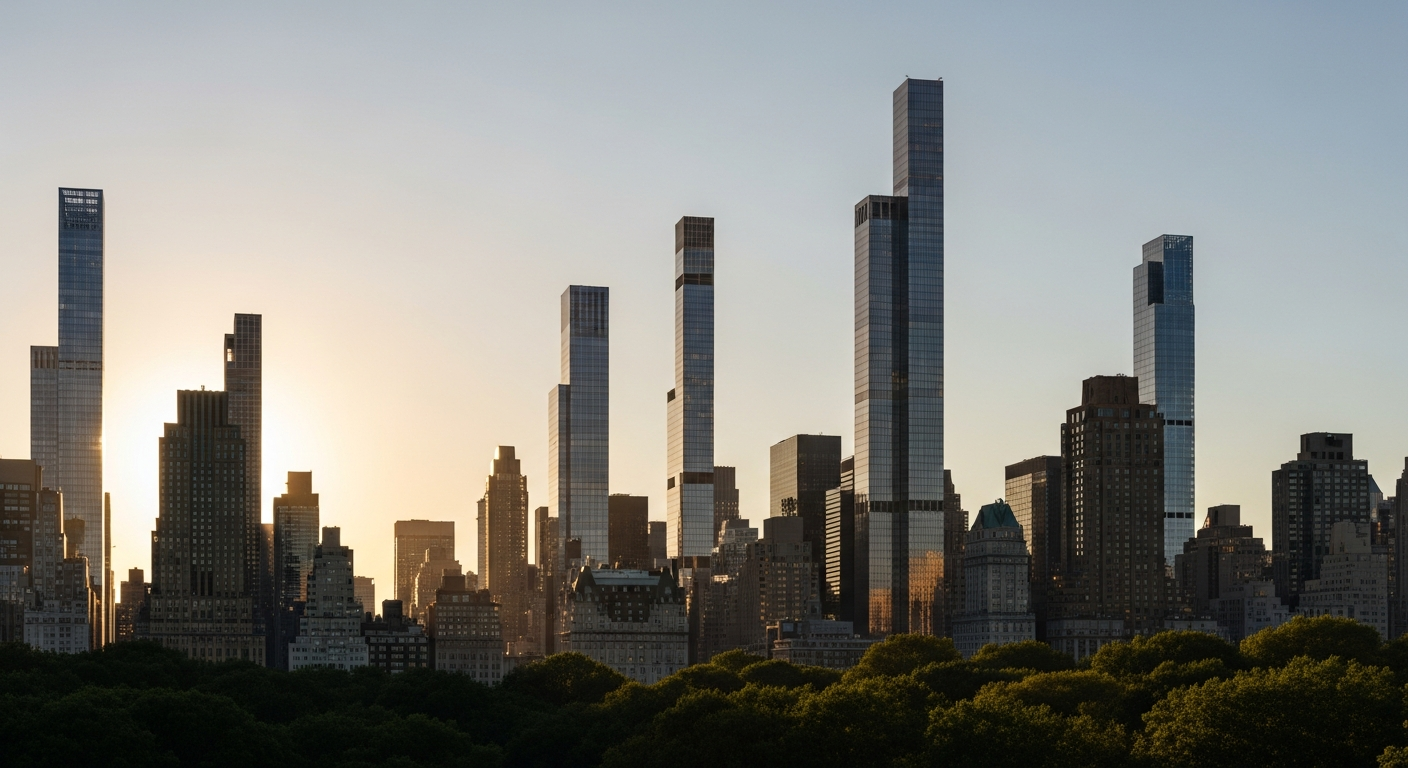
The Manhattan luxury market entered the second quarter of 2026 with the strongest underlying momentum it has shown since 2022. The Q1 2026 luxury median sale price closed at $6.85 million across condo, co-op, and townhouse transactions at $4M+, with the $4 million threshold for the luxury market category, an average luxury sale of $9.93 million, and quarterly contract activity in the $10M to $20M tier up 47.4 percent year over year (per Douglas Elliman / Miller Samuel and Compass Q1 2026 data, with Olshan Realty's weekly contracts data confirming the trend). The week of March 2 to March 8 logged 43 contracts at $4M+ totaling $422 million in contract volume — the strongest single week since May 2025, and the early April through early May activity through early Q2 has sustained the pace. The total residential transaction count slipped 3.2 percent year over year to 2,279 closings, but luxury demand was the meaningful exception to that softer overall print, and the $4M+ tier is where the actual story of the Manhattan 2026 market lives. This report covers what is closing, what is signing, what the price bands actually look like, and what the data does and does not yet show for the second quarter.
The Headline Numbers — Q1 2026 Closed
The official luxury market frame, per the standard Manhattan reporting set:
- Luxury threshold (Q1 2026): $4,500,000 (UrbanDigs).
- Average luxury sale price: $9,927,062 (Q1 2026), up 10.01 percent quarter-over-quarter and approximately flat year-over-year.
- Median luxury sale price: $6,900,000 (UrbanDigs) / $6.85 million (Douglas Elliman / Miller Samuel), up 13.11 percent quarter-over-quarter and approximately flat year-over-year.
- Total Manhattan median price (all transactions): $1,225,000, up 5.2 percent from $1,165,000 in Q1 2025.
- Condo median: $1,750,000.
- Co-op median: $850,000 (essentially flat year-over-year — the co-op market continues to lag the luxury surge).
- Active inventory: approximately 6,000 units, a five-year first-quarter low.
- Median days on market (Manhattan-wide): approximately 110 days, down 9 percent year-over-year and the fastest start to a year since 2018.
The most important number in that set is the $10M-to-$20M contract activity up 47.4 percent year over year. This is the segment that drives the trophy market — buyers stepping up from $5M co-ops, downtown families consolidating into trophy condos, international UHNW principals re-entering the New York market after a soft 2024 — and it is the segment whose strength most reliably signals durability into subsequent quarters.
The Compass Q1 2026 Manhattan Market Report adds: ultra-luxury condo sales rose 30.0 percent year over year, with activity shifting from the $30 million trophy band that dominated 2025 toward a deeper and broader $20 million to $30 million band — a sign that the market's breadth has expanded rather than narrowed at the top.
Olshan Weekly Contract Activity — The Q1 Highlight Reel
Donna Olshan's weekly luxury contract report has been the most useful real-time read on the Manhattan $4M+ market for nearly two decades, and Q1 2026 produced a series of weeks that defined the quarter.
Week of March 2–8, 2026. 43 contracts at $4M+ signed, totaling $422 million in contract volume — the most in a single week since May 2025. Median asking price across the week's contracts was $6 million; average discount from final ask was 9 percent. The week's activity was distributed across condo (the dominant share, particularly in Upper West Side and Midtown East buildings), townhouse, and co-op segments.
February 2026 totals. 123 luxury contracts signed in February 2026, up from 114 in February 2025. Total dollar volume of approximately $1.38 billion; average price of $11.24 million. The February print confirmed that the strength of early March was the continuation of a sustained acceleration rather than a single-week anomaly.
April 20–26, 2026. 34 luxury contracts signed for the week, with a $45 million penthouse at Robert A.M. Stern's 16 Fifth Avenue (the new Madison Realty Capital downtown launch) leading as Manhattan's top contract of the year to date. The 16 Fifth contract is significant for several reasons — it confirmed the new-construction premium that 16 Fifth has been able to capture, it established a new downtown ceiling for 2026, and it pulled the Greenwich Village–Flatiron corridor explicitly into the trophy condominium conversation.
May 2026 (early). A Flatiron Building penthouse contract at $18 million was the top contract for the week of May 4–10, with the Flatiron Building's recently completed residential conversion entering the luxury contract board for the first time as a meaningful presence.
The weekly cadence through Q1 and into Q2 has held above the 2025 pace by roughly 8 to 12 percent on average. The market is not running away from itself; it is steady, broad, and selectively strong at the top.
Townhouses — The Quietest Strong Story
Manhattan townhouse activity through Q1 2026 was, in headline numbers, mixed:
- 191 townhouse sales year to date (through end of Q1 / early Q2), down 2.1 percent from the same period in Q1 2025.
- Median sale price slipped 3.3 percent to $9.94 million.
- Average sale price rose 3.1 percent to $13.99 million, reflecting the influence of several high-end deals at the trophy end.
The headline "median down 3.3 percent" reads softer than the underlying market actually feels. Three factors are worth highlighting:
The trophy band remained active. Townhouse sales at $10M+ continued at a steady pace through Q1, with notable closings in the West Village (Charles Street, Perry Street, West 11th Street), Carnegie Hill (East 70s and 80s between Fifth and Madison), and Tribeca. The transactions at the top of the market that did close, closed at strong pricing — the average sale price rise reflects this.
The compressed inventory. Townhouse listings in the $5M-to-$10M band were down meaningfully year-over-year, which compressed the volume of mid-band closings. The buyer demand in this band was actually stronger than in 2025; the limiting factor was supply, not demand. Many of the houses that would have produced 2025-equivalent closings in this band have either been pulled from the market (sellers waiting for a stronger pricing read), traded off-market without entering the public data set, or remained in the long-tenured-owner inventory that simply does not turn over in a typical year.
Off-market share remained high. As the four pillar articles in this series have consistently noted, 35 to 50 percent of UHNW townhouse transactions above $10 million happen off-market and never appear in the public closing data. The Q1 2026 reported townhouse data understates the actual townhouse transaction volume in the $10M+ tier accordingly.
The realistic 2026 reading on Manhattan townhouses: demand is steady-to-strong at the top of the market, supply at the $5M-to-$10M band is the binding constraint, and the off-market transaction share continues to rise as long-tenure owners and discreet buyers find each other through relationship channels rather than public listings.
For context on the townhouse market structure, our Manhattan Townhouse 2026 pillar covers the full neighborhood-by-neighborhood, width-by-width, condition-by-condition pricing frame.
Condos — Where the Q1 Surge Concentrated
Condominium transactions were the engine of Q1 2026's luxury activity. The defining patterns:
Upper West Side condo dominance. The Real Deal's mid-April analysis of Q1 contracts confirmed that Upper West Side condo buildings dominated the borough's luxury contract count — with strong activity at 15 Central Park West, 220 Central Park South, Carlton House, and the broader pre-war and new-construction luxury inventory along Central Park West and the West End Avenue spine. The buildings that defined the trophy condo market in 2018-2022 continue to define it in 2026.
Downtown new-construction strength. The downtown luxury condo set — 56 Leonard, 70 Vestry, 443 Greenwich, 30 Park Place, One Madison, Madison Square Park Tower, 212 Fifth, and the new 16 Fifth Avenue — produced a meaningful share of the quarter's $5M-to-$25M contract activity. The 16 Fifth $45M penthouse contract was the most visible single transaction, but the broader downtown new-construction set delivered a steady cadence of $4M-to-$20M closings.
$5M to $10M condo demand strong, supply tight. Pending sales in the $5M-to-$10M condo segment showed a 14.3 percent decrease year-over-year, with supply down 16.6 percent — a clear supply-constrained pattern where transaction count understates underlying demand strength. Buyers in this band reported multiple-offer situations and aggressive pricing in best-in-class units more frequently than at any point since 2022.
$10M+ condo activity surged. The 47.4 percent year-over-year increase in $10M-to-$20M contract activity (per Compass) was the quarter's defining luxury number, and reflected the return of step-up buyers who had been waiting through 2024's soft cycle. The $20M-to-$30M band, in particular, showed accelerated activity relative to the $30M+ trophy band that defined 2025 — a sign that the market's breadth at the top has expanded.
Aman New York resale market. The Aman New York Tower condominium resales were a Q1 narrative anchor, with several Aman resale transactions setting new pricing benchmarks for the Midtown East trophy condo market. The Aman's status as the city's most expensive new development of the past five years has continued to support resale demand.
For neighborhood-specific deep dives into the downtown condo market, see our Tribeca pillar, our Flatiron/NoMad guide, our SoHo guide, and our Greenwich Village pillar.
Co-ops — Still the Soft Spot
Co-op transactions remained the underperforming segment of the Manhattan market through Q1 2026:
- Co-op median sale price: $850,000, essentially flat year-over-year.
- The spread between condo and co-op medians — $1,750,000 versus $850,000 — is one of the widest gaps in recent memory.
- Co-op share of transactions: continued to decline, with co-op sales as a share of total Manhattan residential transactions at multi-decade lows.
Why? Three structural factors:
The board approval process remains a meaningful friction. The standardized UHNW co-op board package — the financial substance, the reference letters, the interview — has not gotten any easier in 2025-2026, and buyers who have a choice between a co-op and a comparable condo continue, on margin, to choose the condo. The Manhattan UHNW co-op tier — 740 Park, 834 Fifth, 1040 Fifth, the trophy buildings on Park and Fifth — remains a distinct market with its own demand pool, but the broader co-op universe (the $1M to $5M general-market segment) has lost share to the condominium alternative consistently for several years.
Financing constraints. Co-op boards typically permit 50 to 75 percent loan-to-value financing; condos permit 70 to 75 percent and sometimes higher. In a rate environment where 2026 30-year mortgages run in the 6 to 7 percent range, the financing differential matters for buyers in the lower price bands and pushes marginal transactions toward the condo segment.
Generational shift. UHNW buyers under 50 — the principals who are now stepping up into the $5M-to-$15M Manhattan luxury bracket — have, in survey after survey, expressed a preference for condominium flexibility over co-op approval. The board interview, the package preparation, the social discretion — these are accepted by older trophy buyers who remember the tier as the apex of Manhattan ownership, but they are friction for younger principals who view the condominium as the default Manhattan residential product.
The trophy co-op tier — 740 Park, 834 Fifth, 1040 Fifth, 960 Fifth, 2 East 67th — continued to trade quietly through Q1 2026, with off-market activity dominating disclosed transaction volume.
Pricing Tiers — What $4M, $10M, and $25M+ Actually Buys in Q1/Q2 2026
The three structural tiers that define the Manhattan luxury market in 2026:
$4 million to $10 million — The Entry Luxury Band
This is where the bulk of Q1 2026 luxury contract activity concentrated, and it is the band whose supply-constrained dynamics most defined the quarter.
What $4M to $7M buys: A two-bedroom or three-bedroom in a flagship downtown new-construction building (56 Leonard lower floors, One Madison mid-tower, 70 Vestry smaller units, 212 Fifth, 280 Park Avenue South). A classic-six pre-war on Park Avenue or Fifth Avenue (Upper East Side). A converted loft of 2,000 to 3,000 square feet in a distinguished SoHo, Tribeca, or Flatiron building. A narrower townhouse in good condition in Harlem, Hamilton Heights, or the periphery of established townhouse neighborhoods.
What $7M to $10M buys: A larger three-bedroom in flagship new-construction buildings (mid-floor units at 70 Vestry, 56 Leonard, 16 Fifth Avenue, One Madison, Madison Square Park Tower). A full-floor or large-share co-op in a top pre-war building (Beresford, San Remo, lower floors at 1040 Fifth). A 3,000-to-4,000 square foot trophy-floor loft in a top SoHo, Tribeca, or Flatiron building. A 20-foot-wide townhouse in good condition in West Village, Greenwich Village, Chelsea, or Brooklyn Heights.
Average discount from list in this band (Q1 2026): approximately 6 to 10 percent. Aggressive negotiating opportunities have narrowed as buyer demand has firmed.
$10 million to $25 million — The Trophy Step-Up
This is the band whose 47.4 percent year-over-year contract increase defined Q1 2026's luxury narrative.
What $10M to $15M buys: A full-floor or large-portion residence in a top flagship building (56 Leonard upper floors, 70 Vestry mid-to-upper, 443 Greenwich, One Madison upper floors, Madison Square Park Tower, 15 CPW lower floors). A trophy-floor pre-war co-op on Fifth or Park (units at 740 Park, 834 Fifth, 1040 Fifth) — with the board approval process distinguishing the path. A 22-to-25-foot-wide townhouse in mint condition on a recognized West Village or Carnegie Hill block. A penthouse-level loft of 5,000+ square feet at a top SoHo or Tribeca address.
What $15M to $25M buys: A trophy penthouse or full-floor residence in flagship buildings (Madison Square Park Tower penthouses, 56 Leonard upper-tower, 70 Vestry's largest residences, 15 CPW's most distinguished units). A full-floor trophy co-op at 740 Park, 834 Fifth, or 1040 Fifth — the building list is short and the inventory turns over slowly. A 25-foot-wide-or-wider townhouse in mint condition on the city's most distinguished blocks (Washington Square North's Row, West 10th Street, East 70s-80s between Fifth and Madison, Hubert Street and North Moore Street in Tribeca).
Average discount from list in this band (Q1 2026): approximately 7 to 11 percent — wider than the entry luxury band, reflecting both the larger absolute dollar amounts and the longer marketing periods at the trophy tier.
$25 million and above — The Trophy Apex
Q1 2026's $25M+ activity was concentrated in a small number of headline transactions, with the broader category quiet rather than absent.
What $25M+ buys: Penthouses at the most distinguished new-construction towers (16 Fifth Avenue's $45M April contract, the upper tower at 56 Leonard, the trophy penthouses at 70 Vestry, the Madison Square Park Tower triplex penthouse at the $77.7M re-listing, 220 CPS upper-tower residences). Full-floor or duplex residences at 15 CPW's trophy band. Trophy townhouses on the city's most distinguished blocks — 25-foot-plus widths on the best Carnegie Hill mansion blocks, exceptional houses on Washington Square North. Trophy co-op residences at 740 Park and 834 Fifth (where they trade) and the 1040 Fifth duplex inventory.
The $25M+ category produced fewer trophy contracts in Q1 2026 than in 2025's record-setting cycle, but the activity that did occur was concentrated in the strongest buildings and the buyers stepping up to this tier paid full pricing. The data shows breadth at $10M-to-$25M expanding faster than depth at $25M+ — a healthy pattern that suggests a sustainable rather than speculative cycle.
Days on Market and Discount from Ask
Two operational metrics matter for the buyer who is entering this market in May 2026:
Days on market. Manhattan-wide median DOM ran approximately 110 days in Q1 2026, down 9 percent year-over-year and the fastest start to a year since 2018. Luxury DOM in the $4M-to-$10M band ran tighter than the borough median; the supply-constrained dynamic that defined the band produced multiple-offer situations on well-priced inventory and DOM under 60 days for the strongest properties. Trophy properties at $15M+ continued to run longer DOM (180 to 365+ days is common at the top of the market), reflecting the smaller buyer pool at each price band.
Discount from final ask. The Q1 2026 average discount from final ask was approximately 9 percent at the Olshan-tracked $4M+ tier in the strongest weeks (the March 2-8 week specifically), with quarterly averages running 7 to 11 percent depending on price band. The discount narrowed from 2024's 10 to 13 percent typical range — a clear signal of firming demand. Buyers entering the market in Q2 should expect more competitive pricing and less negotiating leverage on well-priced inventory than they would have encountered 12 to 18 months ago.
What the Data Does Not Yet Show — Early Q2 Pattern
The Q1 2026 data is closed and disclosed. The early Q2 read — the period from early April through the publication of this report in mid-May — is preliminary but suggestive:
Olshan weekly contracts continued the Q1 pace. Through the weekly reports of April and early May, the Manhattan $4M+ contract count has run in the 30-to-45 range per week with consistent average prices in the $9M to $13M range. The April 20-26 print of 34 contracts led by the 16 Fifth Avenue $45M penthouse was a representative week. The cadence is firm.
Spring listing volume returned. April and early May historically deliver the year's strongest new-listing volume, and Q2 2026 has followed that pattern. The supply constraints that defined Q1 are easing modestly as sellers respond to the firmer pricing environment with new listings. The $5M-to-$10M condo segment, in particular, has seen meaningful new inventory in April.
Trophy launches continued. Beyond 16 Fifth Avenue, the spring 2026 new-development calendar has included continued sales at Aman New York Tower, ongoing activity at the Madison Square Park Tower trophy penthouse re-listing, and emerging interest in several boutique conversions across the West Village and Tribeca. The new-development pipeline supporting Q3 and Q4 2026 closings is healthy.
Mamdani-effect pricing. A late-April CNBC analysis noted Manhattan luxury sales had continued to rise despite the New York City mayoral primary discussion around the pied-à-terre tax proposal (advocated by Zohran Mamdani's campaign). The data through early May does not show meaningful evidence of buyer pull-back attributable to the tax proposal; UHNW buyers, in particular, have continued to transact at the same pace. The longer-term implications depend on the November general election and any subsequent legislative process.
Macro context. The broader U.S. economic environment in early Q2 2026 — rate stability, equity markets at or near records, continued strong wealth formation in technology and finance sectors — is supportive of continued Manhattan luxury demand. The downside risks (recession, equity correction, rate move) are present but not imminent in the consensus view.
What Q2 Might Look Like — A Cautious Forecast
The realistic Q2 2026 expectation:
- Continued strength in the $4M-to-$10M tier, with supply normalization moderating the multiple-offer dynamic but firm pricing continuing.
- Continued breadth in the $10M-to-$25M tier, with the year-over-year contract growth that defined Q1 likely to moderate in absolute terms (because of base-effect arithmetic) but remain positive.
- Selective trophy activity at $25M+, with new-construction launches at 16 Fifth, Aman New York, and similar buildings driving the headline transactions while the broader trophy category remains quiet.
- Townhouse activity calibrated to listing supply, with the binding constraint being inventory rather than demand. Off-market transaction share likely continues to rise.
- Co-op continued underperformance, with the trophy co-op tier (740 Park, 834 Fifth, 1040 Fifth) trading quietly off-market and the broader co-op market continuing to lose share to condominiums.
- DOM continuing to compress in the $4M-to-$10M tier; flat-to-modestly-tighter in higher bands.
- Discount from ask narrowing further if supply does not catch up to demand, with the realistic Q2 expectation of 6 to 9 percent average across the luxury tier.
The cautious counterweights: any macroeconomic shock (a meaningful rate move, an equity correction, a geopolitical event), a meaningful adverse turn in New York City policy (the pied-à-terre tax discussion most prominently), or a supply surge from delayed-listing sellers responding to the strong Q1 print could moderate the pace. None of these is the base case in the consensus market view as of mid-May 2026, but all are worth monitoring.
How Caryl Works the Market in This Cycle
Caryl Berenato has represented Manhattan buyers and sellers across forty years of the city's market — through the 1980s boom, the early-1990s correction, the late-1990s recovery, the 2000s expansion, the 2008-09 crisis, the post-2009 trophy-condo cycle, the 2020 COVID dislocation and recovery, and the 2024 mid-cycle pause. The 2026 market reads as a healthy mid-cycle expansion — broad participation, firm pricing, supply-constrained at the entry luxury tier, durably strong at the trophy step-up — without the speculative excesses that have ended prior cycles.
For UHNW buyers entering the Manhattan market in Q2 2026, the conversation starts with where you are in the buyer cycle. First-time Manhattan UHNW buyers — international principals re-entering, suburban families consolidating into the city, tech and finance principals stepping up from rental — face a different set of decisions than long-tenure Manhattan buyers stepping up within the city. The right neighborhoods, the right buildings, and the right pricing read depend on which profile applies.
For sellers, the 2026 market is the strongest selling environment in two years. Well-priced inventory in the $4M-to-$15M tier is trading in 60 to 120 days with limited discount from ask. Sellers who have been waiting for a pricing read should reconsider their timing; the supply that does come online in Q2 and Q3 will compete for the demand pool that drove Q1, and earlier listings have positional advantage.
Caryl is a member of REALM Global, the invitation-only luxury real estate network, and holds the Certified Senior Advisor (CSA) designation.
For the underlying neighborhood and property-type guides referenced throughout this report, see:
- Buying a Manhattan Townhouse in 2026 — The Complete UHNW Guide
- Tribeca Real Estate — A UHNW Buyer's Guide
- Greenwich Village Real Estate — Historic Homes & Townhouses
- Flatiron & NoMad Real Estate — Loft Conversions, Condos & the Emerging Luxury Market
- SoHo Lofts & Cast-Iron Buildings — A Buyer's Guide
- Manhattan Townhouse Restoration — Landmark Constraints, Budgets & What to Expect
- Estate Sales in Manhattan — A Sensitive Guide
Frequently Asked Questions
What was the Manhattan luxury median sale price in Q1 2026?
$6.85 million per Douglas Elliman / Miller Samuel and $6.9 million per UrbanDigs, up approximately 13 percent quarter-over-quarter and roughly flat year-over-year. The luxury threshold for Q1 2026 was set at $4.5 million.
How strong was the $10M+ tier?
Very strong. Compass reported Q1 2026 contracts at $10 million to $20 million up 47.4 percent year-over-year. Ultra-luxury condo sales (above $10M) rose 30.0 percent. The trophy band ($25M+) was quieter than 2025 but supported by individual headline contracts including the $45 million 16 Fifth Avenue penthouse in April.
What did Olshan's weekly luxury reports show?
The week of March 2-8 logged 43 contracts at $4M+ totaling $422 million in contract volume — the most in a single week since May 2025. February 2026 logged 123 luxury contracts versus 114 in February 2025, with $1.38 billion in dollar volume and an average price of $11.24 million.
How is the townhouse market doing in 2026?
Mixed in headline numbers, strong in underlying dynamics. 191 townhouse sales year-to-date through Q1, down 2.1 percent. Median sale price $9.94 million (down 3.3 percent). Average sale price $13.99 million (up 3.1 percent), reflecting strong trophy activity. Off-market share continues to run 35-50 percent at the $10M+ tier and is not in the public closing data.
What is happening with co-ops?
Continuing to underperform. Co-op median sale price $850,000, essentially flat year-over-year, versus condo median $1,750,000. The condo-co-op spread is at multi-decade highs. Trophy co-op tier (740 Park, 834 Fifth) continues to trade off-market but the broader co-op universe has lost share to condominiums consistently for several years.
What is the average discount from list in Q1 2026?
Approximately 9 percent at the Olshan-tracked $4M+ tier in the strongest weeks; 7 to 11 percent across the luxury tier on quarterly average. This is tighter than 2024's 10-13 percent typical range, reflecting firming demand and supply constraints at the entry luxury band.
How is supply trending?
Active Manhattan inventory at approximately 6,000 units — a five-year first-quarter low. The $5M-to-$10M condo segment was particularly supply-constrained, with pending sales down 14.3 percent and supply down 16.6 percent year-over-year. Spring 2026 listings have added meaningful new inventory through April and early May, easing the constraint modestly.
Are days on market shorter in 2026?
Yes. Manhattan-wide median DOM ran approximately 110 days in Q1 2026, down 9 percent year-over-year and the fastest start to a year since 2018. The $4M-to-$10M luxury band ran tighter, with strongest properties trading under 60 days. Trophy properties at $15M+ continue to run longer DOM (180+ days is common at the top).
What is driving the Q1 2026 strength?
Three structural drivers: return of step-up buyers who waited through 2024's soft cycle, supply constraints at the $5M-to-$10M tier producing multiple-offer dynamics, and continued international UHNW demand for Manhattan trophy product. The $10M-to-$20M tier's 47.4 percent year-over-year growth reflects all three.
What is the Q2 2026 outlook?
Continued strength in the $4M-to-$10M tier with supply normalization moderating multiple-offer dynamics; continued breadth in the $10M-to-$25M tier (moderating year-over-year growth on base effects but firm pricing); selective trophy activity at $25M+. Cautious counterweights include macro shocks, New York City policy events (the pied-à-terre tax discussion), and supply surges. The base case is sustained mid-cycle strength.
Sources & Further Reading
- Douglas Elliman / Miller Samuel Q1 2026 Manhattan Sales Market Report.
- Compass Q1 2026 Manhattan Market Report.
- Olshan Realty weekly luxury market reports (Q1 and early Q2 2026).
- UrbanDigs Manhattan luxury threshold and median data.
- The Real Deal Q1 2026 Manhattan luxury coverage.
- Corcoran Q1 2026 Manhattan market report.
- CityRealty top-selling buildings and priciest contracts data.
- CNBC Manhattan luxury market coverage (May 2026).
Townhouse figures reflect Compass Q1 2026 townhouse data and may understate true UHNW transaction volume given off-market share. Forward-looking statements are the author's assessment and not guarantees of subsequent quarterly performance.